Sept. 2, morning. Overnight (Sept. 1 U.S. time), all three major U.S. indices fell in unison. Dow Jones down 0.79%. S&P 500 down 0.71%. Nasdaq down 1.03%. Tensions between the U.S. and Iran escalated into direct military action. Oil prices climbed. The U.S. Treasury 10-year yield hit its highest level since January 2025. That's what drove the decline.
Yet that same night, on the same semiconductor story, Taiwan's benchmark moved the opposite way. Why? We break down the divergence and what it means for KOSPI, Samsung Electronics, and SK Hynix today.
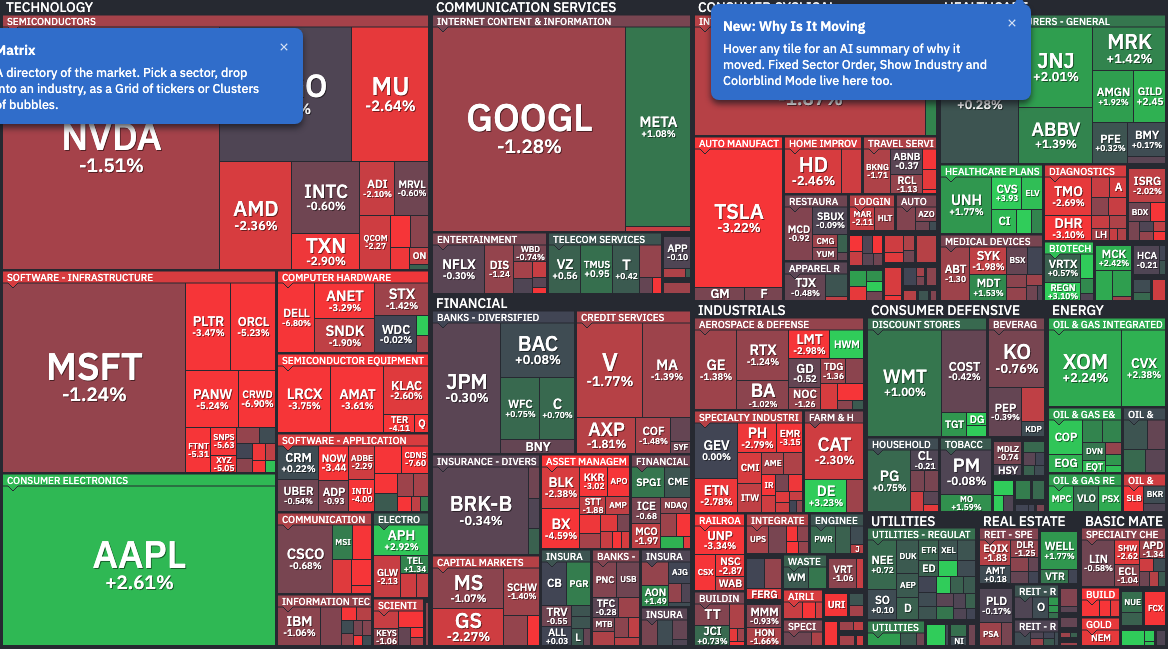
U.S. market heat map (S&P 500) on Sept. 1—green indicates gains, red indicates losses (finviz convention)
Why all three major U.S. indices fell
The Dow Jones Industrial Average closed down 419.02 points, or 0.79%, at 52,766.88. The S&P 500 fell 54.67 points, or 0.71%, to 7,631.47. The Nasdaq Composite dropped 271.12 points, or 1.03%, to 26,099.77. All three ended in the red.
The culprit was the Middle East. The U.S. conducted fresh strikes on Iranian Revolutionary Guard (IRGC) affiliated facilities; Iran retaliated immediately with attacks on U.S. bases in Jordan and the UAE. Tension around the Strait of Hormuz ratcheted back to a fever pitch.
But the fallout extended further. Higher oil prices feed inflation. Inflation concerns mean the Federal Reserve can't cut rates—or worse, may have to hike. The U.S. Treasury 10-year yield surged intraday to 4.798%, its highest level since January 2025. Higher yields pressure growth stocks. That's why the Nasdaq underperformed the Dow and S&P 500.
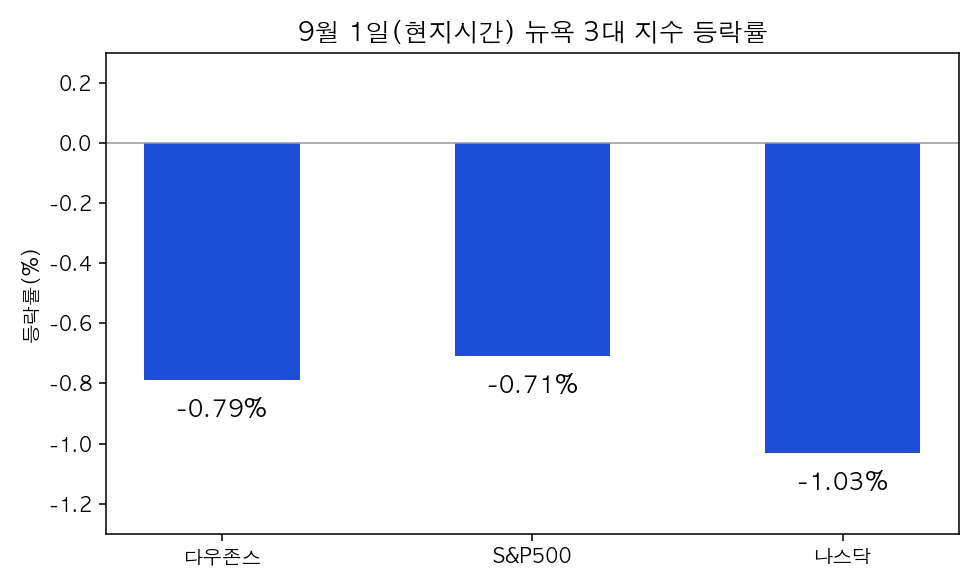
Sept. 1 (U.S. time) closing moves: Dow, S&P 500, Nasdaq
Semiconductors sold off—so why did Taiwan jump?
Rising Treasury yields hit tech particularly hard. Semiconductors suffer most because the sector prices in years of future profits upfront. The Philadelphia Semiconductor Index fell 2.14% overnight. Nvidia down 1.51%. Broadcom down 0.18%. Micron down 2.64%. Sector heavyweights faced headwinds across the board.
Taiwan's main index told a different story. It closed up 1.78% at 46,948.72, marking a new high. It had fallen as much as 0.10% intraday before a late rally pushed it higher. The reason: Nvidia alone.
Nvidia agreed to directly purchase $3.5 billion of the roughly $3.9 billion convertible bond issued by Taiwan fabless chipmaker MediaTek. Alphabet participated in part of the deal, but the critical element is Nvidia's high-speed chip interconnect technology, 'NVLink Fusion.' MediaTek will adopt it. This enables MediaTek's customers' AI accelerators to connect directly to Nvidia's large data centers. CEO Jensen Huang called it a 10-year roadmap.
Same night, same rate shock, opposite outcomes. Falling rates is a force that crushes entire sectors. A specific deal is a force that lifts one stock above that crush. Last night, the individual news won.
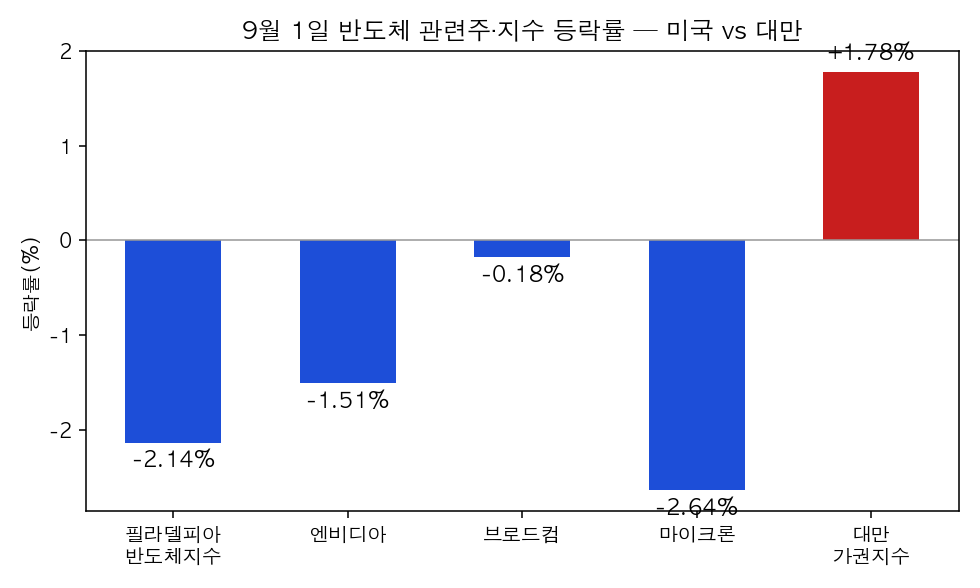
Sept. 1 semiconductor movers and indices—U.S. mostly red (losses), Taiwan green (gains)
The numbers tell the story best. Philadelphia Semiconductor Index down 2.14%. Nvidia down 1.51%. Micron down 2.64%. U.S. chip manufacturers got hit across the board. Yet Taiwan's main index, which includes fabless chip designer MediaTek, closed up 1.78%. It was a sector sell-off. Yet one contract inked on a single stock proved powerful enough to reverse the tide. Last night was a textbook example.
What to watch: rates, FX, oil crossing into the Korean session
WTI crude closed at $90.22 per barrel, up 5.2%. Brent crude at $94.65, up 4.6%. Both breached the $90 level. That said, some on Wall Street note that unless crude eclipses $100 per barrel, it's unlikely to materially squeeze real spending or demand.
The Dollar Index closed at 99.52, up from 99.43 the prior day. Higher Treasury yields and hawkish remarks from the Jackson Hole symposium supported the move. A stronger dollar puts downward pressure on the Korean won. From a foreign investor's vantage point, Korean assets look less attractive in this regime.
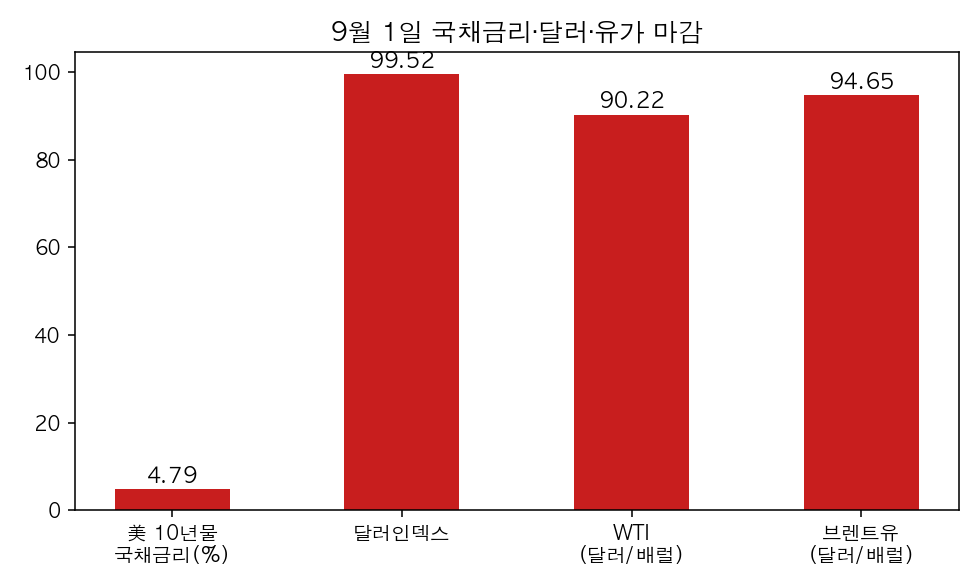
Closing levels Sept. 1: U.S. 10-year Treasury yield, Dollar Index, crude oil
Asia's overnight split
Shanghai Composite closed flat at 3,979.89, down 0.16%. Profit-taking hit AI stocks, which rallied more than 12% over the month of August. Japan's Nikkei 225 dipped 0.15% to 66,215.34. Japan's 10-year yield briefly topped 3%, a first since 1996. Tokyo Electron fell 2.59%. Advantest down 0.92%. Chip equipment makers came under pressure.
Taiwan stood alone, up 1.78% on the Nvidia-MediaTek news.
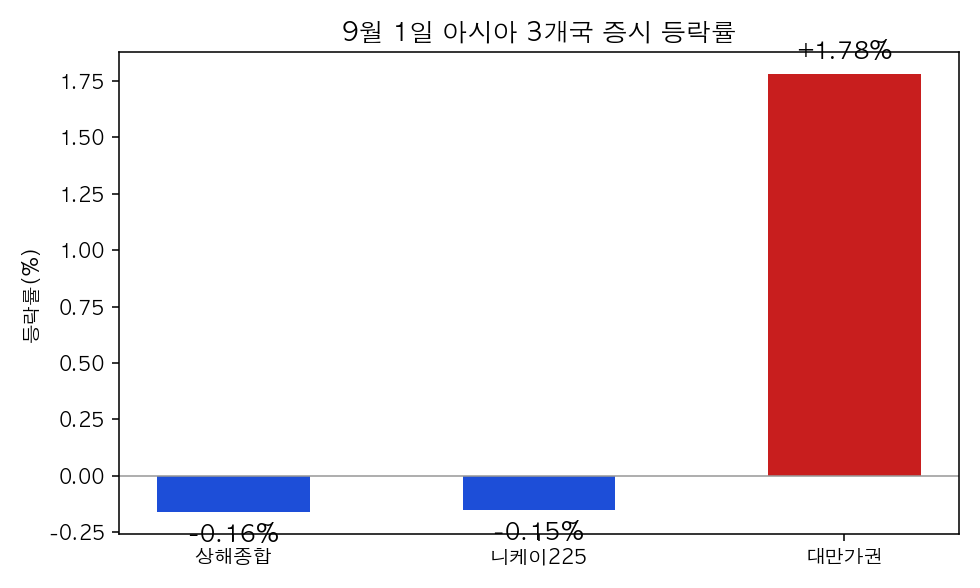
Sept. 1 closing moves: China, Japan, Taiwan
Where does KOSPI stand?
On Sept. 1, the KOSPI fell as far as 6,732.47 intraday, marking a 1.28% drop. But it recovered all losses and closed up 15.78 points, or 0.23%, at 6,835.80. This marks the second straight session of an intraday reversal—weakness at the open, strength at the close.
Samsung Electronics and SK Hynix led the rebound. Samsung Electronics rose 1,000 won, or 0.38%, to 260,000 won. SK Hynix gained 19,000 won, or 1.14%, to 1,693,000 won. The day was unusual: retail investors, foreign investors, and institutional investors all sold. Corporate entities absorbed the supply, accounting for net buying exceeding 1.6 trillion won, including share buybacks. The won-to-dollar rate closed 1.8 won firmer at 1,370.4.
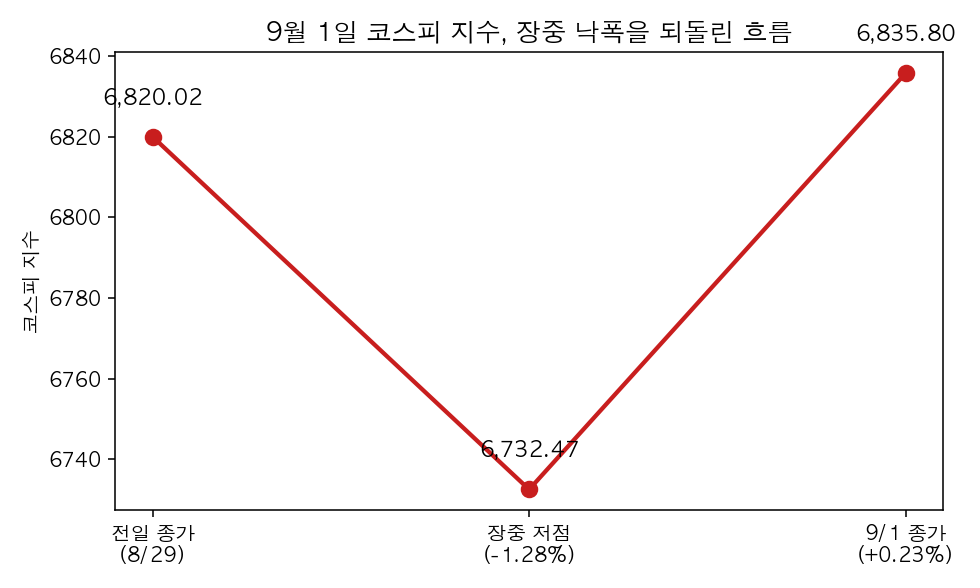
KOSPI intraday Sept. 1—session erased morning losses to close in positive territory
What to watch in the Korean market today
All three U.S. indices retreated and Treasury yields climbed overnight. The KOSPI may open lower today, but yesterday's precedent—a 1.28% morning loss wiped out by day's end—suggests the decline needn't persist to the close. Early weakness that reverses is the pattern to track.
Semiconductor heavyweights face crosscurrents. On one side: weakness in Nasdaq and the Philadelphia Semiconductor Index. On the other: confirmation from the Nvidia-MediaTek deal that AI chip investment is accelerating. Whether Samsung Electronics and SK Hynix step in to defend the index again is the key variable.
Oil at $90-plus, Dollar Index in the 99s. This combination spells won weakness and import-price pressure—a headwind for sectors directly exposed to crude, like refiners, chemicals, and airlines. But U.S.-Iran headlines continue to shift. Breaking developments could inject volatility into the session.
Three forces are at play simultaneously: oil pushing higher, rates rising, and the won under pressure. All three point in the same direction—the same backdrop that weighed on U.S. equities overnight. The countervailing force is whether stock-specific positive news, as Taiwan demonstrated, can pierce through. That's the variable that will determine whether individual Korean names show divergent strength.
In short: The U.S. was weighed down by higher rates and oil. Taiwan fought back on a semiconductor-specific positive. Today, the KOSPI likely opens somewhere between those two extremes. The outcome hinges on whether Samsung Electronics and SK Hynix step in to support the index again.
This article is informational and not an offer of investment advice. Investment decisions and outcomes are the reader's sole responsibility.
#USMarketBrief #KOSPI #Nasdaq #DowJones #SP500 #TreasuryYield #OilPrices #WTI #BrentCrude #DollarIndex #PhiladelphiaSemiconductor #Nvidia #MediaTek #TaiwanStockExchange #SamsungElectronics #SKHynix #SemiconductorExports #KOSPIOutlook #MarketClose #NYMarketClose #USIran #StraitOfHormuz #Nikkei #ShanghaiComposite #BondYields #FXOutlook #OilOutlook #SemiconductorInvesting #AIchips #MarketWatch #IntradayMoves
댓글
댓글 쓰기