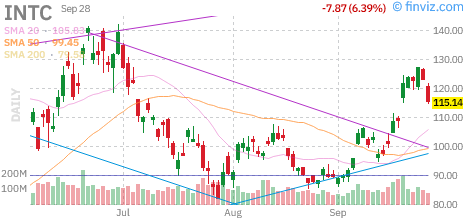
Intel (INTC) fell -6.28% in today's session, closing at $115.27, down from the prior close of $123.00.
The decline was triggered by more than a single catalyst. Multiple headwinds converged.
The setup: how far it rallied first
As recently as September 3, Intel traded at $89. In three weeks, it surged to $123—a gain exceeding 30%. Such sharp short-term rallies are uncommon in semiconductors.
Today's decline cannot be separated from that rally. The sharp gain drew waves of profit-taking. A classic pattern: strong rebound followed by pullback.
The headline: Apple's move
The most concrete catalyst for today's decline came from Apple. The company updated its Mac App Store guidelines, allowing developers to drop Intel-based Mac support for apps that require macOS 13 or later.
The immediate revenue impact is not material. Apple has already shifted to its proprietary M-series chips over the past several years. Still, symbolism matters. The market read this as Intel-based Macs gradually being written out of the software ecosystem, and interpreted the move as a further erosion of Intel's remaining influence in PCs.

Broader sector weakness
Intel was not alone. AMD fell roughly 6% on the same day. Qualcomm and Micron each dropped around 3%. Rising Treasury yields combined with renewed caution about AI investment overheating triggered broad weakness across semiconductors.
While the headline numbers suggest Intel absorbed an outsized hit, the sector as a whole moved in the same direction. Intel simply accounted for a larger share of that decline.
| Ticker | Daily Change |
|---|---|
| Intel (INTC) | -6.28% |
| AMD | ~-6% |
| Micron | ~-3% |
| Qualcomm | ~-3% |
Intel's current position
CEO Reuben Tran took office roughly 18 months ago. He has aggressively streamlined the organization and prioritized the return of Intel's foundry business to profitability. The company has begun running its 18A process node at its Arizona fab and recently secured investment from NVIDIA and SoftBank.

This strategic refocus drove the recent three-month rebound. However, stocks that gain 30% in a short window are inherently volatile and prone to sharp reversals on modest news. Today exemplified that dynamic.
The foundry business remains loss-making. Whether it can achieve profitability will be the critical test for Intel shares going forward.
The takeaway
Intel gained over 30% in three months, then fell more than 6% in a single session as profit-taking, Apple's announcement, and sector-wide pressure converged. The company's underlying fundamentals did not change overnight. Today's decline reflects consolidation following a steep rally more than it reflects a deterioration in Intel's business.
The next meaningful checkpoint is the foundry division's next quarterly earnings release. The trajectory of operating losses will be decisive. That metric will determine whether this rebound can sustain.
One thing is clear: Intel has become one of the highest-volatility mega-cap stocks in the market. Cycles of sharp gains and sharp losses may persist for some time.
Intel trades on U.S. exchanges. This article is factual analysis, not a recommendation to buy or sell. Investment decisions and outcomes rest with the reader.
#Intel #INTC #intelsotck #usstocks #semiconductors #nasdaq #usmarkets #stockfocus #apple #amd #foundry #semiconductorindustry #reuben-tran #18a #usstockinvestment #overseasstocks #profittaking #marketconditions
댓글
댓글 쓰기