The KOSPI fell sharply on September 14, 2026, declining 3.26% to close at 6,684.37, down 225.54 points. But the more striking figure was investor flows: foreign investors sold KRW 3.3 trillion, while retail buyers absorbed nearly KRW 3 trillion of that—a nearly perfect offset.
On days like this, retail investors typically sell too. Not today. They held firm.
Why did the index swing so sharply?
The KOSPI opened at 6,692.61, down sharply from the prior close. It fell to an intraday low of 6,654.82 in the morning, then bounced to an intraday high of 6,773.97 around midday—a 119-point swing within hours. Losses widened again in the afternoon, closing at 6,684.37.
The KOSDAQ fell to 806.79, down 1.69%—a smaller but still steep decline.
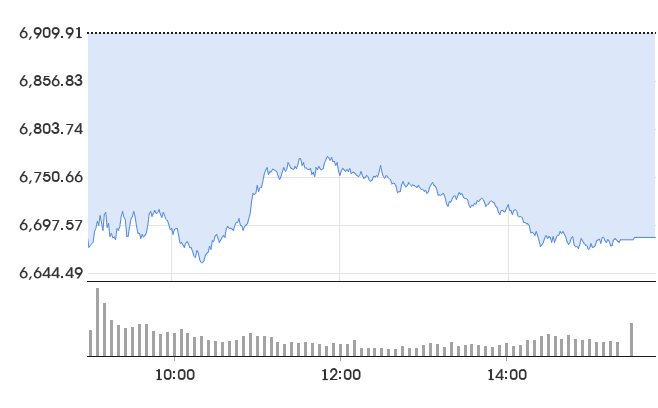
September 14 KOSPI close: 6,684.37 (-3.26%)
The selloff was driven by U.S. data. Over the weekend, the August core consumer price index rose 0.3% month-over-month. Economists expected 0.2%. That miss lifted expectations for a Fed rate increase at the September 16 FOMC meeting. CME FedWatch now puts the probability of a 25 basis-point hike at 86.5%. U.S. employment data has also run stronger than expected. The combination of hotter inflation and employment is weighing on sentiment.
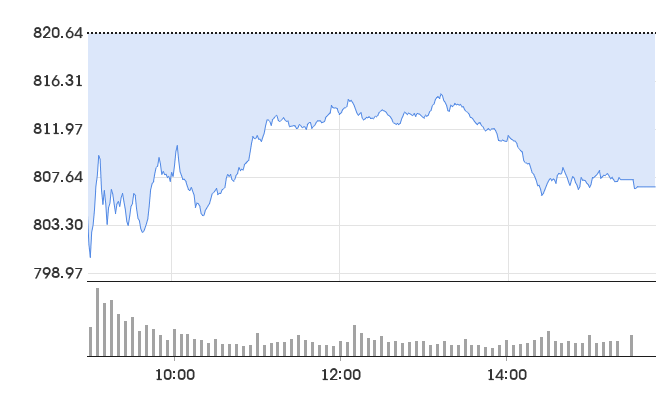
September 14 KOSDAQ close: 806.79 (-1.69%)
AI leaders call for caution
There was another factor. Prominent figures in AI signaled that the industry should slow down. Dario Amodei, CEO of Anthropic, recently likened AI progress to an exponential curve—1, 2, 4, 8, 16, 32—and described the current moment as the point where that curve is accelerating sharply. He argued the pace should be slowed. Sam Altman (OpenAI), Elon Musk (xAI), and Demis Hassabis (Google DeepMind) have signaled agreement. These are leaders who, just months ago, were competing on speed. Altman also announced that OpenAI would not pursue an IPO this year, citing AI safety concerns.
Rivals, in unison, were pumping the brakes. Markets interpreted their remarks as a signal that AI and semiconductor investment spending would slow. Semiconductor and AI stocks sold off sharply. SK Hynix fell 6.35%, Samsung Electronics dropped 4.05%, and the electronics sector as a whole declined 4.75%.
Yet seven stocks hit upper limit
On days when the index falls more than 3%, upper-limit gainers are rare. Not today. Seven stocks closed at their daily upper limit: YOUNGPOONG CORPORATION, AUK CORP, Infinite Healthcare, KS Industries, Artist Company, Korea Advanced Materials, and WeMade Max.
YOUNGPOONG CORPORATION surged 29.91%, closing at KRW 49,950. The catalyst was its subsidiary Youngpoong Electronics, which will begin supplying high-layer printed circuit boards (MLBs) to major North American tech companies starting in the second half of this year. The company has historically specialized in flexible printed circuit boards (FPCBs) for smartphones; this marks its first foray into semiconductor test boards and network-switch boards.
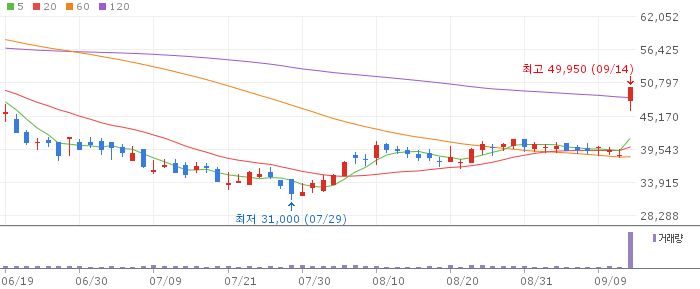
YOUNGPOONG CORPORATION (000670) daily chart, September 14: +29.91% upper limit
AUK CORP also hit its upper limit. The driver was a government initiative: the Ministry of Science and ICT is promoting localization of optical communications technology for AI data centers. Starting September 8, the ministry has been recruiting companies to develop multi-core fiber-based optical interfaces. A rally in U.S. optical-communications stocks over the weekend added momentum. Peers including TMC, Bit and Electronics, and Our Net rose in tandem.
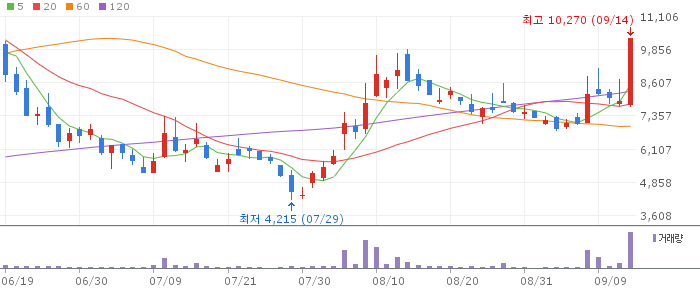
AUK CORP (017900) daily chart, September 14: +30.00% upper limit
Security stocks also surged. Jensen Huang, CEO of Nvidia, named cybersecurity as the next frontier for AI applications at a Goldman Sachs technology conference on September 10. His reasoning: AI is accelerating both the speed of code exploitation and remediation, implying profound change ahead for the security industry. Raon Secure jumped 20.47%, Geniius rose 14.45%, and Pasu AI gained 12.98%.
Defense stocks also rallied. HANWHA SYSTEMS Co., Ltd. gained 5.78%. The company signed a supply contract with Hyundai Rotem, valued at more than KRW 91.6 billion, after market close on September 11. The contract is believed to be for fire control systems and sights for K2 tanks.
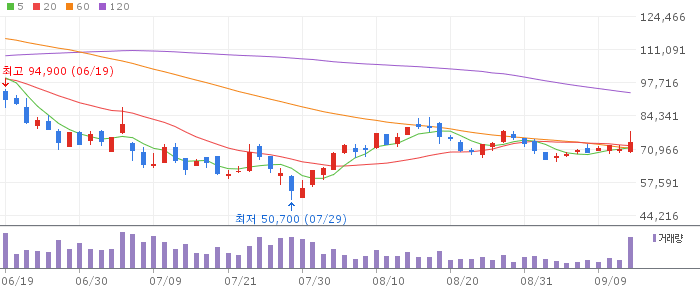
HANWHA SYSTEMS Co., Ltd. (272210) daily chart, September 14: +5.78%
What drove retail buying?
Foreign investors sold KRW 3.3 trillion on the KOSPI; institutional investors sold KRW 1.17 trillion. Foreign investors have now sold for four consecutive days; institutions for two. Retail investors bought KRW 2.97 trillion, while other corporations bought KRW 1.49 trillion. Combined, the buying nearly offset total selling.
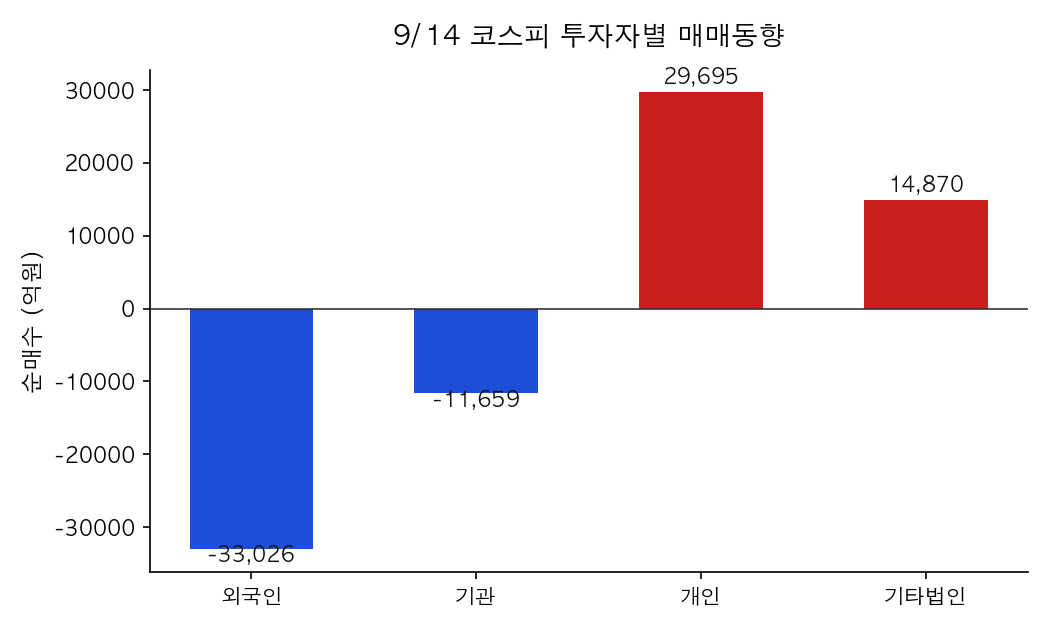
September 14 investor flows on the KOSPI (KRW billions). Self-collected data.
Foreign investors also sold 2,891 futures contracts. Both spot and futures moved in the same direction. The dollar-won rate was 1,347.3 won at 3:30 p.m., up 3.2 won from the previous session's close. The 10-year government bond yield edged down to 4.536%. Ten-year bond futures rose 23 ticks to close at 103.91. Bonds were far steadier than equities.
Looking at 12 years of KOSPI data, retail investors haven't always bought into declines exceeding 3%—early in selloffs, they often sell too. The pattern today—retail absorbing most of the foreign selling—is uncommon. Whether this represents value buying or averaging down will become clearer in coming days, as flows warrant monitoring.
What to watch
The next major event is the September 16 FOMC decision. With markets pricing in an 86.5% probability of a 25 basis-point increase, the actual decision and tone from Fed Chair Powell will be critical. If the outcome matches expectations, markets may take it as reassurance; a more hawkish tone could trigger further selling.
For semiconductors, the key question is whether industry leaders' calls for caution translate into reduced capital spending. So far, these are statements; order books and capex remain unchanged. Whether foreign selling extends to a fifth consecutive day is also worth watching.
For deeper context on today's close, see our previous coverage from September 9 and recent stock-in-focus pieces.
| Category | Value | Notes |
|---|---|---|
| KOSPI | 6,684.37 (-3.26%) | Foreign net selling, 4 consecutive days |
| KOSDAQ | 806.79 (-1.69%) | Foreign net selling, 3 consecutive days |
| Foreign investors | -KRW 3.3 trillion | KOSPI basis |
| Retail investors | +KRW 2.97 trillion | KOSPI basis |
| USD-KRW rate | 1,347.3 won | 3:30 p.m., +3.2 won |
All investment decisions and outcomes are the reader's sole responsibility.
댓글
댓글 쓰기