SK Innovation closed at 149,200 KRW on September 23. The stock is up 51.6% in the past three months.
A year ago, the company was burning through more than 2 trillion KRW in annual losses. Its battery subsidiary, SK On, was the main culprit. Refining margins were weak. The picture has inverted. Analysts are now discussing a 200,000 KRW price target. What shifted in three months?
Why is this refiner outpacing its peers?
Among petrochemical stocks, performance is diverging sharply. Over the past three months, Lotte Chemical fell 10.9%, LG Chem dropped 18.0%, and SKC declined 19.0%. The chemicals group was broadly under pressure. SK Innovation and S-Oil, both refiners, rallied 51.6% and 50.0% respectively—the only two in the sector moving higher.
This is not a story about "petrochemicals are healthy again." It is a story about refining-margin improvement being selective: refiners that benefited from tighter crude markets advanced, while chemical-heavy peers remained stalled. Grouping by sector alone obscures this split.

SK Innovation's Ulsan refinery complex
Second-quarter profit: From loss fears to 3.5 trillion KRW in operating income
The company reported second-quarter revenue of 29.16 trillion KRW and operating income of 3.49 trillion KRW on July 30. Operating profit surged 61.3% from the prior quarter and swung to profitability from a loss a year earlier.
The drivers break into two distinct stories. SK Enmotion, which makes lubricants, posted operating income of 692 billion KRW, up 267% from the prior quarter—a windfall from Middle Eastern supply disruptions tied to regional geopolitical tensions, which briefly squeezed competitors' output. SK Energy, the refining unit, moved in the opposite direction: profit fell. Crude prices slipped from 128.50 USD per barrel in March to 79.50 USD in June, generating inventory losses on year-end-adjusted accounting.
One business capitalized on external disruption; the other absorbed commodity headwinds. This dynamic casts doubt on whether earnings momentum will hold.
The battery pivot: SK On swings profitable
The quarter's most striking development was SK On. Second-quarter operating income reached 822 billion KRW, a turnaround from a first-quarter loss.
Management attributed the swing to cost discipline: supply-chain diversification, value engineering, and yield improvements. In the second half, the company plans to restructure its joint venture with Ford, BlueOvalSK, a move expected to trim roughly 300 billion KRW in annual depreciation and 200 billion KRW in interest expense. Such savings could be material if sustained.
Still, U.S. electric-vehicle demand is softening. Whether SK On's profit improvement lasts beyond one quarter remains an open question.
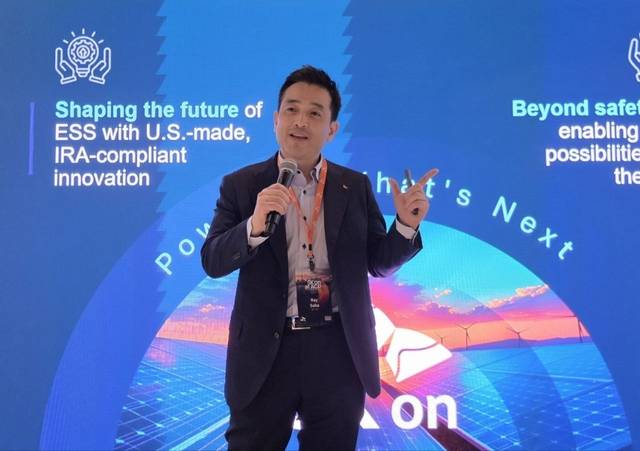
SK On business-development personnel presenting a new energy-storage system at an event in Houston, Texas
Street target: 200,000 KRW
On September 15, UAnta Securities raised its price target from 170,000 KRW to 200,000 KRW. The street's full-year operating-income forecast is 1.01 trillion KRW—more than 20 times last year's 449 billion KRW, if realized.
Meritz Securities upgraded to Buy on July 31, the first upgrade in four years. It had held the stock for years due to battery-unit risk. The second quarter's beat—exceeding consensus by 120%—prompted Meritz to raise its target from 125,000 KRW to 180,000 KRW, a 44% lift. Two reasons: battery losses appear contained, and non-battery earnings were outsized.
A P/E of -7.07: Is that okay?
As of September 23, the P/E sits at -7.07, an odd-looking figure. It reflects 2025 trailing earnings. The company posted a net loss of 2.37 trillion KRW in 2024 and near-zero profit in 2025. The negative reading is a residual of past losses in a trailing four-quarter sum.
The P/B is 1.15x, a modest premium to book value. Analysts' price targets—sitting above the current market price—reflect this logic. If the market viewed the stock as expensive and risky based on past metrics, targets would sit below. They do not. The street is pricing in earnings power after the second quarter, not historical figures.
Foreign-investor ownership ticked from 15.65% in early September to 15.89% on September 23. No rush buying.
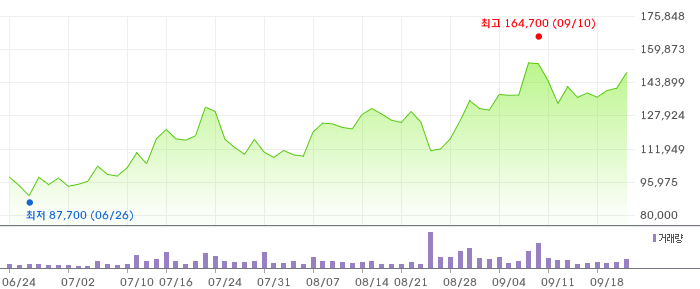
Three-month stock price movement
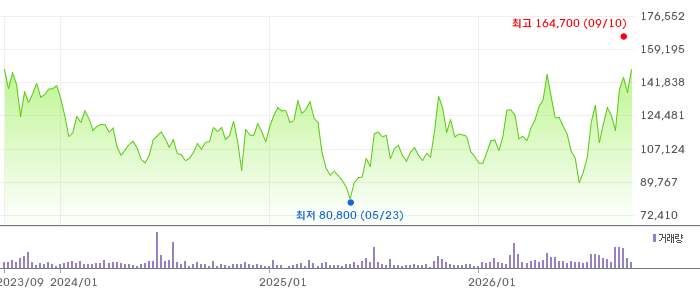
Three-year stock price movement
What to watch
In short, SK Innovation has shed its loss-making label via tangible results. Refining margins and battery profitability both showed up in the same quarter, convincing even a four-year skeptic to upgrade.
One number matters next: the third-quarter earnings, expected in early November. If SK On stays profitable or if the turnaround deepens, the narrative holds. If it reverts to losses, sentiment may shift sharply. Cost savings, once proven, can carry multiple quarters. One quarter of profit proves intention, not durability.
A year ago, loss concerns dominated. Today, a 200,000 KRW target is in circulation. One quarter of third-quarter results could entrench this view or reverse it again.
This article is provided for informational purposes to support investment research and does not constitute a recommendation to buy or sell any security.
#SKInnovation #096770 #SKOn #SKEnmotion #BatteryStocks #RefineryStocks #EnergySecurities #PriceTarget #EarningsImprovement #ProfitabilityTurnaround #UAntaSecurities #MeritzSecurities #Petrochemicals #EnergySector #KoreanStocks #StockAnalysis
댓글
댓글 쓰기