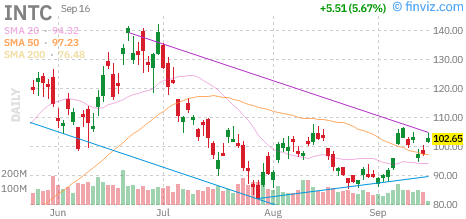
Intel shares surged more than 5% on September 16, breaking above $102, after Reuters reported that SK Hynix and Intel are in discussions about jointly manufacturing memory chips in the United States. The negotiations mark a potential turning point for both chipmakers' U.S. operations.
If realized, this would be SK Hynix's first memory production outside South Korea—and it would happen by leasing capacity from a rival, no less.
What the two sides are discussing
Reuters reported two possible structures. One involves SK Hynix leasing part of Intel's Ohio semiconductor fabrication plant. The second is a joint venture that would include SK Hynix, Intel, and cloud computing firms seeking stable memory supply.
Neither arrangement is confirmed. SK Hynix said it is "exploring various options to strengthen competitiveness, but nothing has been decided." Intel declined to comment on the talks themselves, though it said its Ohio facility plans remain on track.
Why Intel's Ohio facility?
Under pressure from the Trump administration to bring semiconductor production home, SK Hynix is already building a 4 trillion-won AI chip-packaging facility in Indiana. That plant does not manufacture memory wafers. Meanwhile, Intel's Ohio fab faces delayed capacity ramp-up, leaving excess production space. The two companies' needs align.
That said, observers note South Korea could block the deal. Technology sensitivities matter here. For advanced memory products like HBM and DRAM, offshore production transfer could face government resistance.
Why Intel's shares are surging now
This catalyst is far from alone. Intel announced in September it would raise personal-computer CPU prices by roughly 10%—a move that spurred a 9% single-day surge—interpreted by the market as prioritizing margins over volume. Overlapping with that, its advanced 18A process node is ramping production beyond one million wafers processed, adding to bullish sentiment.
Intel's second-quarter revenue reached $16.1 billion, up 25% year-over-year. Foundry revenue climbed to $5.8 billion. However, the foundry unit still posted a $2.1 billion loss, and profitability remains elusive for the business as a whole.
What analysts are saying
Tiger Financial raised its target from $118 to $145, and Northland upgraded its rating to Outperform with a $120 target. Both cite recovering demand for Xeon processors for AI servers and the foundry division's trajectory toward profitability.
At current levels near $102, both targets remain above current prices. That said, targets are forward-looking statements with no guarantee of realization.
Risks to watch
· The SK Hynix deal remains exploratory and could fall apart or result in a much smaller arrangement.
· South Korean government approval of technology transfer remains a variable.
· The foundry division remains unprofitable, and the timing of breakeven remains unconfirmed.
· The stock has surged multiple times over the past two months, creating elevated near-term volatility.
The bottom line
Intel is currently executing two narratives at once. One is about protecting margins through pricing power. The other is about filling foundry capacity—hence the willingness to lease idle fab space to a rival. The turnaround succeeds only if both narratives play out simultaneously.
Two milestones merit attention: whether the SK Hynix talks translate into a binding agreement, and whether next quarter's foundry losses narrow. The stock has risen this far on minimal hard data. When the numbers arrive, it will move sharply again.
Intel is a U.S.-listed security. This article is factual analysis, not investment advice. All investment decisions and outcomes are the reader's responsibility.
#Intel #INTC #SKHynix #semiconductors #memory #DRAM #foundry #Ohio #Xeon #AI #18A #NASDAQ #stock #earnings #analysis
댓글
댓글 쓰기