[Weekly Market Review] KOSPI Reclaims 7,000—yet Two-Thirds of Stocks Fell as Samsung Electronics Rose 9%
September 21–23, 2026: This summary counts three trading days for the KOSPI and KOSDAQ using closing prices. The Korean market closed Wednesday (September 23) for the Chuseok holidays beginning Thursday.
|
Three takeaways 1. KOSPI rose from 6,894.23 to 7,080.92 in three trading days, a gain of 2.71%. The 7,080.92 close is the highest since July 23 (7,096.89), before the plunge. 2. Yet only 933 of 2,759 listed stocks rose—33.8%. The median stock return was -0.72%. 3. September 1–20 semiconductor exports totaled $34.1 billion, representing 47.8% of total exports. Samsung Electronics rose 9.39%, SK Hynix +0.27%. |
The index gained 187 points in four trading days
Monday +1.65%, Tuesday +0.15%, Wednesday +0.90%. KOSPI opened at 6,894.23 and closed at 7,080.92. Over three trading days, a +2.71% gain. KOSDAQ rose from 827.12 to 844.48, a gain of 2.10%.
The shortened week was due to Chuseok holidays. The Korean market closed Thursday–Saturday (September 24–26), making Wednesday the final trading day of September. Trading resumes Monday, September 28.
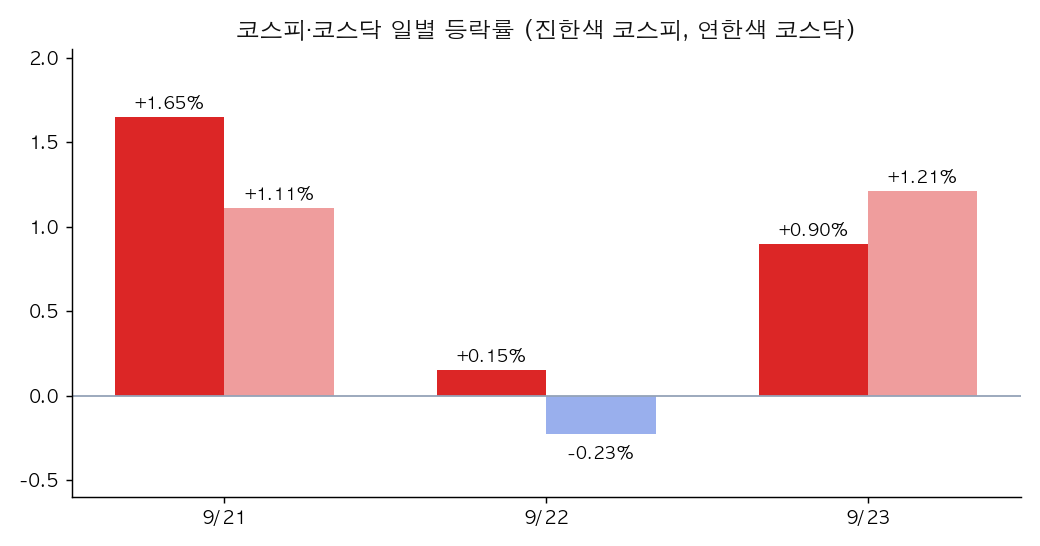
Daily percentage changes for KOSPI and KOSDAQ. Only on Tuesday did KOSDAQ move opposite to KOSPI.
| Indicator | Sept. 18 close | Sept. 23 close | Change |
|---|---|---|---|
| KOSPI | 6,894.23 | 7,080.92 | +2.71% |
| KOSDAQ | 827.12 | 844.48 | +2.10% |
| KRW/USD | 1,383.3 | 1,358.4 | -24.9 |
| 10Y Treasury (KRW) | 4.466% | 4.392% | -7.4bp |
| 3Y Treasury (KRW) | 4.035% | 4.006% | -2.9bp |
Why 7,080 marks a recovery, not a new high
The KOSPI's 7,080.92 is not new ground this year. It closed at 7,096.89 on July 23. Five days later, on July 28, the index fell more than 10% in a single day.
July 30's close was 5,593.56—a 38.6% decline from the June 22 high of 9,114.55. From that low, two months of recovery brought the index to this week's 7,080. From the July low, a gain of +26.6%; from the June high, still -22.3%.
So this week's 7,000 milestone is a retracement, not a new high. Two months of gains have merely returned the index to where it stood before the crash.
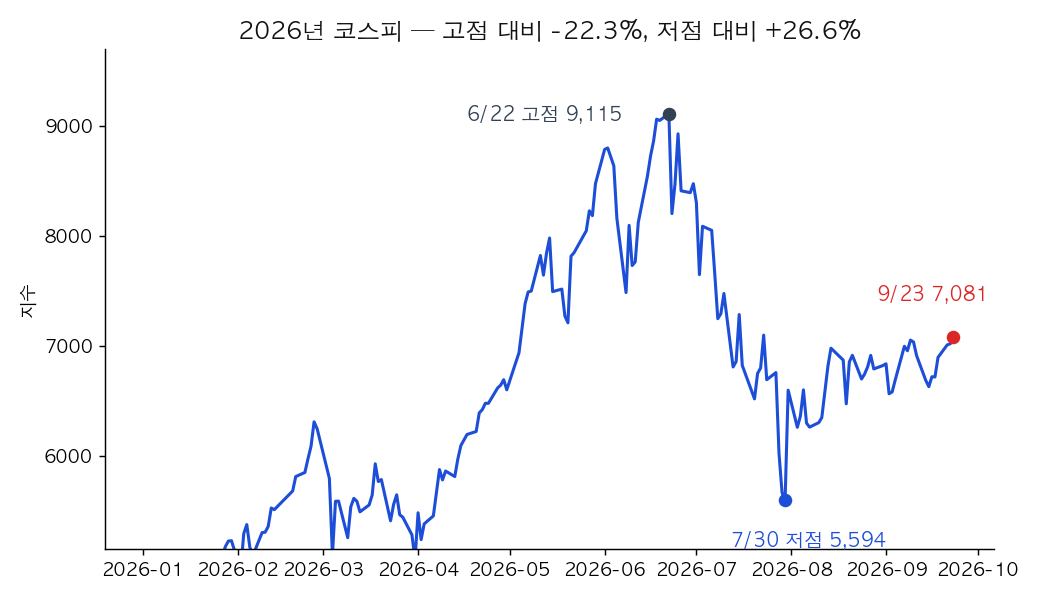
KOSPI daily closes in 2026. June high, July low, and the present moment.
The index rose while two-thirds of stocks fell
Here is the real picture. We compared September 18 and September 23 closing prices for all 2,759 listed stocks. Only 933 rose. That is 33.8% of the total. The other two-thirds fell.
The median stock return was -0.72%. The index's +2.71% gain came from a handful of large-cap stocks.
The picture barely changes when filtering for liquid names. Among 284 stocks with average daily volume exceeding 100 billion KRW, 148 rose and 132 fell. Their median return was +0.48%.
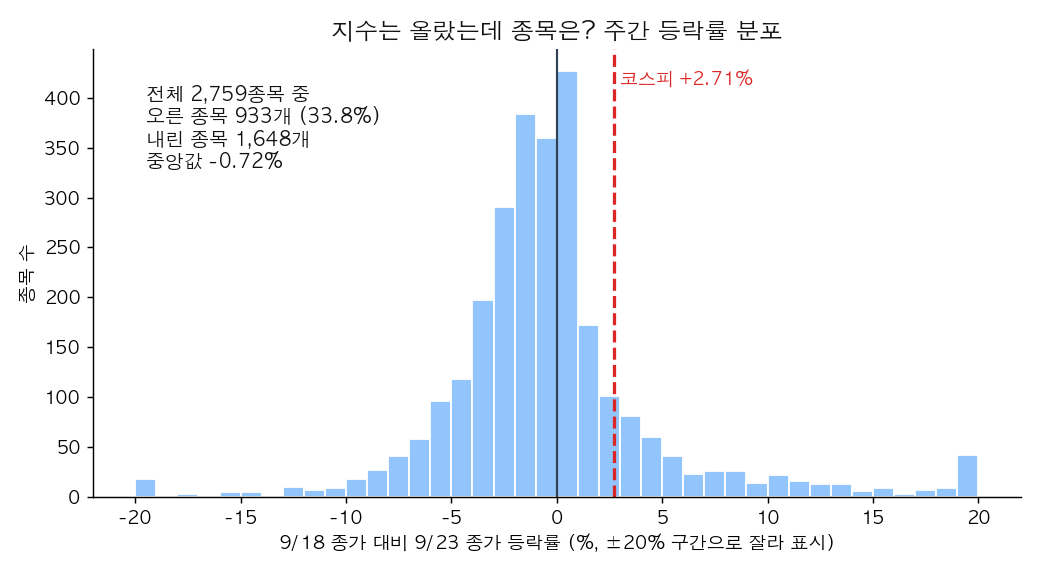
Distribution of weekly returns across 2,759 stocks. The red dashed line marks the KOSPI return. The density of the distribution sits to its left.
Semiconductors accounted for half of exports
The Korean Customs Service released trade data during Monday's session. Exports for September 1–20 reached $71.4 billion, a 78.3% increase from the same period last year—a record for any 20-day span. The previous record was June's $61.7 billion.
Semiconductors accounted for $34.1 billion of that total, up 259.4%, and represented 47.8% of total exports. That is a 24.1 percentage-point increase from last year—roughly one in two export shipments is now a semiconductor product.
Imports reached $48.4 billion, up 26.7%, yielding a trade surplus of $23 billion.
Samsung Electronics rose 9%; SK Hynix rose 0.3%
Two semiconductor giants, divergent paths. Samsung Electronics rose from 261,000 KRW to 285,500 KRW, a +9.39% gain. SK Hynix moved from 1,857,000 KRW to 1,862,000 KRW—a +0.27% gain. Essentially flat.
One data point explains the divergence. Reports (Seoul Economy, September 20) that Samsung plans to more than double its HBM4 and HBM4E production next year broke over the weekend. Samsung Electronics opened Monday with a +4.98% gain. Because SK Hynix has led in HBM historically, the market saw Samsung's capacity plans as a competitive narrowing.
That said, the production expansion remains planned. Actual output volumes and yields remain unconfirmed.
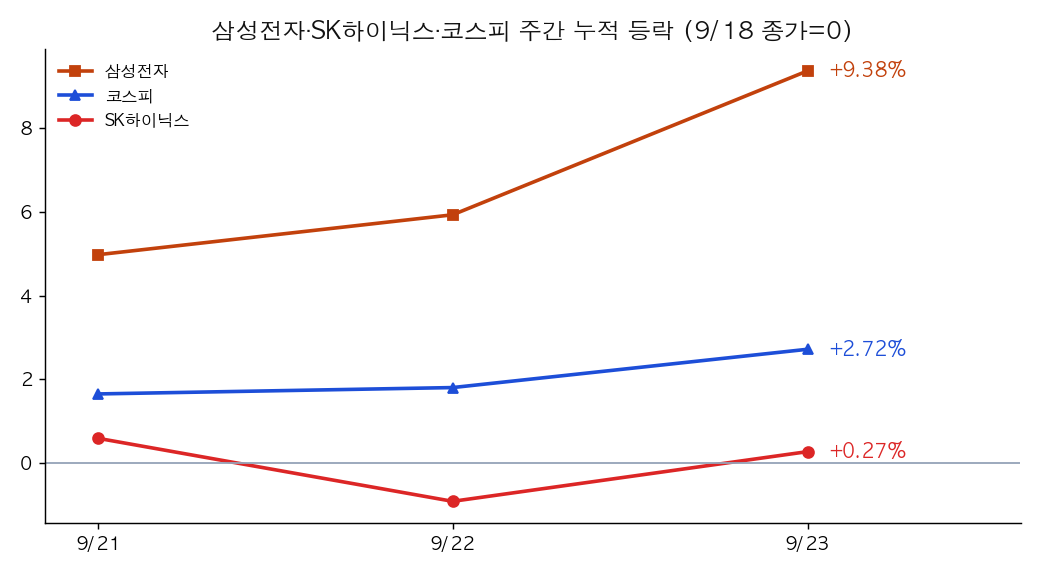
Four-day cumulative performance, indexed to September 18 close = 0. Blue line is KOSPI.
Investor flows shifted toward equipment and materials
Semiconductor equipment and materials stocks outpaced the major chipmakers. The average weekly return among eight key names was +14.71%.
| Stock | Sept. 18 | Sept. 23 | Weekly |
|---|---|---|---|
| Padu | 61,000 KRW | 81,600 KRW | +33.77% |
| Ujin Tech | 138,000 KRW | 163,600 KRW | +18.55% |
| SFA Semiconductor | 9,020 KRW | 10,570 KRW | +17.18% |
| Photonex Corp | 126,900 KRW | 144,800 KRW | +14.11% |
| ISC | 186,300 KRW | 212,500 KRW | +14.06% |
| Wonik IPS | 121,500 KRW | 133,700 KRW | +10.04% |
| Rino | 69,600 KRW | 74,300 KRW | +6.75% |
| Hanmi Semiconductor | 236,000 KRW | 243,500 KRW | +3.18% |
For balance, four defense stocks averaged -6.32% over the same four days. Hanwha Aerospace -5.3%, Hanwha Systems -7.6%, Hyundai Rotem -5.4%, LIG Nex1 -7.0%. Three auto names averaged -3.84%, and four battery stocks fell -2.07%.
Money flows in one direction; other sectors provide the counterweight. This week made that mechanism visible.
Tuesday intraday erasure: 185 points in one day
The week was not uniformly smooth. KOSPI opened Tuesday at 7,161.61, rallied to 7,171.44 intraday, then sold off to 6,986.27. A 185-point drop within a single session—2.6% wiped out in hours.
It closed at 7,017.91, up just 10.19 points from Monday—a +0.15% daily return that masked the turbulence. The intraday range told a different story.
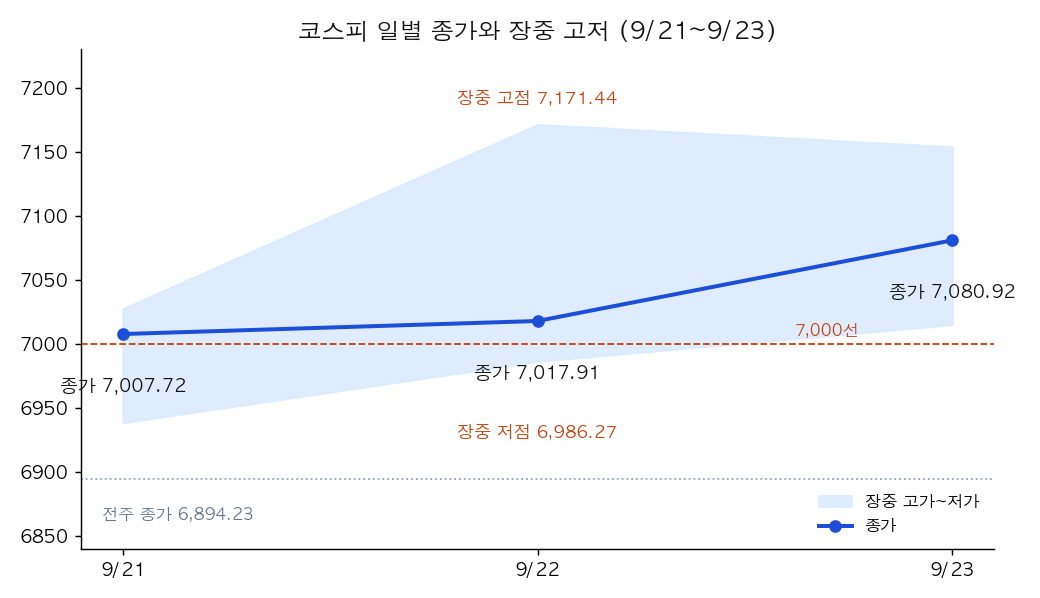
Light blue bands show each day's high-to-low range. Tuesday's band is notably wider.
Retail investors net sold 6 trillion KRW
By investor type, retail investors were net sellers of 6.02 trillion KRW in KOSPI over the four days. Institutional investors bought 1.69 trillion KRW net, while foreign investors were net sellers of 593.8 billion KRW.
One number stood out: other corporates—the category capturing treasury stock buybacks and similar activity—bought approximately 1.6 trillion KRW each day, consistently, across all three sessions. Monday 1.66 trillion KRW, Tuesday 1.65 trillion KRW, Wednesday 1.64 trillion KRW. Last week's daily purchases held the same pattern. No public disclosure explains why the volume remains so uniform.
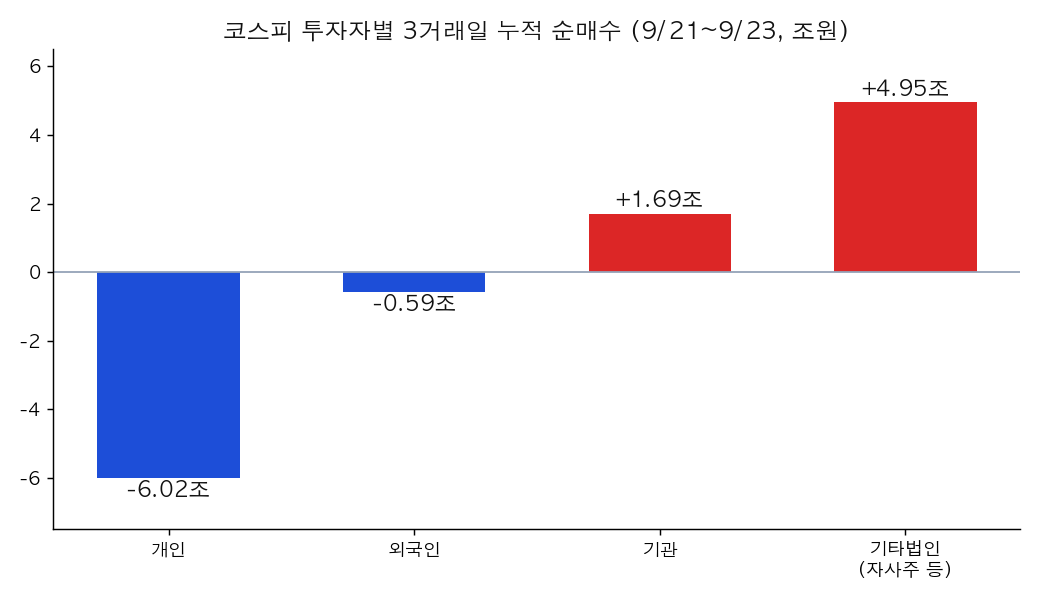
Retail sold 6 trillion KRW; other corporates and institutions absorbed the flow over four days.
The won strengthened 24.9 to 1,358.4
KRW/USD fell from 1,383.3 to 1,358.4, a strengthening of 24.9. Tuesday alone accounted for 16.3 of that drop on a weekly basis, with intraday lows touching 1,352.9. Currency traders cited holiday-driven demand for won conversions and supply imbalances ahead of the Chuseok break.
The 10-year Korean Treasury yield fell 7.4 basis points from 4.466% to 4.392%. Weakness in global oil prices following news of a planned U.S.–Iran diplomatic meeting supported bond strength.
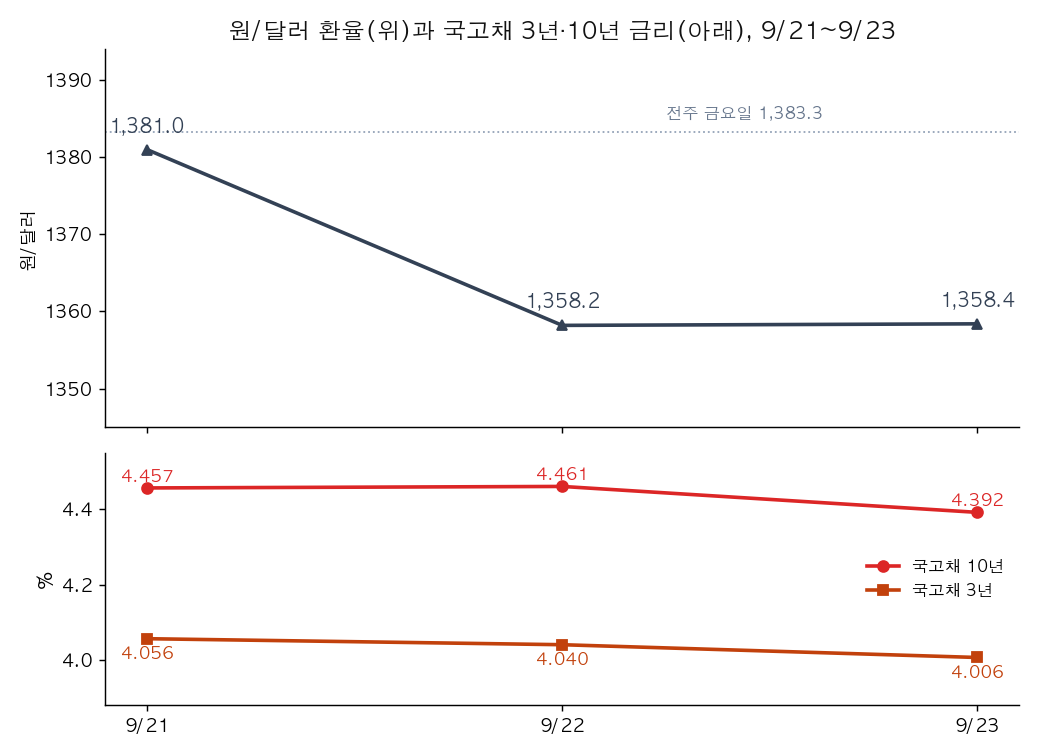
Exchange rate (top) and 3-year and 10-year Treasury yields (bottom). Both moved lower over the week.
Nine of sixteen KOSPI sectors declined
Among the sixteen KOSPI sector indices with closing data for all three trading days, seven rose and nine fell. This occurred in a week when the broad index rose 2.71%.
Healthcare & Medical Devices led with +9.88%, followed by Electrical & Electronics at +4.50%. The losers: Construction -4.25%, Metals -3.85%, and Machinery & Equipment -2.38%. Construction fell -5.66% on Wednesday alone.
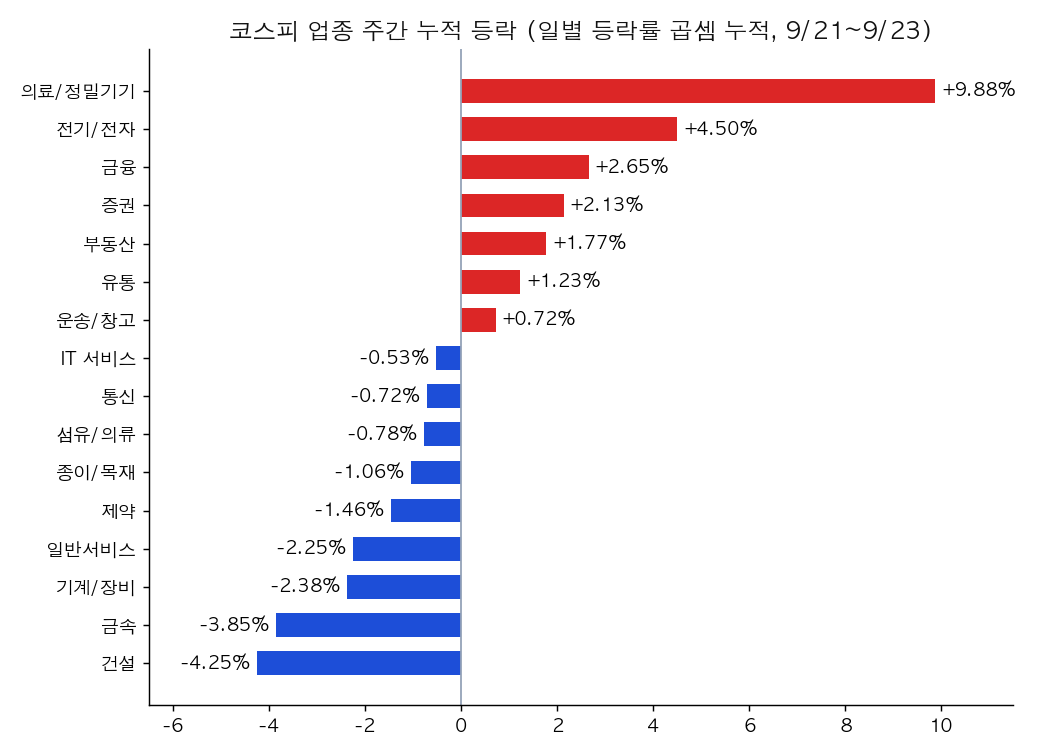
Cumulative sector returns based on daily close-to-close changes. Only sectors with published closing data for all four days are included.
KOSDAQ IPOs drove outsized moves
Two KOSDAQ IPOs posted sharp moves over consecutive days. Neosapiens, which listed Monday, closed +243.00%. Wise Planet Company, which listed Wednesday, ended +285.83%.
On Wednesday, WooriNet hit the daily limit up as quantum cryptography and quantum computing names rallied. Xgate and Coweaver joined the move at +10.16% and +9.26% respectively. By weekly return, Tomato Systems posted the largest gain, climbing from 1,962 KRW to 4,060 KRW—more than double in four days.
On the flip side, Aurum Therapeutics fell from 37,400 KRW to 25,000 KRW, a -33.16% loss. Same market, same four days.
What happened and what to watch during the holiday break
Major developments occurred in the U.S. during the Korean holiday. Chinese President Xi Jinping made a state visit to the U.S. September 23–25, with a summit at the White House on September 24. This marked the first state visit by a Chinese president in eleven years.
The summit concluded without a joint statement. President Trump confirmed plans to meet President Xi again in Shenzhen for the November APEC summit and in Miami for the December G20. The status of negotiations on tariffs and semiconductor export controls remains undisclosed.
Accordingly, trading Monday, September 28, will absorb four days of overseas developments at once. Three numbers to monitor:
| Date | What to watch |
|---|---|
| Sept. 28 (Mon.) | How fully the market prices four days of U.S. equity-market and FX moves; foreign investor flow direction |
| Oct. 1 (Thurs.) | September final export-import figures. Whether semiconductor's 47.8% share in mid-month held for the full month |
| October (ongoing) | Third-quarter earnings season. Whether export strength translates into corporate profit growth |
By the headline number, this was a positive week. Counted by individual stocks, two-thirds fell. Both statements are true.
This article is an explainer of market data and does not constitute investment advice. Past performance does not guarantee future results.
댓글
댓글 쓰기