[Korea Market Close] KOSPI at 6,870, retail investors absorbed nearly 3 trillion won sold by foreigners for a fourth straight day
The KOSPI closed at 6,870.81 on September 29, 2026, down 0.27% from the previous day. The index movement alone appears unremarkable, but the underlying investor flows tell a different story. Foreign investors have sold for a fourth consecutive trading day, offloading KRW 2.92 trillion today alone—nearly KRW 3 trillion. Retail and institutional investors absorbed the entire selling pressure, which accounts for why losses were limited to −0.27%.
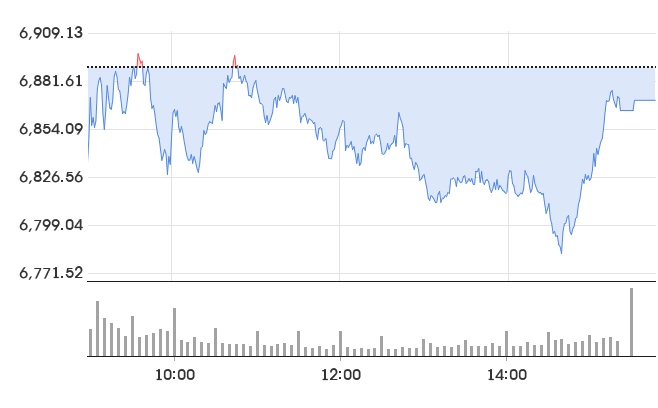
Intraday volatility was far more severe. The index dropped as low as 6,782.99 in afternoon trading, a decline of −1.55%. A late-session recovery erased most losses, swinging the index more than 100 points within a single day.
KOSPI recent daily candlesticks (Naver Finance)
KOSPI and investor flows: the numbers
The KOSPI opened at 6,844.41, down 45 points from the prior close. Early trading brought a brief rebound to 6,898, before the index surrendered those gains and hit a session low of 6,782.99 in afternoon hours. A recovery of nearly 90 points into the close led to the final print of 6,870.81.
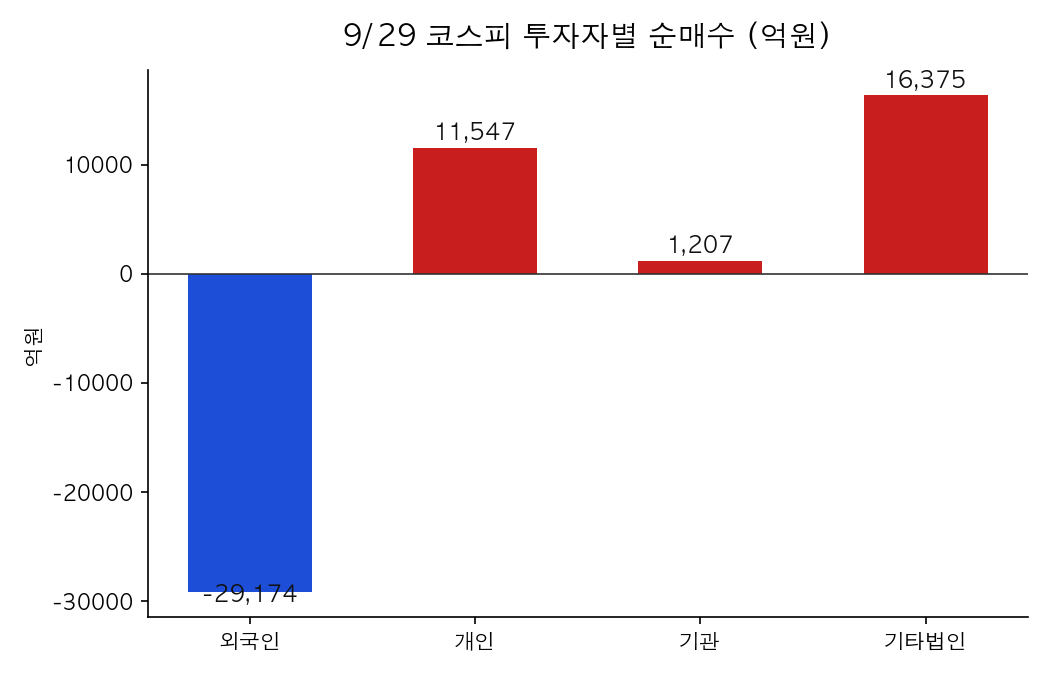
Investor flows reveal the real story beneath the surface. Foreign investors sold a net KRW 2.92 trillion. Retail investors purchased KRW 1.15 trillion, while institutions accumulated KRW 120.7 billion. Other corporates added another KRW 1.64 trillion. A single category—foreign investors—supplied the selling; all other market participants absorbed the supply across the trading session.
| Investor Type | Net Purchase (billion won) |
|---|---|
| Foreign investors | −2,917.4 |
| Retail investors | +1,154.7 |
| Institutional investors | +120.7 |
| Other corporates | +1,637.5 |
Original compilation
Among large-cap names, Samsung Electronics stood out. Today was its ex-dividend date, which typically results in a mechanical price decline equivalent to the dividend payout. Samsung Electronics traded through that headwind and gained 0.93%, a resilient performance that also provided some downside support to the broader index.
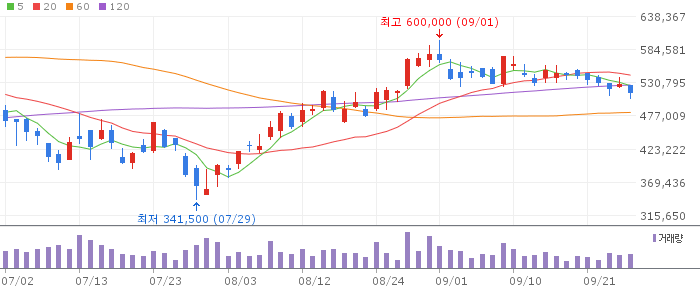
By contrast, Samsung SDI fell 4.13%. LG Energy Solution dropped 3.16%. Both are leading battery names, and their synchronized weakness stood out. HD Hyundai Heavy Industries (−2.94%) and Doosan Enerbility (−2.80%) also underperformed.
Samsung SDI recent three-month candlesticks (Naver Finance, red=up/blue=down)
KOSDAQ: semiconductors led the rally
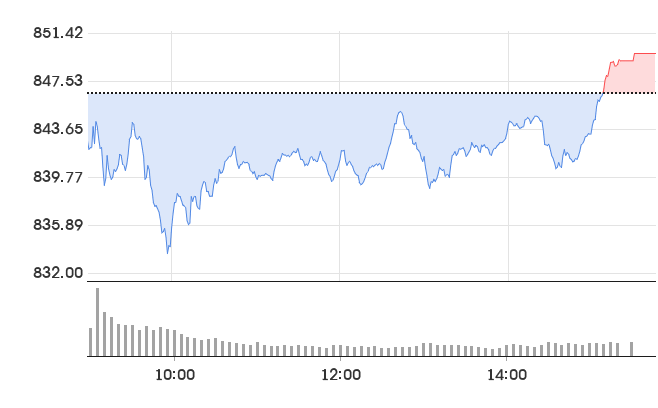
KOSDAQ moved in the opposite direction, closing at 849.80, a gain of 0.38% and the third consecutive day of advances. Morning weakness carried the index as low as 833, but a vigorous afternoon rally reversed the day's losses.
Semiconductor equipment stocks led the rebound. HPSP surged 8.93%, PSK Holdings 8.33%, Ugin Tech 7.74%, TCK 7.14%, and Jusung Engineering 6.22%. A morning report from KB Securities fueled the momentum, citing strong uptake of Muse, an AI-agent platform. The analysis emphasized a market shift beyond simple query-response AI toward agentic AI systems that execute tasks autonomously. The key point: these systems require iterative reasoning steps, driving up token consumption and expanding demand beyond HBM and GPUs to include NAND and CPUs. Semiconductor equipment names appear to be trading on this supply-chain thesis.
KOSDAQ recent daily candlesticks (Naver Finance)
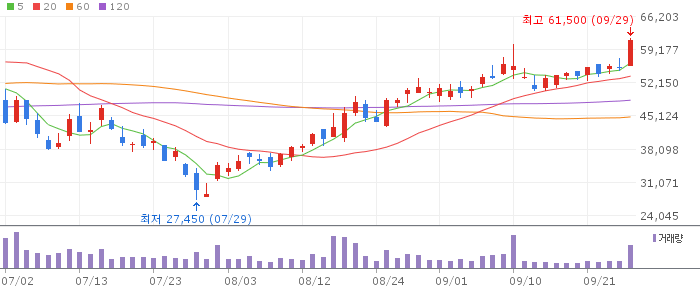
HPSP recent three-month candlesticks (Naver Finance, red=up/blue=down)
Samsung Electro-Mechanics: record capex for a single product
Among KOSPI upside catalysts, semiconductor substrate names merit attention. Samsung Electro-Mechanics announced after market close plans to invest KRW 4.27 trillion to expand FC-BGA (flip-chip ball grid array) production capacity at its Sejong facility. The outlay represents 43.6% of shareholders' equity—a historic commitment. The company describes this as the largest single-product capex in its history. The investment timeline runs from September 2026 through May 2028, with production commencing in September 2028.
The announcement lifted multiple related names. Korea Circuit, Ducksan Hi-Metal, Taiseong, Neottis, and TLB—all substrate specialists—rose in sympathy. MLCC-related names including Hanwha Q CELLS, GIS, and Kchip also gained. Taiseong rallied 13.33%, bolstered by news that semiconductor substrate maker Semitech received a purchase order from an AI server equipment supplier.
Today's limit-up moves, sharp gainers, and notable declines
C-SITE recorded its second consecutive limit-up close of +29.99%, riding momentum from a change-of-control share acquisition. Terraview hit the up-limit at +30.00% on a KRW 1.36 billion equipment supply contract. Hyundai Biologylands reached +29.90% following FDA approval of its dental bone graft material. New listings Global Technology and BigWave Robotics both soared on their debut day, gaining 82.20% and 66.11% respectively.
On the downside, secondary battery and aerospace names came under pressure. Ecopro BYD fell 4.67% and Ecopro 3.79%, weighing concerns about China's announced roadmap for solid-state battery early production by 2030. Aerospace-related stocks including Sensorview (−7.64%) and Innospace (−5.70%) also retreated. While SpaceX's Starship achieved orbital insertion, market participants reacted to reports of an earlier-than-planned booster recovery.
The real market driver: U.S. Treasury yields
The KOSPI's weak open reflected overnight weakness in U.S. markets. The 10-year Treasury yield climbed above 5.2%, reaching 5.274% intraday—the highest level since June 2007. The 2-year yield rose to 4.924% and the 30-year to 5.562%, all advancing in lockstep.
The move stemmed from renewed inflation concerns. Federal Reserve Governor Lisa Cook noted that AI-related demand and elevated energy prices are expected to exert price pressure in coming months. Markets now price a 70.3% probability of a 25-basis-point rate increase at the October FOMC meeting, with 95.5% odds of further tightening by year-end. This represents a sharp reversal from recent rate-cut expectations. The market narrative has shifted entirely from rate cuts to potential rate increases.
Middle East tensions remain unresolved. Iran has demanded the release of frozen foreign assets and an end to maritime blockades as preconditions for reopening the Strait of Hormuz within seven days. President Trump rejected the proposal, though separate talks mediated by Qatar are scheduled in New York. Separately, Saudi Arabia announced the resumption of crude exports through a previously targeted pipeline. Treasury yields, oil prices, and Middle East geopolitics remain tightly intertwined.
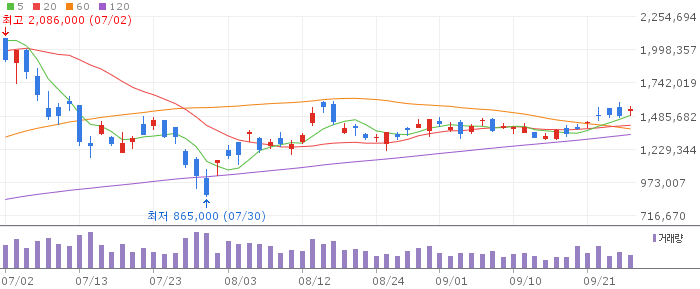
Samsung Electronics recent three-month candlesticks (Naver Finance, red=up/blue=down)
Bottom line
Today's 0.27% KOSPI decline appears ordinary in isolation. Beneath the surface, however, the momentum shift is pronounced. Foreign investors continue a four-day selling cycle at scale, while domestic participants absorb the entire supply. U.S. Treasury yields have reached post-2007 highs—a signal that deserves careful attention. The immediate variable is the October FOMC decision. Markets currently price a 70.3% probability of a 25-basis-point increase; the actual outcome will shape the next market phase.
Context from recent sessions is instructive. KOSPI's 6,889 sell-off as 5% Treasury yields break: why Samsung Electronics held but HLB hit the limit-up covers the early stages of the 5% yield break. KOSPI flat as Trump rejects Iran proposal and Treasury yields spike to 5.2% details the overnight U.S. events driving today's 5.2% breach.
This article is provided for informational purposes. Investment decisions and their outcomes are the reader's responsibility.
#KOSPI #KOSPIIndex #KOSDAQ #ForeignInvestorSelling #SamsungElectronics #SamsungSDI #SamsungElectroMechanics #FCBGA #SemiconductorEquipment #HPSP #AgenticAI #MusePlatform #TreasuryYield #USBondYield #FedRateHike #FOMC #SecondaryBattery #EcoproBYD #CSite #LimitUp #SharpGainer #KoreaMarketClose #KOSPIClose #KOSPIOutlook #MarketSummary #InvestorFlows #ExDividend #KOSPI6870 #KOSDAQ849 #StockInvesting
댓글
댓글 쓰기