[Weekly Market Review] KOSPI Reclaims 7,000 for First Time in 33 Trading Days—Why Retail Investors Sold 9.9 Trillion Won
September 7-11, 2026. Here's a five-trading-day summary of the KOSPI and KOSDAQ.
|
Three takeaways 1. KOSPI climbed from 6,687.21 to 6,909.91, up 3.33% on the week. KOSDAQ rose from 813.50 to 820.64, up 0.88%. Wednesday's close of 7,051.64 marked the first time above 7,000 since July 23—33 trading days. 2. Over five trading days, retail investors sold a net 9.91 trillion won. Other corporations bought 8.49 trillion won net. Institutions purchased 3.44 trillion won. Foreign investors sold 1.98 trillion won net. 3. Friday saw KOSPI down 1.76%. The 10-year Korean Treasury yield climbed to 4.540%, and the probability of a U.S. September rate hike jumped to 86.3% following the CPI print. |
Monday alone: retail investors dumped 6.8 trillion won
This week's story begins Monday. On September 7, KOSPI surged 4.61%—closing at 6,995.39, up 308 points in a day. OpenAI unveiled its new O1 model, signaling the era of artificial general intelligence. Over the weekend, the Philadelphia Semiconductor Index had climbed 3.37%. Samsung Electronics rose 5.68%, SK Hynix jumped 8.26%.
Retail investors sold. Net selling reached 6.84 trillion won—the heaviest single-day outflow of the week. Buyers stepped in: foreign investors took 2.59 trillion won, institutions 2.65 trillion won, other corporations 1.64 trillion won.
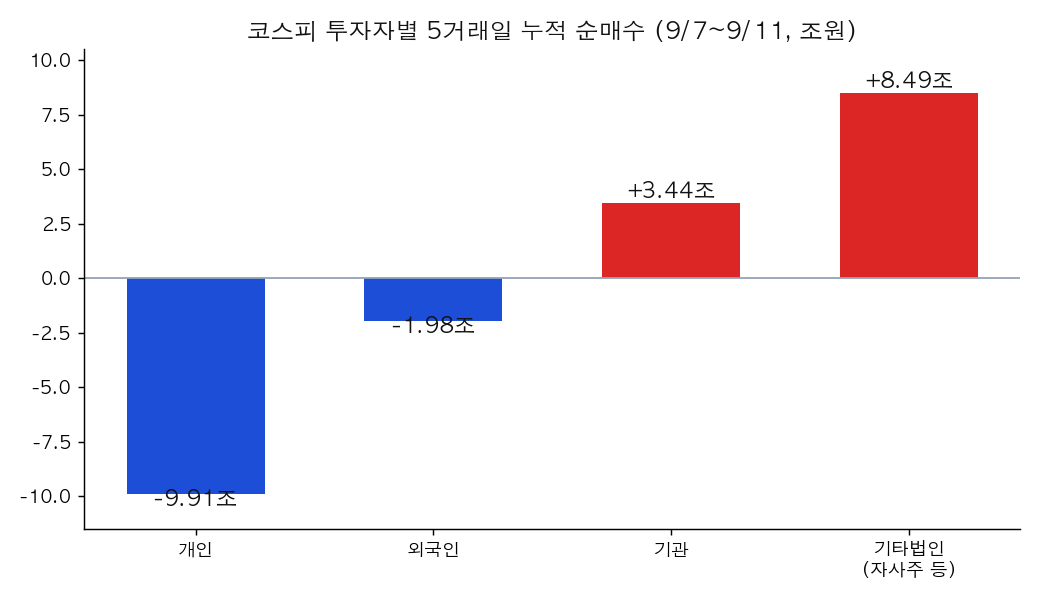
Aggregated from daily market-close investor-flow statements across all five trading days. Net sum across all four categories: +0.04 trillion won.
Tuesday: 3.03 trillion won net selling. Wednesday: 2.29 trillion won net selling. Four days totaled 12.16 trillion won in net outflows. Thursday and Friday switched back to net buying, but only 2.25 trillion won. For the week, retail net selling reached 9.91 trillion won. The index climbed 3.33% while retail investors locked in gains.
Why they sold is not disclosed in the close statement. KOSPI had been hammered to 6,547 in the final week of August, then rebounded within striking distance of 7,000 in a single week. The most likely explanation: investors with underwater positions exiting at breakeven or small profits. Confirmed facts: magnitude and direction.
One familiar name returns: other corporations. After 8.06 trillion won in net buying last week, they purchased 8.49 trillion won this week—a daily pace of roughly 1.6-1.8 trillion won, remarkably consistent all five days. This category captures company stock buybacks. Two consecutive weeks of 16.5 trillion won in buyback demand.
The 7,000 line touched three times. Closing above it twice.
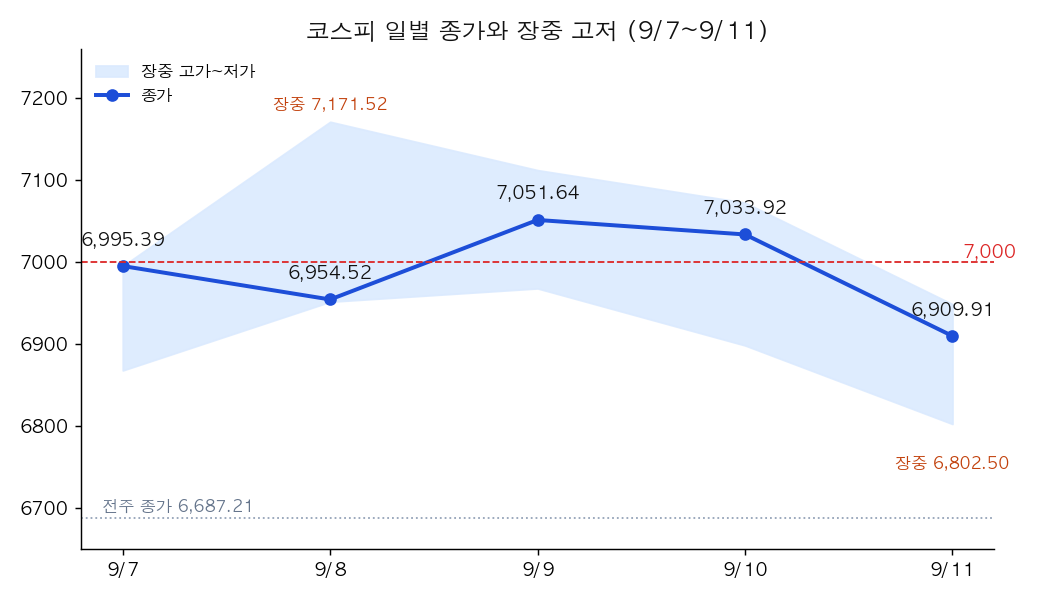
Blue bands show intraday high and low. Tuesday's upper wick and Friday's lower wick were sharp.
Tuesday, September 8. KOSPI hit an intraday high of 7,171.52 but closed at 6,954.52. The gap from peak to close: 217 points. Morning saw the index eclipse 7,100, yet the afternoon surrendered the entire gain and finished negative. News arrived during Asian hours: Saudi Arabian energy facilities in the south came under attack by Houthi fighters. Oil surged.
Wednesday pushed higher again: 7,051.64 on the close. By closing basis, the first time since July 23. Thirty-three trading days. Thursday held at 7,033.92. On the joint expiry of index futures and options, foreign investors sold 2.48 trillion won, pushing the index down to an intraday low of 6,898.45. Retail and institutional buyers absorbed the sales and lifted the index back above 7,000.
Friday was the problem. KOSPI gapped open at 6,802.50, down 3.29%. The intraday low came at the opening; the index recovered over 100 points to close at 6,909.91. Still, that's a 1.76% decline. From Tuesday's intraday high of 7,171.52 to Friday's intraday low of 6,802.50—a 369-point swing, or −5.15%—within a single week. Volatility like that compressed the entire gain.
Index scorecard
| Metric | Sept 4 Close | Sept 11 Close | Weekly |
|---|---|---|---|
| KOSPI | 6,687.21 | 6,909.91 | +3.33% |
| KOSDAQ | 813.50 | 820.64 | +0.88% |
| KRW/USD | 1,350.4 | 1,345.9 | −4.5 |
| 10Y KTB Yield | 4.360% | 4.540% | +18.0bp |
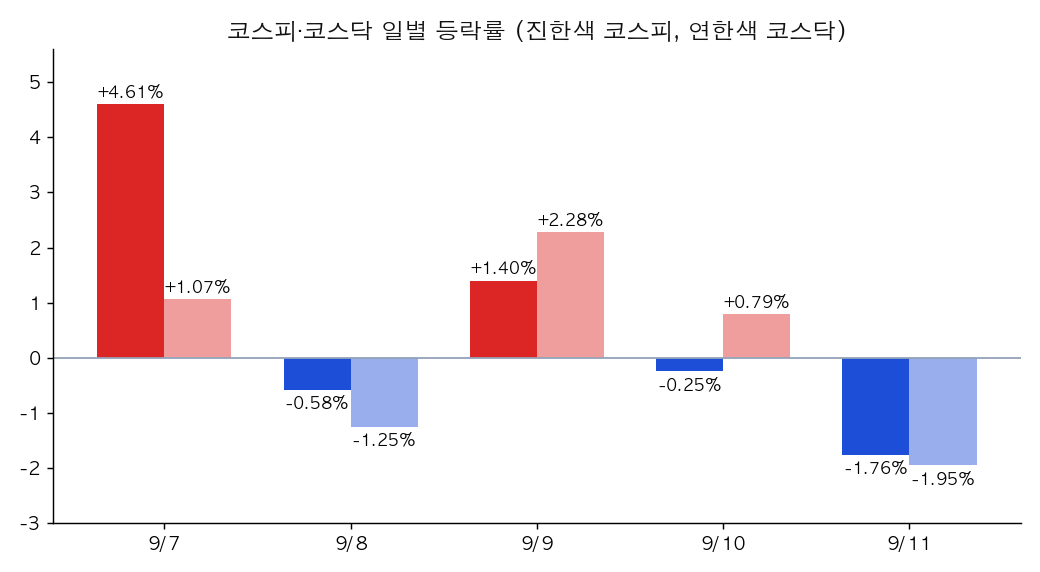
Monday's +4.61% in KOSPI accounted for the week's entire gain. The remaining four days, in aggregate, posted losses.
KOSDAQ took a different path. Monday gained only 1.07%, trailing KOSPI. Thursday saw institutions buy 1.35 trillion won, pushing the index up 0.79% to 832.92—the week's high close. Friday fell 1.95%, with pain concentrated in growth: Phadu −13.62%, Wontix −7.15%, EcoPro BM −7.08%. KOSDAQ semiconductor equipment stocks absorbed Friday's heaviest losses.
Oil at $100, yields at 4.5%. These two forces shaped Friday.
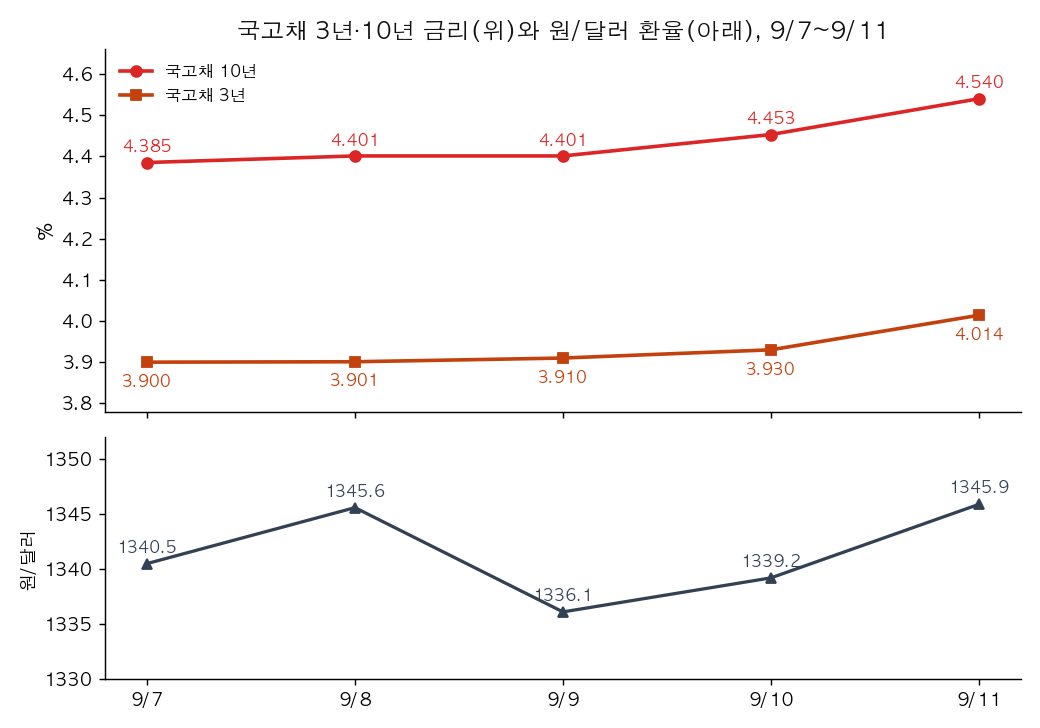
Exchange rate as of 15:30 market close. Yields are end-of-day on 3Y and 10Y Korean Treasury notes.
The 10-year KTB yield climbed from 4.385% Monday to 4.540% Friday. Friday alone saw 8.7 basis points added. The 3-year moved to 4.014%, breaking above 4.0%. On Friday alone, foreign investors sold 23,103 contracts of 3-year Treasury futures.
The catalyst: oil. The U.S. and Iran traded strikes on shipping. U.S. forces hit targets near Kharg Island, Iran's primary crude-export hub. Iran responded with ballistic missiles against a Jordanian base hosting American troops. In the Red Sea, Houthi forces seized Mokha port and are advancing toward the Bab al-Mandeb Strait. Thursday evening, WTI October futures jumped 6.69% to $102.48. Brent climbed to $107.63. Eight consecutive trading days of gains—the highest close since May 19.
Rising oil typically feeds into inflation. The same day, U.S. August producer prices came in at +0.4% month-over-month, +5.4% year-over-year—higher than expected. The CME FedWatch tool showed September rate-hike odds at 71.1%. This was already known when the Korean market opened. Friday's −3.29% gap down reflected that headline.
U.S. consumer prices landed Friday evening, after the Korean close: +0.4% month-over-month, +3.4% year-over-year, in line with expectations. Core was +0.3% month-over-month, slightly above the 0.2% forecast. The 10-year U.S. Treasury briefly traded at 4.99% before retracing, and September hike odds climbed to 86.3%. Yet U.S. equities staged a five-trading-day rebound: the Dow +0.98%, S&P 500 +0.86%, Nasdaq +0.96%. WTI pulled back 2% to $100.05, Brent to $104.61. The rate hike was already priced in; the oil retreat prompted relief buying.
The won was quiet, trading between 1,336.1 and 1,345.9 for the week—down 4.5 won. Foreign investors sold 5.21 trillion won over four days, yet the currency barely budged. Why remains unclear.
SK Hynix up 10% on the week; Samsung Electronics up 1.6%
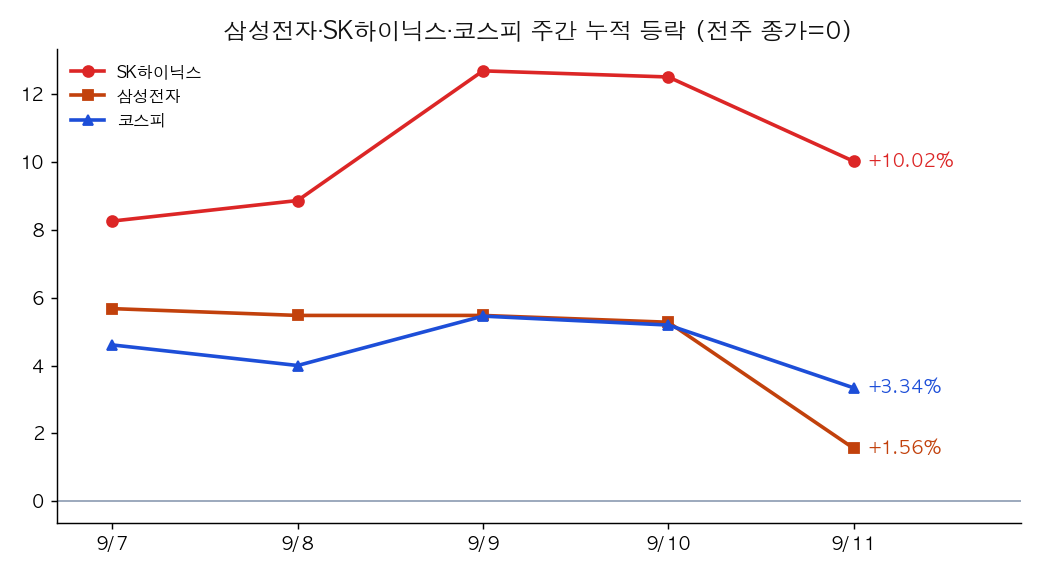
Daily returns compounded across the five-day period. Prior week's close = 0%.
SK Hynix gained 10.02% on the week. Monday contributed +8.26%, Wednesday added +3.51%. Intel announced a 10% hike in October CPU pricing; Qualcomm and Amazon unveiled a joint data-center chip venture. Wednesday's close saw the TSMC August revenue report: +53.3% year-over-year for the month—a record. Memory-sector fundamentals remain solid.
Samsung Electronics managed only +1.56% on the week. After Monday's +5.68%, the remaining four days showed flat to negative performance. Friday: −3.53%. Underperformance versus KOSPI's +3.33% by a factor of six. Both are semiconductors, yet results diverged sharply. Goldman Sachs maintained a KOSPI price target of 12,000 on Monday, arguing that memory-cycle fundamentals are underappreciated. Readers will weigh that claim individually. At 6,909 now, the path to 12,000 implies 74% upside.
Why semiconductors fell Friday also merits scrutiny. The close noted concern that rising rates could dampen memory demand. The Philadelphia Semiconductor Index fell −2.66% Thursday evening. Han Mi Semiconductor shed −8.70% in reaction. The decline reflects rates, not earnings. That distinction matters.
Construction +11%, machinery +7.9%. Eight nuclear plants in the calculation
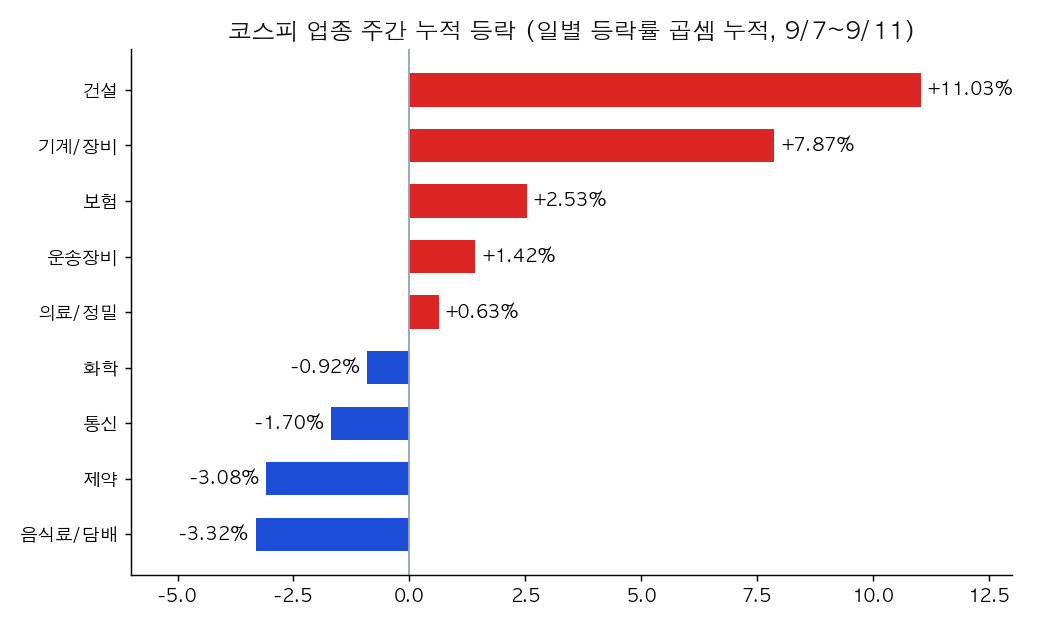
Only sectors with daily close statements for all five trading days are included. Sectors with any missing day (e.g., Electrical/Electronics, Financials) are excluded.
Construction rose 11.03% on the week, posting gains all five days. News arrived Monday that the first project under the $350 billion U.S. investment would likely be the Encinahl natural-gas combined-cycle plant in Texas. Follow-on projects under negotiation include construction of up to 8 nuclear units in the United States. Daewoo Engineering rose +9.26%, Hyundai Engineering +6.02%, Hanwha Q Cells +13.66%. Doosan Enerbility jumped +10.98% Monday. Wednesday brought confirmation that Korea Electric Power will invest 55 trillion won over five years in transmission and distribution infrastructure, lifting power-equipment stocks.
Insurance and banking moved opposite on Friday. While KOSPI fell −1.76%, Samsung Fire surged +6.03%, KB Financial gained +2.60%, Shinhan Financial +2.36%. Rising rates expand net interest margins in banking and insurance. Thursday, too: Hanwha Q Life +6.21%, Hanwha Life +4.73%. Insurance sector posted +2.53% on the week. Capital flows clearly favor sectors that benefit from higher rates during volatility.
Shipbuilding survived Friday. HD Hyundai Heavy Industries rose +5.62%, Korea Shipbuilding & Offshore Engineering +3.98%. New investment in engines and propulsion exceeded market expectations. Wednesday brought news that Hanwha Ocean won preferred-negotiation-partner status for a 683 billion-won Thai frigate contract.
Laggards: Food −3.32%, Pharma −3.08%, Telecom −1.70%. Food stocks fell even though Thursday saw headlines of Black Sea grain-corridor disruptions—non-GMO corn imports dropped nearly 70% in August—and warnings of tighter non-GMO soybean supply for tofu production. Pharma sold off Friday as rate-hike fears gripped the sector across the board. Battery makers surged Wednesday: Samsung SDI +8.30%, LG Energy Solution +6.46%, SK Innovation +11.23%. The catalyst was momentum excluding Chinese vendors from U.S. energy-storage markets. Thursday and Friday erased much of those gains.
What to watch next week
The Federal Reserve's Open Market Committee meets September 15-16. Results arrive Thursday, September 17, at 3 a.m. Korean time. FedWatch leans toward a hike; Bloomberg's consensus survey leans toward a hold. Chairman Kevin Walsh, in his first year since May, held rates steady twice. Market calculus suggests this meeting could differ. Friday, September 18, brings the Bank of Japan meeting. Street forecasts band KOSPI between 6,400-7,400—a 1,000-point range on either side. That spread itself signals uncertainty.
| What to watch | Why |
|---|---|
| Sept 17 pre-dawn FOMC outcome and dot plot | Hike odds at 86.3%. The rate decision matters less than the dot plot—how many additional moves are penciled in—since that defines the rate trajectory |
| WTI holding $100 | Friday clipped at $100.05. Further retreat may trigger relief like Friday in New York; another rise brings a night like Thursday |
| 3Y KTB 4.0% level, 10Y at 4.5% | Both breached this week. If they stabilize here, growth stocks—chips and battery makers especially—face the most pressure |
| Other corporation buyback sustained | Two weeks running at 1.6-1.8 trillion daily. The day this support stops marks the loss of a key floor |
| Foreign investor selling three days running | Wed-Fri outflow: 5.21 trillion won. Monday will signal whether this extends to a fourth consecutive day—the first confirmation checkpoint |
| Korea Exchange after-hours market opens Sept 14 | Trading hours expand beyond the regular close. Opening week's turnover will hint at participant interest |
Distilled to one sentence: This week, the KOSPI index captured its 3.33% gain on Monday alone. The remaining four days were buffeted by oil prices and interest-rate expectations. Retail outflows of 9.9 trillion won were offset by corporate buyback demand. Next week pivots on whether that framework survives the FOMC.
Investment decisions and their outcomes rest with you.
댓글
댓글 쓰기