On Tuesday morning, September 8, 2026: South Korea's KOSPI index jumped 308.18 points, or 4.61%, in Monday's session, closing at 6,995.39. The paradox is striking. U.S. equities had stumbled just one day earlier. The divergence tells the story of how semiconductor strength and artificial intelligence momentum can override traditional market signals. Here's what happened.
A note on timing: U.S. markets were closed Monday, September 7, for Labor Day. All references to "Friday's close" below reflect Friday, September 4, U.S. time—the trading session immediately before Korea's Monday open.
Friday: U.S. three major indices retreated across the board
On September 4, the Dow Jones fell 271.86 points, or 0.51%, closing at 53,414.25. The Nasdaq declined 77.07 points, or 0.29%, to 26,506.99. The S&P 500 dropped 29.11 points, or 0.38%, to 7,718.60. All three closed in red. The culprit: a surprise jobs print.
The U.S. Labor Department reported 162,000 nonfarm payrolls added in August. Market consensus had called for 56,000. Nearly triple the expectation. The unemployment rate came in as forecast at 4.1%.
Strong employment usually bolsters equities. Not this time. The market worried that the Fed would hold its nerve and raise rates at its September 15-16 meeting. CME FedWatch data reflected the shift: the probability of a 25 basis-point hike rose within hours from 49.4% to 58.4%. That repricing hit risk assets hard.
The damage was broad. Tesla tumbled 5.92% after its Cybercab robotaxi event underwhelmed. The U.S. National Highway Traffic Safety Administration opened a formal safety investigation into the steer-by-wire and pedal-free design. Apple (-2.51%), Microsoft (-2.04%), and Alphabet A (-1.11%) joined the sell-off. Lululemon cratered 17.38%—third-quarter guidance missed badly. Adobe slid 6.73% on news of CEO succession. The breadth was striking: mega-cap tech sold indiscriminately.
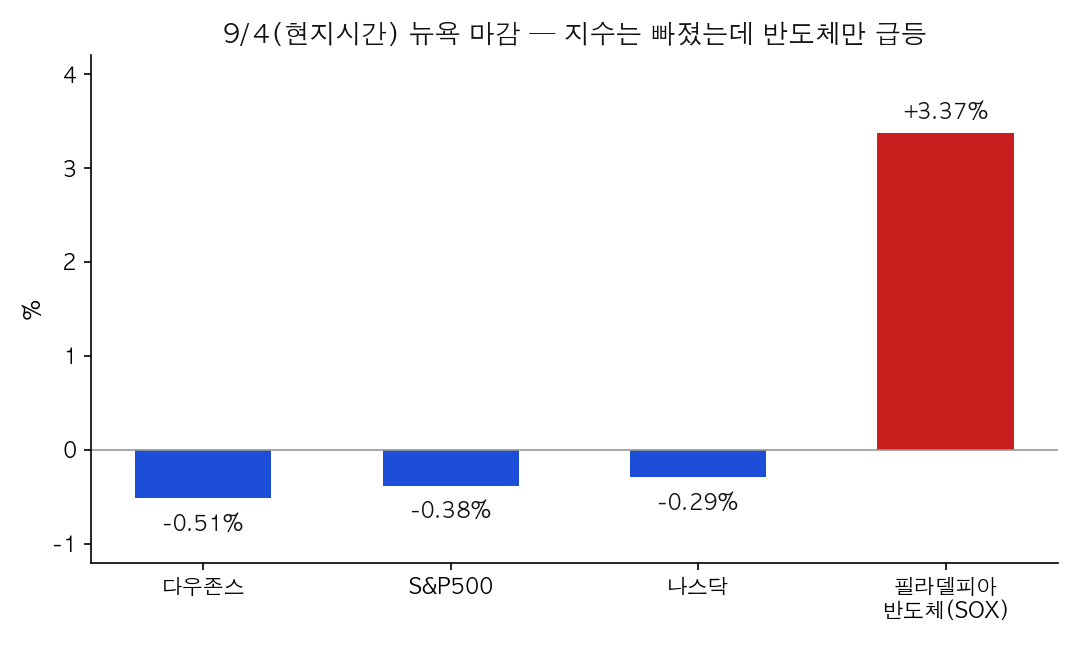
Sept. 4, U.S. time: The three major indices fell, but the Philadelphia Semiconductor Index surged nearly 3%
Yet the semiconductor index rallied hard—up 3.37%
On the same day, the Philadelphia Semiconductor Index (SOX) advanced 383 points, or 3.37%, closing at 11,735.26. While the broader market retreated, chip stocks rallied alone. That divergence became the core driver of Asia's next session—and Korea's Monday rally.
The catalyst: NAND flash supply dynamics. Global NAND revenue surged roughly 70% quarter-over-quarter in Q2 as AI data centers continued to absorb storage capacity. Pricing remained firm; supply remained tight. Separately, OpenAI unveiled its new model, GPT-6 Astra, on September 3. Each generation of AI seemed to require not just more GPUs, but also more HBM, more DRAM, and more NAND. That prospect lifted semiconductor valuations.
The results: SanDisk climbed 11.90%, the largest gainer. SK Hynix ADR added 8.14%. Micron rose 6.10%. Intel (+4.51%), AMD (+4.69%), and TSMC (+2.85%) all advanced. Nvidia's move was modest at 0.84%. Broad indices fell, yet memory and foundry stocks rose. The market was effectively saying: "Rising rates are one story; semiconductor cycle strength is another story."
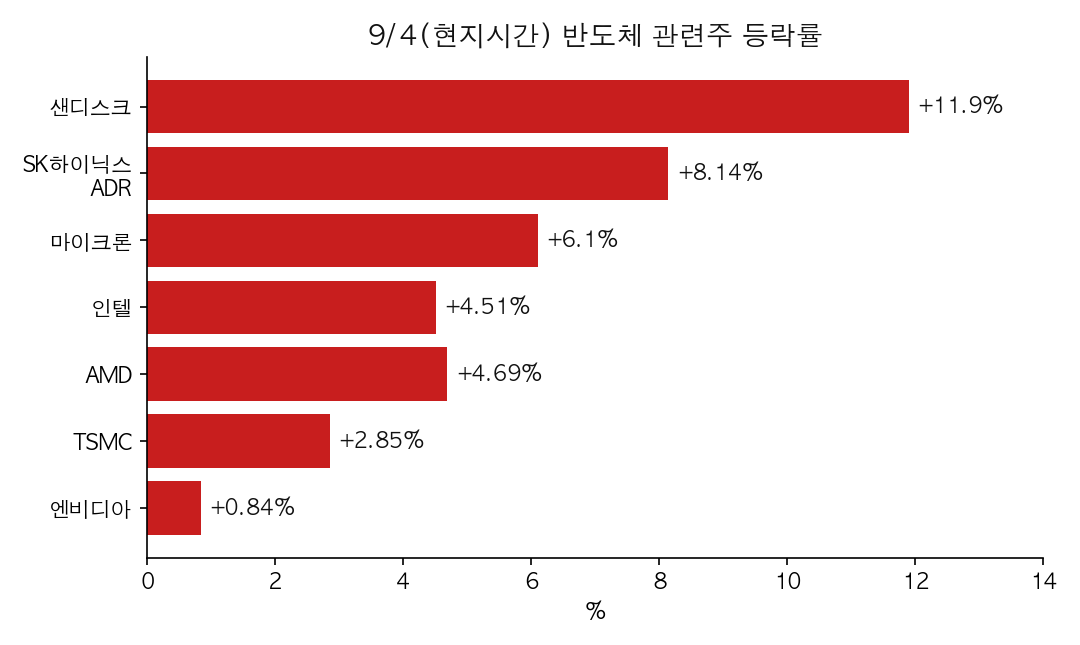
Sept. 4, U.S. time: Semiconductor and foundry stocks climb despite market-wide retreat
Treasury yields, the dollar, and oil all moved higher
The employment surprise pushed U.S. Treasury yields higher across the curve. The 10-year yield rose 2.10 basis points to 4.784%. The 2-year climbed 4.70 basis points to 4.379%. The 30-year added 0.30 basis points to 5.246%. The 10-2 spread narrowed from 43.10 to 40.50 basis points.
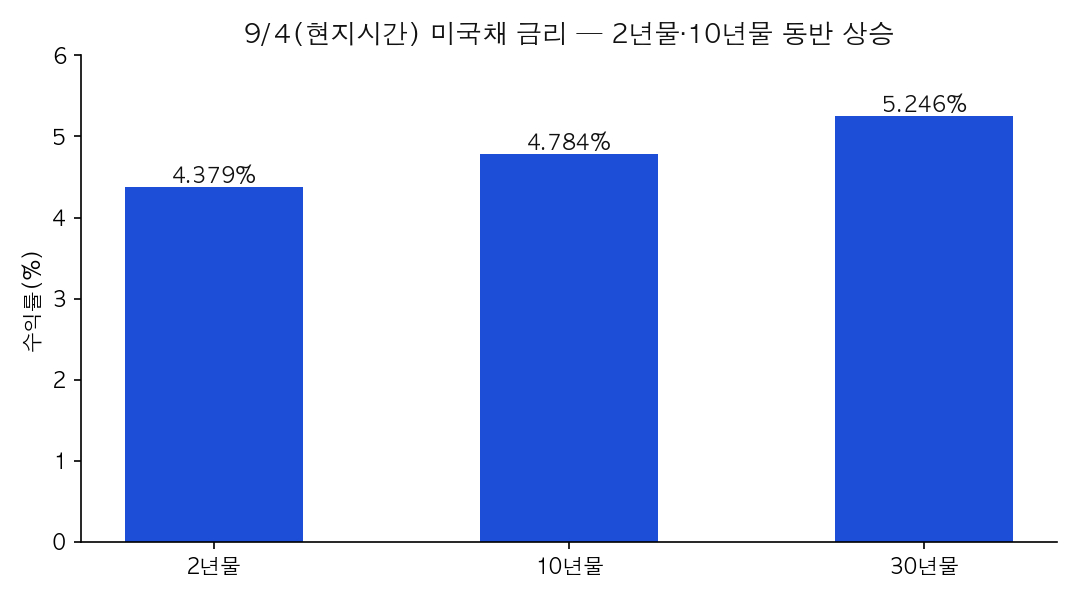
Sept. 4, U.S. time: Treasury yields rose across the curve
The dollar strengthened against the yen and euro. USD/JPY traded at 156.239, up 0.488. EUR/USD at 1.1615, down 0.0014. Market reaction was muted, however. Investors treated the jobs number as a single data point, not a settled forecast. August CPI, due September 11, held more weight in the rate conversation. As a result, the dollar index pulled back from its intraday high of 99.392, giving back part of the move.
Oil extended a five-day rally. WTI crude added 0.20% to $91.48 per barrel. Brent rose 0.80% to $96.28. Clashes between Yemeni government forces and Houthi militia near the Bab al-Mandab strait—a vital chokepoint for Saudi and Gulf crude exports—claimed 129 lives in a single day. Supply concerns pushed prices higher. A separate risk factor: President Trump stated that a strike on suspected Iranian nuclear facilities could come soon, adding geopolitical tension to the oil complex.
Monday: Korea and much of Asia rallied on semiconductor strength
Monday, September 7, was Korea's first trading session after the U.S. Labor Day break. Instead of following the prior day's selloff, the KOSPI surged 4.61% to 6,995.39. The KOSDAQ added 1.07% to 822.19.
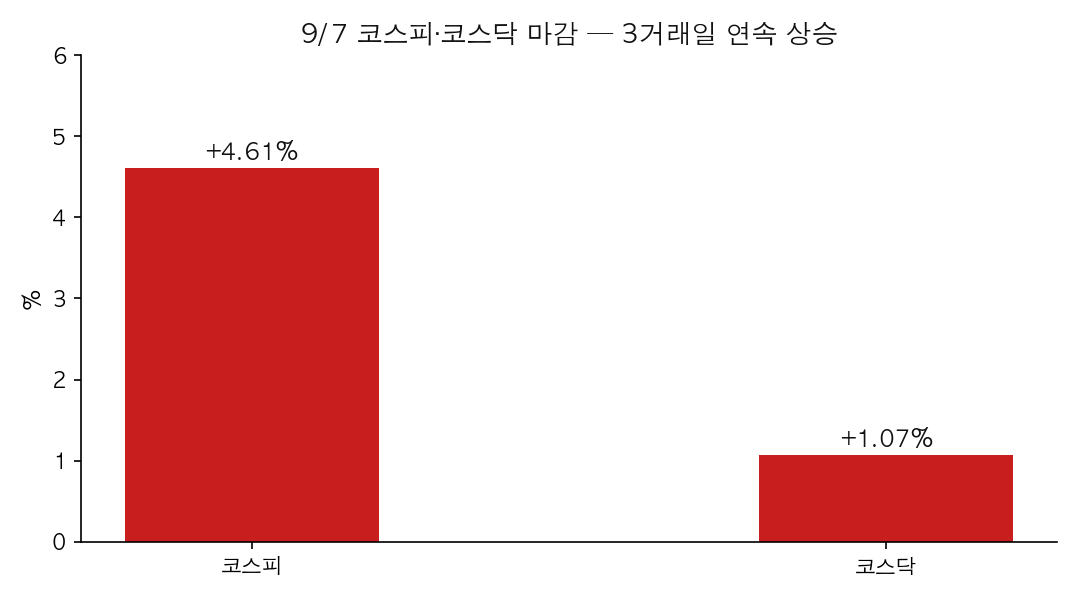
Sept. 7: KOSPI and KOSDAQ rallied for a third consecutive session
The gain came not from U.S. equities but from semiconductor strength and AI enthusiasm. Samsung Electronics (+5.68%), SK Hynix (+8.26%), and Hanmi Semiconductor (+4.57%) all surged. Nvidia's CEO Jensen Huang amplified the mood, posting on social media on September 6: "From ChatGPT to Astra took four years. AGI has arrived. We will deploy 400,000 GPUs next." The vision of accelerating chip demand drove the rally.
Investor flows supported the momentum. Foreign investors placed net buy orders of 2.586 trillion won. Institutional investors added 2.650 trillion won. Retail investors sold 6.837 trillion won. This marked the third consecutive session of coordinated foreign and institutional buying. Goldman Sachs maintained its KOSPI target of 12,000 points, citing deepening NAND supply scarcity. The thesis: expanded AI data-center investment would continue to strain memory-chip availability.
The won moved opposite to the equity index. USD/KRW fell 9.6 won, or 0.71%, to 1,340.5 (3:30 p.m. local time). Strong equities but a weakening currency—a divergence worth noting.
Asia broadly participated in the rally
Japan's Nikkei 225 climbed to 66,399.84, up 2.12%. SoftBank Group (+11.22%), Kioxia Holdings (+9.31%), and Tokyo Electron (+4.73%) led the AI and semiconductor upside. China's Shanghai Composite edged higher to 3,932.70, up 0.07%, but faced headwinds. Chip and AI names strengthened, but banking and insurance stocks softened after the government announced 54 billion dollars in capital support for state-owned banks and insurers—a move some read as a signal of stress, not confidence.
Taiwan's Taiex finished strong at 47,326.27, up 1.67%. TSMC gained 2.07%. UMC (+10.00%) and MediaTek (+7.81%) posted outsized gains. Hong Kong's Hang Seng, by contrast, fell 0.93%—the only major regional index to decline.
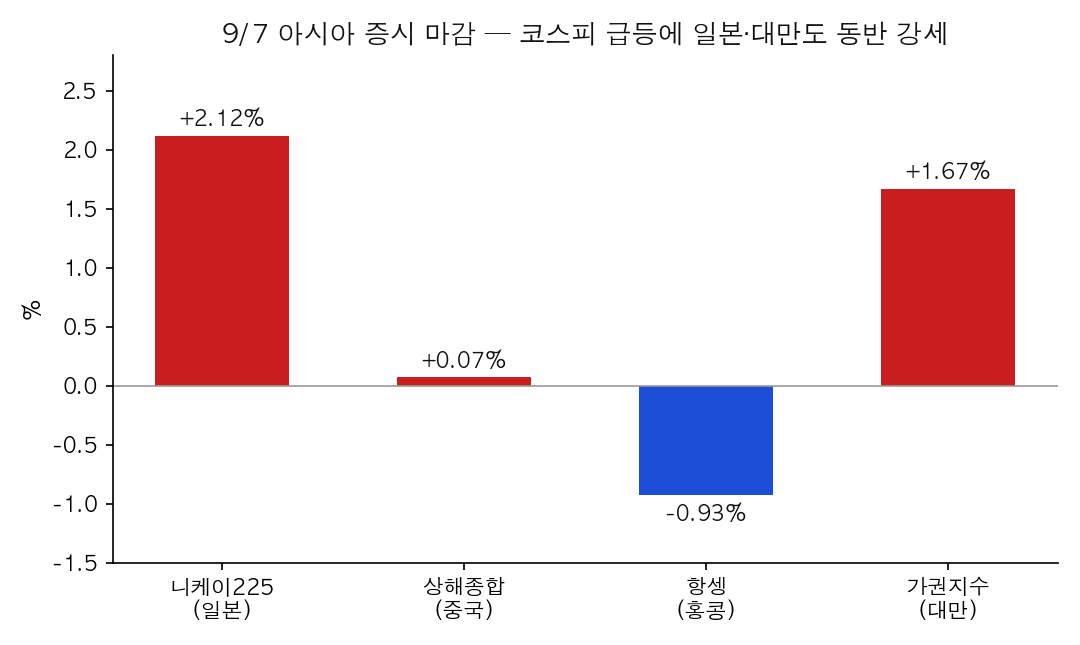
Sept. 7: Asian equities rallied in tandem, driven by semiconductor and AI optimism
What to watch in the sessions ahead
First: momentum and exhaustion. A 4.61% one-day jump on top of a two-session winning streak raises questions about profit-taking and reversal risk. Short-term overbought readings have appeared in several indices.
Second: the staying power of semiconductor strength. Monday's Korea rally rode on U.S. chip-stock momentum while American markets were closed. Tonight, U.S. bourses reopen. Whether semiconductor and foundry names hold their gains—or if rate concerns resurface—will shape the next move for Asia.
Third: August U.S. CPI, due September 11. Market debate centers on core CPI: does it print 0.2% or 0.3%? The employment surprise already lifted rate-hike odds. A hot inflation number could solidify that shift; a cool one might allow officials to pause. El-Erian has argued the Fed will be the only central bank not raising in September, a contrarian view. Consensus fractures here.
Fourth: the Korean won. Despite Monday's equity surge, USD/KRW weakened—a reversal of the typical inverse relationship. This reflected exporters selling dollars and yen weakness. If rate-hike fears resurface, dollar demand could strengthen, testing the won's resilience.
Within sectors, watch power and energy alongside semiconductors. Doosan Enerbility (+10.98%) and Doosan Engineering (+11.30%) jumped on news that a major U.S. project would include eight nuclear units and that Doosan would build a combined-cycle facility. Whether this momentum spreads or recedes as semiconductor mega-cap gravity reasserts itself remains to be seen.
The bottom line
Friday's employment surprise rattled U.S. markets and lifted rate expectations. The three major indices fell. Yet the Philadelphia Semiconductor Index surged nearly 3%, as NAND supply tightness and GPT-6 momentum outweighed macro concerns. That chip strength bridged the U.S. Labor Day holiday and drove Korea's KOSPI up 4.61% on Monday. Ahead lies a test: can the semiconductor thesis hold through a rate-conscious, CPI-focused week, or does equity caution resume? The next 48 hours will answer that question.
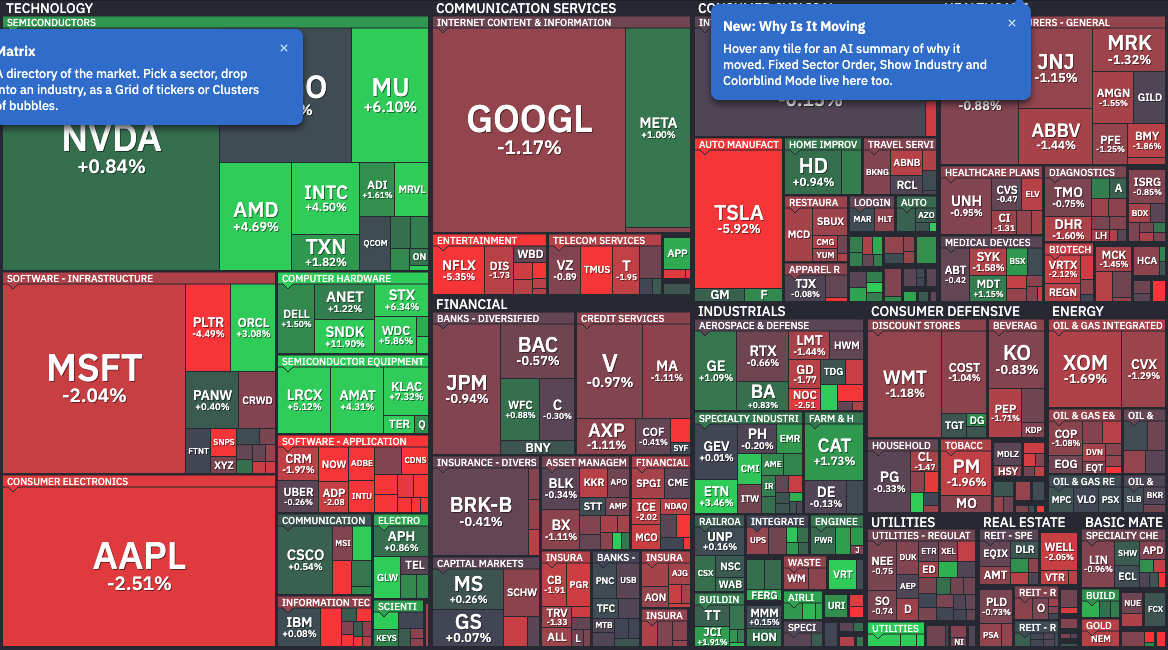
Sept. 4, U.S. time: S&P 500 sector heatmap. Green = gains, red = losses (Finviz, U.S. color convention)
This article is for informational purposes. It is not investment advice, nor does it constitute a recommendation to buy or sell any security. All investment decisions and their outcomes rest with the individual investor.
#KOSPI #KOSDAQ #SemiconductorIndex #Philadelphia #SOX #SKHynix #Samsung #Micron #Intel #AMD #TSMC #Nvidia #OpenAI #GPT6Astra #Nikkei #Shanghai #Taiex #HangSeng #USEmployment #FedRate #TreasuryYields #DollarIndex #Semiconductor #MemoryChip #DataCenterAI #Korea #AsiaMarkets
댓글
댓글 쓰기