Qualcomm shares jumped 5.02% during U.S. market trading on September 8, 2026, reaching $177.21. The move followed an early-morning announcement that Qualcomm and Amazon Web Services (AWS) would jointly develop custom semiconductors for AI datacenters across multiple generations of products.
The gain came with a twist: Qualcomm granted Amazon warrants to purchase up to 25 million shares—worth roughly $4 billion at current prices. Why would a company best known for smartphone processors suddenly make headlines in datacenter chips, and at such a steep price? The answer unfolds in stages.
Custom AI Chips: Qualcomm Plays Catch-Up
Big Tech's shift away from Nvidia GPU dependency has been underway for years. The winners so far: Broadcom and Marvell. Marvell sealed a custom-chip agreement with Google in August worth up to $12.2 billion in share-purchase rights. Google had relied mainly on Broadcom before that. Meta, Microsoft, and Amazon have all begun splitting custom-silicon contracts among multiple partners—a deliberate diversification play.
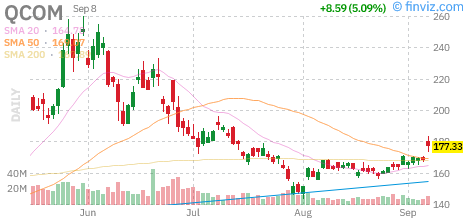
Qualcomm is the latecomer. At its investor day in June, the company unveiled its Dragonfly AI 200, AI 250, and AI 300 lineups for datacenters—the first public showing of this roadmap. Today's Amazon agreement represents the first time a major customer name has been attached to those products. Notably, Broadcom shares also rose 3% to $367.10 the same day. The fact that a rival's stock climbed alongside suggests the market read this as validation that the custom-silicon category itself is expanding, not that Qualcomm has taken Broadcom's share.
What Exactly Did the Companies Announce This Morning?
Qualcomm and AWS announced a multi-generational collaboration to co-develop custom silicon optimized for large-scale AI inference workloads. The partnership includes 1.6 terabits-per-second optical connectivity. Qualcomm will also leverage AWS infrastructure and Amazon Bedrock to accelerate chip design.
Qualcomm CEO Cristiano Amon framed the deal as a response to accelerating AI demand: "As AI scales, datacenter infrastructure will need greater performance and efficiency across both computing and connectivity." AWS VP Prasad Kalyanaraman called it a partnership to "push the boundaries of what's possible."

Why Give Amazon $4 Billion in Stock?
The real headline isn't cash—it's equity. Qualcomm issued Amazon warrants to purchase up to 25 million shares at $161.26 per share, exercisable through September 2036. At today's stock price, that represents roughly $4 billion in potential value.
The shares don't transfer all at once. According to Qualcomm's SEC filing, vesting is tied to "execution of the commercial arrangement" and Amazon's commitment to purchase up to $60 billion worth of Qualcomm server processors. The practice of issuing equity to secure long-term partnerships is established in semiconductors. Marvell used the same structure with Google (up to $12.2 billion in stock value). Unconventional for most industries, but not unprecedented here.
Will This Deal Actually Pay Off for Qualcomm?
The upside is clear. Qualcomm has worked to shed its "smartphone company" label for years. This agreement puts the world's largest cloud provider's name on Qualcomm's roadmap. CEO Amon has laid out ambitious targets: non-phone revenue of $40 billion by fiscal 2029, and datacenter revenue growing from an estimated $5 billion in fiscal 2027 to $15 billion by fiscal 2029.
But the announcement carries a notable gap. It includes no committed volumes, no revenue guidance, and no timeline for actual delivery. A strategic customer name is positive; whether it turns into material revenue remains unclear.
How Is Qualcomm's Core Business Faring?
Today's news overshadowed Qualcomm's actual quarterly results, which merit a second look. Fiscal Q3 revenue of $9.95 billion beat expectations, but segment performance showed sharp contrast:
| Segment | FQ3 Revenue | Year-Over-Year |
|---|---|---|
| Handset | $5.09 billion | −20% |
| Automotive | $1.59 billion | +61% |
| IoT | $1.83 billion | +9% |
Handset revenue has fallen for five straight quarters, offset by automotive, which has now posted 23 consecutive quarters of double-digit growth. Non-GAAP diluted EPS of $2.21 fell 20% year-over-year and slightly missed consensus estimates. It was a quiet quarter on the earnings front—which is why the Amazon announcement hit harder.
Where Does Valuation Stand?
Qualcomm's current P/E sits at 19.6x, and today's market cap of $189.7 billion amounts to roughly one-ninth of Broadcom's $1.755 trillion valuation. JP Morgan raised its Qualcomm price target to $265 in June—up from $160—ahead of the investor day, betting Amon would unveil aggressive datacenter revenue goals. He did: the path from a guided $5 billion in fiscal 2027 datacenter revenue to $15 billion by fiscal 2029. Today's Amazon deal appears to be the market's first confirmation that roadmap is moving off the drawing board.
What to Watch From Here
Today's surge hinged on a single fact: a major cloud provider's name is now real. Handset revenue is shrinking; automotive and IoT are holding the line. Now there's a new pillar. But amounts and timelines are absent. Real revenue recognition may still be months or quarters away.
Watch Qualcomm's next earnings report. Two things matter: whether datacenter revenue appears as an actual line-item number, and whether the next warrant vesting condition (proof of commercial execution) becomes public. Those two data points will tell whether today's rally reflects substance or optimism.
A U.S.-listed security. This article is factual analysis, not a buy or sell recommendation. Investment decisions and outcomes rest with the individual.
#Qualcomm #QCOM #Amazon #AWS #AI #Semiconductors #CustomChips #Broadcom #Marvell #Datacenters #Amon #Warrant #StockInFocus #USMarkets #Nasdaq
댓글
댓글 쓰기