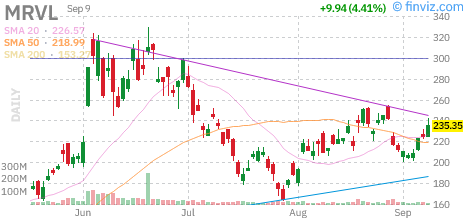
Marvell (MRVL) jumped 4.37% on September 9, reaching $235, after CEO Matt Murphy appeared on CNBC's "Mad Money" with Jim Cramer and substantially raised the company's revenue outlook. The stock has climbed more than 240% over the past year.
Marvell wasn't the only gainer. U.S. optical-networking and AI-chip stocks rallied broadly, though Marvell registered one of the sharpest moves.
Why the Cramer appearance mattered
Murphy raised fiscal 2025 guidance to roughly $12 billion in revenue and fiscal 2026 guidance to approximately $18 billion—a significant step up from earlier projections.
More than $1.5 billion of FY2026 revenue is expected to come from data centers. In 2023, that segment generated $2 billion, underscoring the dramatic transformation taking shape. Murphy attributed the outlook partly to long-standing relationships with major customers like Google and Amazon.
Numbers alone don't produce rallies this sharp
A guidance raise might seem to justify a 4.37% move, but context from the past few months tells a fuller story.
| Date | Event | Details |
|---|---|---|
| March | Nvidia investment | $2 billion investment; inclusion in NVLink ecosystem |
| August | Google contract | Warrant to purchase up to 58.97 million shares at $206.58 per share |
| September | Guidance raise | FY2025: $12 billion; FY2026: $18 billion |
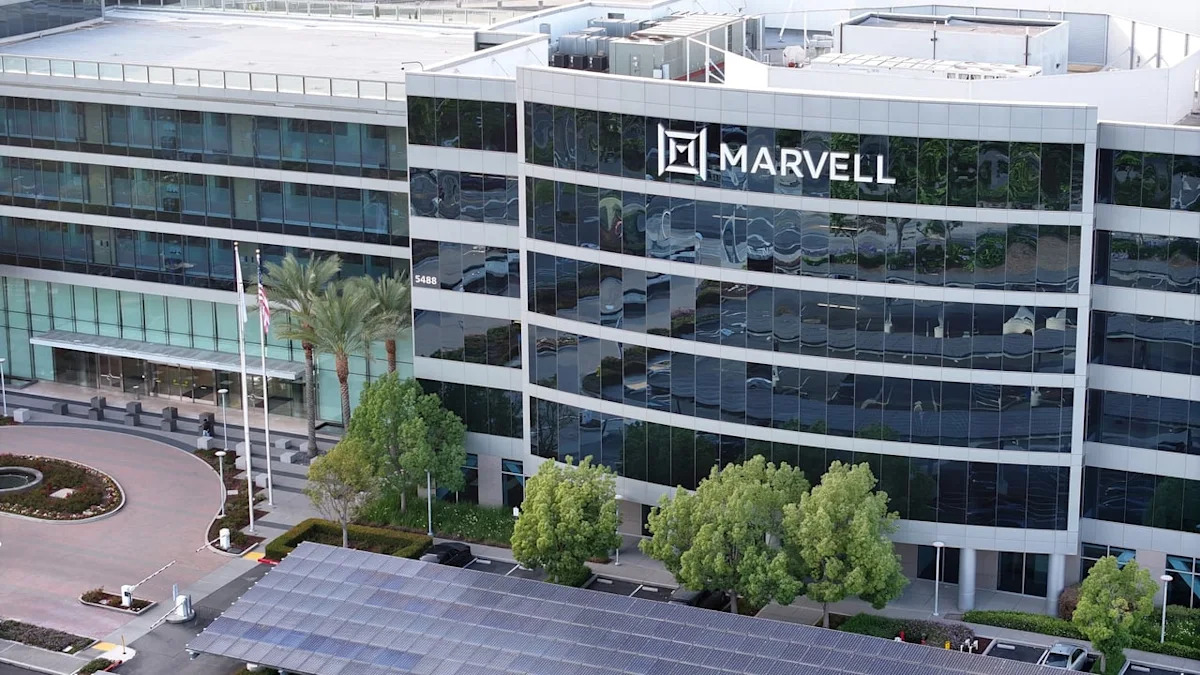
Why would Nvidia invest in a custom-chip company that could compete with its own GPUs? The answer is straightforward. Hyperscalers have committed to using both Nvidia GPUs and custom-designed chips—like Google's TPU—alongside each other. Marvell is the company helping them design and manufacture those chips. Broadcom captured this market first; Marvell is now establishing itself as the second major player.
Will these wins translate into sustainable growth?
Consider the Google contract. It includes warrants, which means potential share dilution remains a factor until Google actually exercises them. But the structure favors Marvell: the terms become most advantageous when Google continues placing orders. For the company, this is primarily a long-term customer lock-in mechanism.
The Nvidia investment works similarly. The $2 billion matters less than what accompanies it: Marvell's chips now sit atop Nvidia's ecosystem standard, NVLink. This integration makes it far easier for customers to combine Marvell chips with Nvidia equipment. The risk, however, is concentration. As revenue clusters among a handful of major customers, any strategic shift by one of them poses a proportional threat.
Is the stock overvalued at this level?
With a gain exceeding 240% over the past year, the question is warranted. Yet analyst sentiment tells a different story. The consensus rating among 44 analysts tracked by FactSet is "strong buy," and the average price target is $284.80—more than 27% above the current price. When targets exceed the current level, it signals the market majority doesn't view current valuations as already stretched. That said, targets are forecasts, not certainties. A move of this magnitude can attract profit-taking within days.
In March, the stock fell nearly 10% following earnings despite solid numbers, illustrating that Marvell trades on the expectation that results will exceed guidance, not merely meet it. Whether today's 4.37% gain holds depends on next quarter's ability to prove this new guidance credible.
Where Marvell stands now
Marvell is a company whose future rests heavily on one or two major customers. So far, that bet is working. The company projects with apparent confidence. But analyst targets and earnings expectations are already elevated. The critical test arrives with next quarter's results: whether data-center revenue growth actually matches management's claims. If it falls short, the stock could reverse sharply in a day, as it did in March.
The next catalyst is Marvell's next earnings report. Whether data-center sales growth aligns with the company's $18 billion FY2026 projection will determine whether this rally has lasting momentum.
U.S.-listed stock. This article is factual analysis, not a buy or sell recommendation. Investment decisions and their outcomes rest with the reader.
#Marvell #MRVL #MarvellStock #USStocks #Nasdaq #Semiconductors #AIChips #DataCenters #Nvidia #Google #CustomChips #OpticalNetworking #SemiStocks #USMarkets #StockInFocus #Surges #AIChip #Hyperscalers #JimCramer #MattMurphy
댓글
댓글 쓰기