Overnight (Sept. 28, U.S. time), the three major U.S. indices all closed lower. The driver was straightforward: Iran proposed a seven-day plan to reopen the Strait of Hormuz. President Trump rejected the proposal over the weekend.
Oil surged and Treasury yields followed. When energy prices and rates rise together, equity markets bear a double burden—higher inflation and borrowing costs hit at once. KOSPI shed 2.70% on Monday, closing at 6,889.74. What to watch today: whether Seoul extends yesterday's losses or absorbs the overnight moves.
U.S. index closes: Dow -0.67%, Nasdaq -0.92%, S&P 500 -0.77%

New York Stock Exchange
The Dow Jones Industrial Average fell 346.90 points, or -0.67%, to 51,481.51. The Nasdaq Composite dropped 248.34 points, or -0.92%, to 26,820.38. The S&P 500 declined 59.72 points, or -0.77%, to 7,683.69.
All three fell, though declines were modest. The Dow held up best; Nasdaq took the worst hit. That distribution tells the story: growth and technology stocks, which are most sensitive to rising rates, absorbed the largest pressure.
Boeing plummeted 6.9% on the day. The Federal Aviation Administration delayed certification of the 737 MAX 10 due to unresolved software issues under review. The news landed hard. Individual stock moves dominated broader weakness.
Philadelphia Semiconductor Index (SOX): NVIDIA gains while Intel stumbles
Data center GPU (reference image)
The Philadelphia Semiconductor Index fell 2.6%. The semiconductor ETF (SOXX) also declined roughly 2%. When oil and yields rise together, semiconductor stocks typically feel pressure first—valuation multiples contract in higher-rate environments. Last night was no exception.
Yet NVIDIA alone rose 1.68% to $228.86. The company announced an additional $150 billion to its share buyback authorization, bringing the total program to $235 billion—the largest increase on record. Markets interpreted the move as a signal of strong cash position and operational confidence.
Intel, by contrast, fell more than 5%. Firms with heavy capital expenditure obligations react more sharply to rate increases. Within the same sector, NVIDIA and Intel traced opposite paths in a single session.
SK Hynix ADRs' overnight movements remain unconfirmed. Morning brokerage research will provide clarity. We decline to speculate on numbers we cannot verify.
Rates, oil, and the Korean won: the variables that matter for Seoul
Oil production facility (reference image)
The U.S. 10-year Treasury yield rose 0.06 percentage points to 5.24%. On a typical day, rates move 0.01-0.02 points. This move was three to four times larger.
Crude oil moved even more sharply. West Texas Intermediate crude jumped as much as 4% intraday, reaching $96 per barrel—its highest level in roughly two weeks. Brent crude rose above $108 per barrel. The Strait of Hormuz channels a substantial portion of global oil trade. One collapsed negotiation sent crude surging.
Rising oil prices flow through the Korean market via two channels: through inflation and monetary tightening (higher rates), and through direct refining and chemical sector input costs. The latter compounds the challenge—sudden 4% daily crude swings disrupt margin forecasts and production planning across the energy value chain.
Overnight: Asia's broader market picture

Tokyo Stock Exchange interior (reference image)
Asian equities were under pressure before U.S. cash markets opened. KOSPI fell 191.18 points, or -2.70%, to 6,889.74. Japan's Nikkei 225 declined 486.58 points, or -0.73%, to 65,877.62. China's Shanghai Composite fell 64.75 points, or -1.67%, to 3,823.62. Hong Kong's Hang Seng stood alone with a +0.61% gain.
Taiwan was closed for Teachers Day; there was no session.
| Index | Close | Change |
|---|---|---|
| KOSPI (9/28) | 6,889.74 | -2.70% |
| Dow Jones (9/28 U.S.) | 51,481.51 | -0.67% |
| Nasdaq (9/28 U.S.) | 26,820.38 | -0.92% |
| S&P 500 (9/28 U.S.) | 7,683.69 | -0.77% |
| Nikkei 225 (9/28) | 65,877.62 | -0.73% |
| Shanghai Composite (9/28) | 3,823.62 | -1.67% |
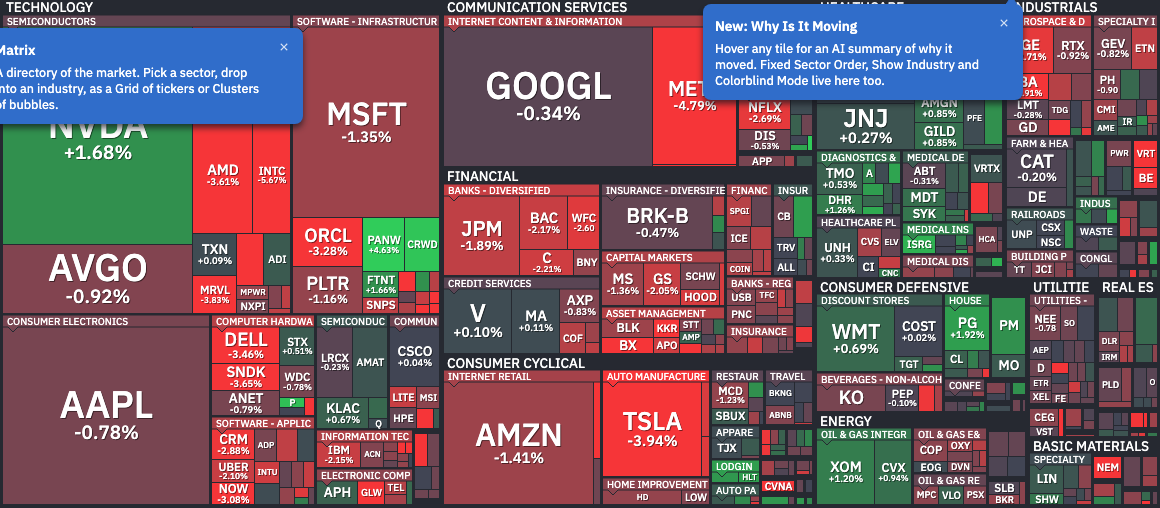
U.S. market heatmap (S&P 500) from overnight session. Green=gainers, red=decliners. (Finviz U.S. color convention)
What to watch in Seoul today
Korea Exchange building (reference image)
KOSPI already sits 2.70% lower from yesterday. First item to monitor: whether Seoul's open absorbs tonight's moves or extends the decline. U.S. index losses were less than 1%, but rates and oil both spiked. How that translates into Korean investor flows bears watching.
Second: the semiconductor split. The SOX index fell 2.6% overall, yet NVIDIA rose alone on share buyback news. Whether Korean semiconductor leaders follow the sector decline or respond to NVIDIA's signal will matter.
Third: energy and chemicals. Brent crude has reached its highest level in roughly two weeks. Refining margins and input cost pressures could emerge as a market theme today.
Finally, the Korean won. Yesterday, the KRW/USD rate weakened 7.6 won to 1,365.1. Overnight, the dollar also strengthened in New York as longer rates climbed. The Dollar Index rose from 100.97 to 101.18. Whether won weakness persists and how it affects foreign investor flows will be a variable to track.
Summary
In one sentence: diplomatic negotiations collapsed. Oil and rates surged together. Equity markets absorbed the shock in measured portions. The Dow, Nasdaq, and S&P 500 each fell less than 1%. Yet within semiconductors, the NVIDIA-Intel gap widened sharply.
KOSPI already sits 2.70% lower than Monday's close. Seoul faces tonight's moves on top of that baseline. Whether today brings further losses, stabilization, or recovery will hinge on opening-hour flows. Hormuz Strait negotiations could also return to the table this week—another variable to monitor.
Investment decisions and outcomes remain your responsibility.
댓글
댓글 쓰기