[Korea Market Close] KOSPI Plunges to 6,889 as Treasury Yields Breach 5%—Samsung Electronics Slides While HLB Surges on FDA Approval
On September 28, 2026, KOSPI closed at 6,889.74, down 191.24 points or -2.70%, marking its first decline in five trading days. Yet on the same day, twelve HLB-affiliated companies on KOSDAQ hit daily limits. One index segment shed over 5%. The other surged 30%. The market split dramatically within a single session.
The explanation is straightforward. U.S. Treasury rates, not company-specific news, drove the broad index. Individual company announcements, not macro trends, moved individual stocks. The two forces operated independently. This created the unusual picture of a falling index accompanied by a dozen limit-up names.
U.S. Treasury Yields Moved Alone During the Holiday
KOSPI was closed for four trading days over the Chuseok holiday. In that interval, the 10-year U.S. Treasury yield climbed to 5.22%. The 30-year yield exceeded 5.5%—the highest level since 2007. Rising Treasury yields increase borrowing costs for companies that rely on debt to fund growth.
Consider the numbers. CoreWeave, a data-center infrastructure provider, disclosed in an SEC filing that a 100 basis point increase in rates raises annual interest expense by approximately $30 million. Oracle reportedly sent a force majeure notice to its New Mexico data-center developer on the 24th, citing rising project costs. The implication: AI data-center build-out may slow.
Korea's bond market moved in tandem. The 3-year government bond yield rose 11.3 bp to 4.119%. The 10-year yield climbed 14.7 bp to 4.539%. The USD-KRW pair hit 1,365.1, up 8.1 won. Higher rates and a weaker won reduce foreign investors' incentive to hold Korean stocks at this juncture.
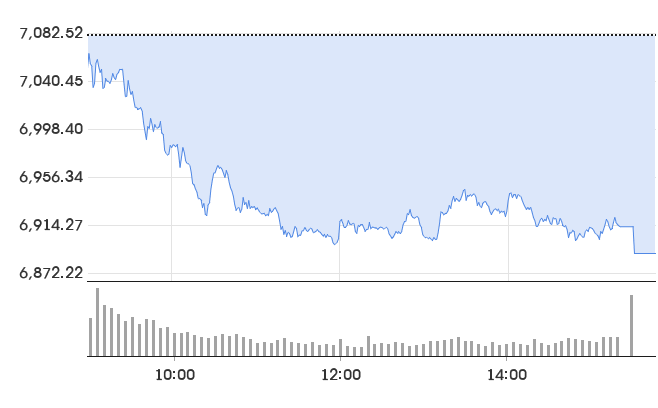
KOSPI recent daily (Naver Finance)
Foreign Investors and Institutions Sold; Retail Investors Bought
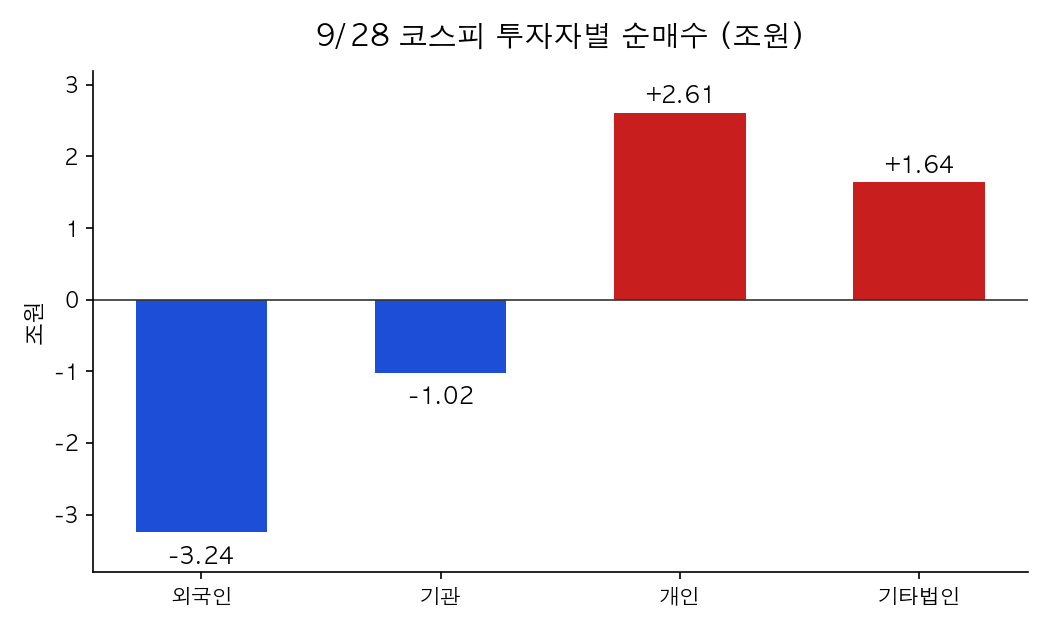
Investor flows on KOSPI tell the story. Foreign investors net sold KRW 3.24 trillion. Institutions net sold KRW 1.02 trillion. Foreign selling extended a two-day streak. Institutional selling reversed after one day of buying. Retail investors, by contrast, net bought KRW 2.61 trillion—their first purchase in five sessions. Other corporations bought an additional KRW 1.64 trillion.
Over KRW 4 trillion left the market. Retail and corporate buyers absorbed nearly all of it. Whether this reflects bargain-hunting or passive participation is unclear from a single day's data. Still, retail purchasing at this volume on a day the index fell 2.70% bears watching.
Direct compilation and analysis
Samsung Electronics and SK Hynix Drag Index Lower
KOSPI's top-two firms by market cap fell sharply. Samsung Electronics dropped 5.43%. SK Hynix slid 5.05%. The pair account for a material share of today's index decline. Higher Treasury yields sparked worries about AI data-center capex velocity—a concern that immediately hit semiconductor bellwethers.
SK's holding companies faced an additional headwind. SK Square fell 7.56%, while SK Holdings declined 5.40%. The weighing factor was news that Solidigm, an indirect subsidiary, may pursue a U.S. IPO. An IPO reprices subsidiary equity in the open market, potentially diluting parent-company shareholder value. This remains speculative; the market is pricing in a possibility rather than a decision.
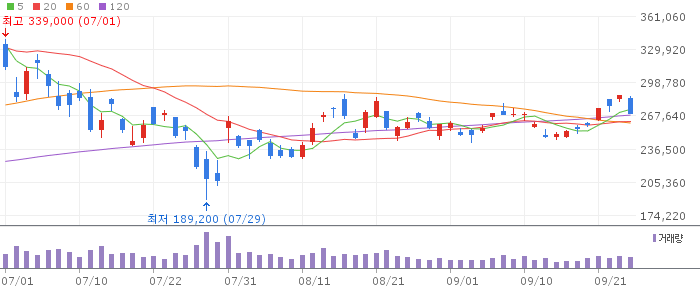
Samsung Electronics recent daily (Naver Finance, red=up/blue=down)
Solar and Construction Rally on Separate Tailwinds
Solar plays moved in the opposite direction. Hanwha Solutions surged 14.21%, while OCI Holdings jumped 10.92%. U.S. module and polysilicon prices have risen. Analysts flagged that tariffs imposed under Section 232 starting in December could widen gains further. HD Hyundai Energy Solution (+4.16%) and OCI (+3.64%) joined the rally.
Construction shares also surged. Daewoo E&C rose 7.11%, Hyundai E&C gained 2.89%, and GS E&C climbed 2.75%. Analysts attribute the strength to persistent optimism over data-center and nuclear-plant contract awards. Sector-wide, despite the index decline, chemicals led with a 3.20% gain, aligning with the infrastructure narrative.
KOSDAQ Defended by HLB Group Limit-Up Rally
KOSDAQ closed at 846.58, up 0.25%, extending a two-day rally—the opposite trajectory of KOSPI. HLB's U.S. subsidiary Elevate Pharma won FDA approval for Lipiktu, a cholangiocarcinoma treatment. The news rippled across the entire HLB group.
Twelve HLB affiliates—HLB Pharma, Csight, HLB Peps, HLB Biostep, HLB Innovation, Korean BNC, HLB Life Sciences, HLB, HLB Panajin, HLB Therapeutics, HLB Genex, and HLB Global—all closed at the daily limit (+29.8% to +30.0%). Cholangiocarcinoma is a rare malignancy of the bile ducts. Approximately 8,000 new cases are diagnosed annually in the U.S. HLB described this as the first instance a Korean drug or biotech firm has won FDA approval for an oncology candidate directly from the agency. The company aims to launch the drug in the U.S. in the fourth quarter.
KOSDAQ semiconductor stocks, by contrast, lagged. Equip makers tumbled: Wonkwang IPS fell 7.85%, Ujin Tech declined 5.20%, and Reno Industrial dropped 4.17%. The Treasury yield pressure again—it hit KOSDAQ's semiconductor names no less than KOSPI's.
A second tailwind lifted pharma and biotech broadly. The U.S. Commerce Department's Industrial Security Bureau announced that under Section 232 tariffs, rare drugs, cell therapies, and gene therapies will face 0% duties. The exemption takes effect on September 29. This means HLB's surge reflected not just the company-specific approval but also a sector-wide regulatory tailwind. Other biotech names—ImmunOnCia, Bynetex, and Alteo Genetics—rose alongside HLB.
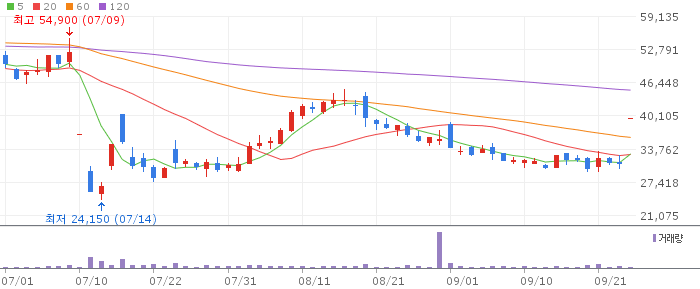
HLB recent daily (Naver Finance, red=up/blue=down)
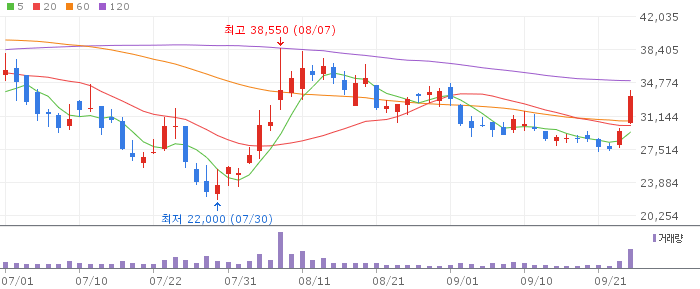
Hanwha Solutions recent daily (Naver Finance, red=up/blue=down)
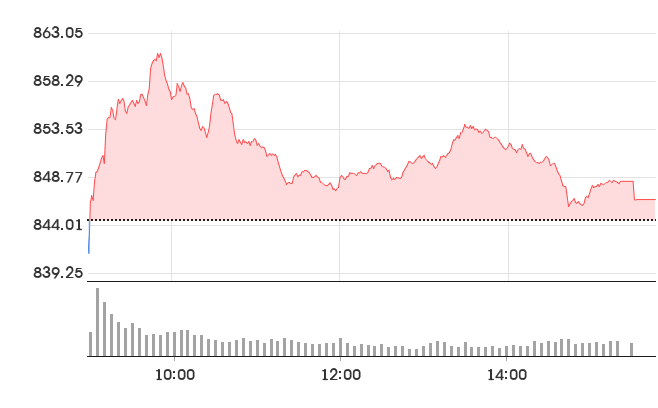
KOSDAQ recent daily (Naver Finance)
Market in Focus
| Item | KOSPI | KOSDAQ |
|---|---|---|
| Close | 6,889.74 | 846.58 |
| Change | -2.70% | +0.25% |
| Foreign investors | -KRW 3.24T | +KRW 0.46T |
| Institutions | -KRW 1.02T | -KRW 0.75T |
| Retail | +KRW 2.61T | +KRW 0.22T |
What to Watch
In one sentence: macro trends (Treasury yields) pushed the index down while company-specific news (FDA approvals, contract wins) lifted individual stocks. Two opposing forces worked the same market on the same day.
First to watch: U.S. Treasury yields. Whether they climb further above 5% or stabilize here will be decisive. Further rate hikes could extend pressure on semiconductor leaders. A reversal could recover some of today's losses. KOSPI held above 7,000 for five sessions before breaking down today. The next day or two will signal whether this is a correction or a trend shift.
When we covered KOSPI's rebound to 6,345 on September 24, we noted a pattern: the index and sector themes diverged sharply. Today saw that pattern repeat. Focusing solely on the index misses the broader picture. Today was a reminder of that fact.
This article is for informational purposes and does not constitute investment advice. Investment decisions and results are the reader's responsibility.
#KOSPI #KOSPIIndex #KOSDAQ #TreasuryYields #UST #SamsungElectronics #SKHynix #HLB #HanwhaSolutions #DaewooEC #CurrentAccount #WonDollar #ForeignSelling #InstitutionalSelling #RetailBuying #SolarTheme #ConstructionStocks #SemiconductorStocks #HLBGroup #Lipiktu #CholangiocarcinomaDrug #FDAApproval #CoreWeave #Oracle #Solidigm #SKSquare #MarketClose #KoreaMarketClose #DomesticMarket #ClosingData
댓글
댓글 쓰기