The KOSPI closed at 6,954.52 on September 8, down 40.87 points, or 0.58% from the previous day. In yesterday's report, retail investors sold for three consecutive days while the index still managed gains. Today was different. Retail selling stretched to a fourth consecutive session, and the index finally capitulated.
The decline was not gradual. The index climbed to 2.52% higher intraday, only to give back all those gains and close in negative territory. The intraday swing spanned 3.1 percentage points.
Morning gains evaporated by the afternoon close
The KOSPI opened at 7,045.79, up 0.72% from the prior close. It surged above 7,100 midmorning, reaching an intraday high of 7,171.52—a gain of 2.52% for the session.
OpenAI unveiled its new AI model, Astra, lifting semiconductor and AI-related stocks during the morning. Yet the strength did not hold.
After hitting its high, the index rapidly surrendered its gains. Late in the session, it turned sharply lower, sliding to an intraday low of 6,951.78 before closing at 6,954.52—some 217 points, or 3%, below the day's peak.
This marked the KOSPI's first decline in four trading days.
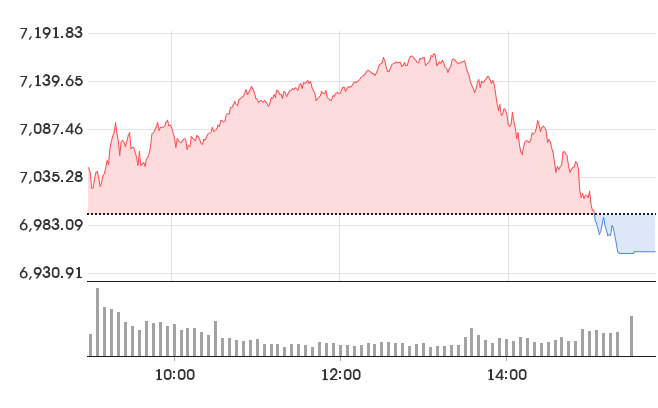
KOSPI daily chart, recent period (Naver Finance; red = up, blue = down)
Why retail investors have sold four days running
Today's flows showed retail investors net selling KRW 3.0331 trillion. Meanwhile, foreign investors net bought KRW 648.2 billion and institutional investors KRW 642.8 billion. Retail selling has now run four consecutive days, while foreign and institutional flows have aligned on four consecutive days of net buying.
The directions have been mirror images. For the previous three days, however, retail selling was outweighed by foreign and institutional buying, allowing the index to rise. Today proved different—the index finally broke in line with retail weakness.
Other corporate buyers net purchased KRW 1.7588 trillion, absorbing a substantial share of retail selling.
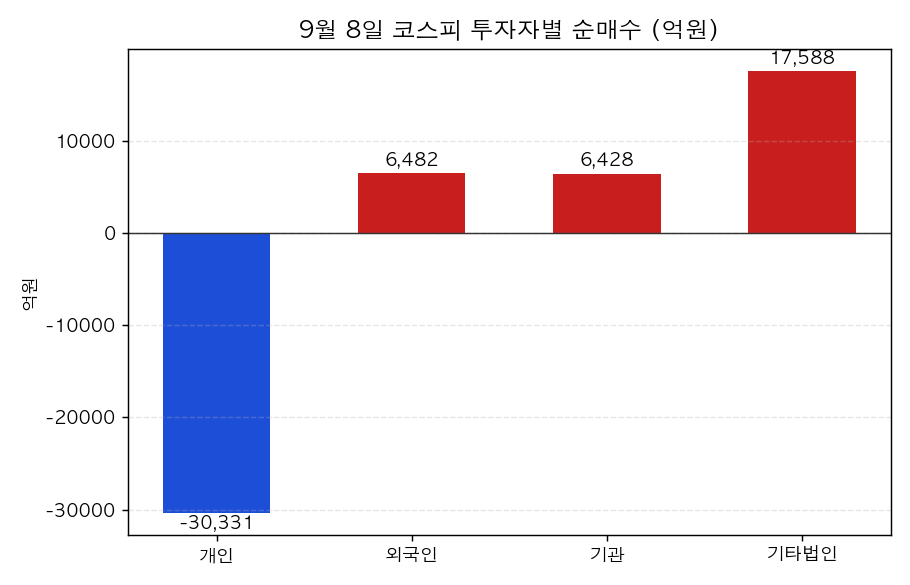
Direct compilation and analysis
Middle East geopolitical risk intensified as the backdrop. Yemeni Houthi forces attacked energy and infrastructure facilities in southern Saudi Arabia. International oil prices surged sharply during Asian trading. Compounding the move were U.S.-Canada trade tensions and caution ahead of U.S. inflation data due September 10–11 (local time). Multiple risk-off catalysts converged on a single day, dampening appetite for equities.
Winners: nuclear power; losers: robotics, batteries, auto stocks
The strongest theme today was nuclear power, buoyed by U.S. plans to build eight new reactors. Korea Electric Power Technology surged 16.60%. Orbix and Seonjeon Giftec both hit daily limit-up of +29.83% and +29.80%, respectively. Three nuclear-related names jumped sharply on the same day.
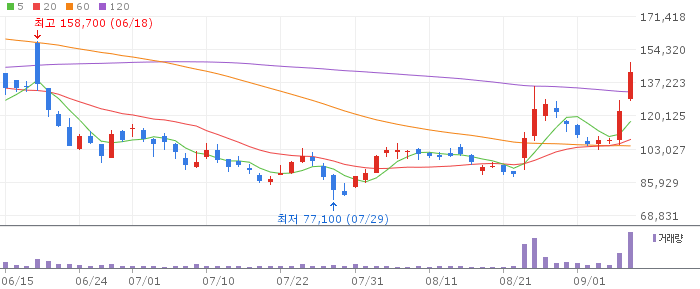
Korea Electric Power Technology daily chart, recent period (Naver Finance; red = up, blue = down)
Abortion and contraception names rallied on reports that the government is considering domestic approval of the medication mifepristone by year-end. Hyundai Pharmaceutical jumped 23.99%. Reports that domestic companies are in talks for U.S. investment in Alaska LNG operations triggered strength in steel-related small-caps; Shin Steel advanced 16.24%. Surging crude oil boosted refinery and gas-station operators. Copper prices hit all-time highs, lifting base metals.
Weakness was decisive. Robotics, autos and auto parts, and battery makers topped the decline list. Hyundai Motor fell 2.04%, Kia 2.34%, and Hyundai Mobis 3.94%. LG Energy Solution retreated 3.86% and Samsung SDI 2.03%. Samsung Electro-Mechanics dropped 5.78% amid MLCC weakness—the largest decline among top-cap KOSPI names.
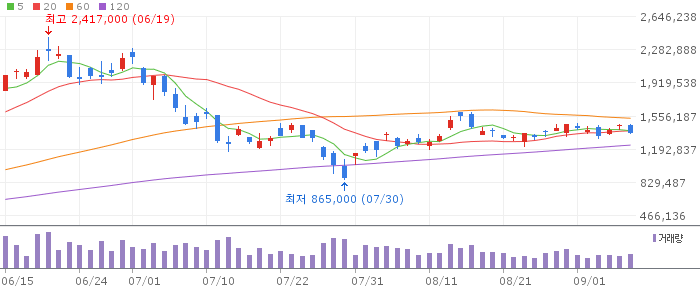
Samsung Electro-Mechanics daily chart, recent period (Naver Finance; red = up, blue = down)
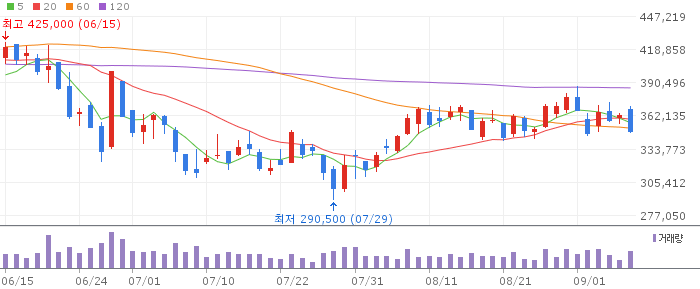
LG Energy Solution daily chart, recent period (Naver Finance; red = up, blue = down)
By sector, electric power and gas advanced 3.27%, construction 3.04%. IT services fell 3.21%, medical and precision equipment 2.10%, transportation and parts 1.80%. Most sectors closed lower. Only nuclear and construction posted clear gains.
KOSDAQ followed a similar pattern
The KOSDAQ closed at 811.88, down 10.31 points, or 1.25% from the previous day. The flow mirrored the KOSPI. It opened at 825.03 and climbed to 830.21 intraday—a gain of 0.98%. Late-session selling drove it down to 811.88.
Institutional investors net sold KRW 217.8 billion, marking a second consecutive day of selling. Retail investors net bought KRW 148.9 billion and foreign investors KRW 60.8 billion. Most sectors finished lower. Pharma and biotech (HLB −3.95%, Alteogen −3.15%) and batteries (Ecopro −1.70%) retreated. Robotics (Rainbow Robotics −3.35%, Robotis −5.80%) and semiconductors (Ujin Tech −3.42%, Goyoung −3.38%) all fell.
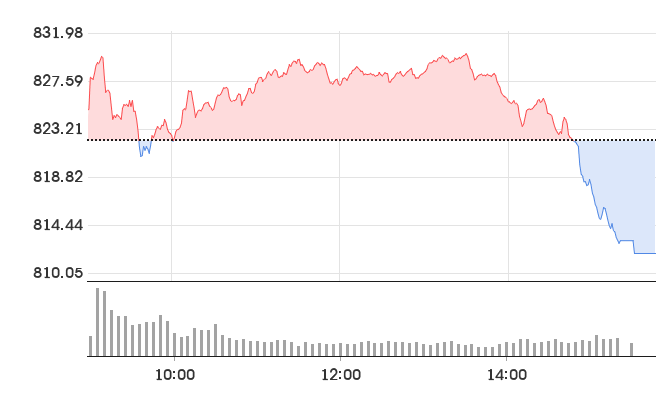
KOSDAQ daily chart, recent period (Naver Finance; red = up, blue = down)
Four names hit daily limit-up today
Bit and Electronics rose 30.00% to hit the daily limit after the government named it an implementing organization for the "AI Data Center and 6G Optical Parts Localization Project" led by the Ministry of Science and ICT and the National Information Society Agency. The Codi closed up 29.93% for a second consecutive limit-up on word of a KRW 30 billion convertible bond offering for subsidiary acquisitions. Nuclear plays Orbix (+29.83%) and Seonjeon Giftec (+29.80%), mentioned earlier, push the day's limit-ups to four total.
Stradvision rallied 19.22% after Arm added it to its Total Design for Physical AI ecosystem.
Twelve years of price action in context
Cases in which the KOSPI gives back a two-percentage-point intraday gain and closes negative are rare when viewed over a trailing twelve-year span. Intraday swings exceeding 3 percentage points typically occur when new news breaks during the session or when there is ample short-covering supply from prior rallies. Today both conditions aligned. Morning buying came on OpenAI's model launch. Afternoon selling followed Middle East headlines.
Four consecutive days of retail selling is not unusual in itself. The sequence is. For three of those four days, the index held. Only on the fourth day did it break. Foreign and institutional buying capacity did not evaporate overnight. A single external input—Middle East risk—tilted the balance.
What to watch next
The next inflection point arrives with U.S. inflation data on September 10–11 (local time). Its outcome will likely determine whether foreign and institutional net buying persists through the week's close. Also worth watching: whether Middle East developments continue to weigh on crude oil and thus risk sentiment.
See yesterday's report, KOSPI Nears 7,000 as Retail Sells Three Days Straight; Index Gains Three Days Running, for fuller context on how this week's flows have reversed.
This article is provided for informational purposes only and does not constitute a recommendation to buy or sell any security. Investment decisions and their outcomes are the reader's sole responsibility.
#KOSPI #KOSPIindex #KOSDAQ #KOSDAQindex #marketclose #koreanmarketclose #foreignnetbuying #institutionalnetbuying #retailnetselling #nuclearpower #KoreaPowerTech #Orbix #SeojeonGiftec #SamsungElectro-Mechanics #LGEnergySolution #HyundaiMotor #crudeoil #middleeastrisk #BitandElectronics #TheCodi #Stradvision #limitup #abortioncontraceptiontheme #mifepristone #HyundaiPharmaceutical #ShinSteel #steelsmallcaps #KOSPIoutlook #KOSDAQoutlook #marketsummary #todaysmmarket
댓글
댓글 쓰기