[Personal Finance] The Reverse Mortgage Payout Ceiling: At 75, Your Monthly Payment Is Fixed at 3.666 Million Won
I spent a long time staring at reverse mortgage payout tables and noticed something that stopped me cold. At age 75, the monthly payment is identical whether your home is worth 1 billion won, 1.1 billion won, or 1.2 billion won—exactly 3.666 million won. Add another 200 million won in home value and your check doesn't budge by a single won.
Monthly payouts have a built-in ceiling. Many people assume a more expensive home means a larger check. The numbers show otherwise.
All figures below come directly from the Korea Housing Finance Corporation's official payout examples, published on their website. These are lifelong fixed-rate payouts for standard homes—published by the corporation, not calculations I've made.
What's Your Monthly Payment?
Look at the table first. All figures are in units of 10,000 won monthly. For couples, the younger spouse's age determines the payout. If the husband is 70 but the wife is 60, you use 60. Many people miss this.
| Age | 300M won | 500M won | 700M won | 900M won | 1.2B won |
|---|---|---|---|---|---|
| 55 | 46.8 | 78.0 | 109.2 | 140.4 | 187.2 |
| 60 | 63.2 | 105.3 | 147.5 | 189.6 | 252.8 |
| 65 | 75.8 | 126.4 | 177.0 | 227.6 | 303.5 |
| 70 | 92.3 | 153.9 | 215.5 | 277.0 | 341.4 |
| 75 | 114.3 | 190.6 | 266.9 | 343.1 | 366.6 |
| 80 | 144.9 | 241.6 | 338.2 | 406.0 | 406.0 |
Korea Housing Finance Corporation monthly payout examples (lifelong fixed-rate, standard homes) · units of 10,000 won
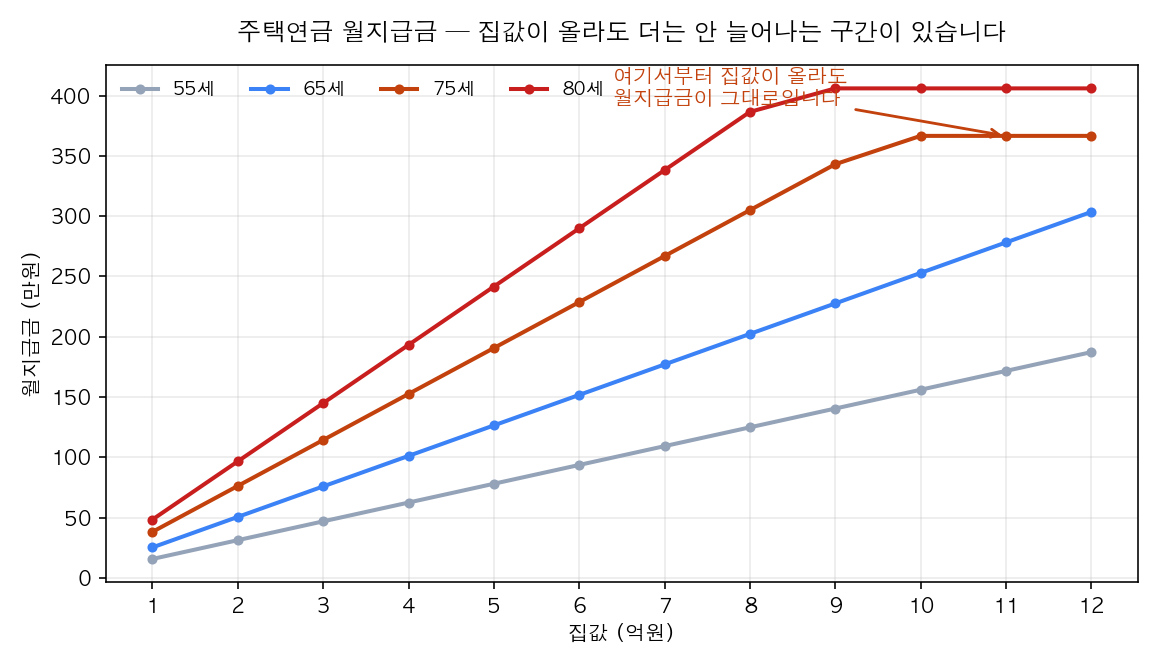
The highlighted cells show where the ceiling takes effect. At 80, any home above 900 million won yields a fixed 4.06 million won monthly—even at 1.2 billion won. At 75, the ceiling locks in at 3.666 million won for homes at 1 billion won and above.
The chart makes it clearer. Notice where the line flattens at the right end.
Author's compilation
The corporation doesn't explain why the ceiling exists. But the effect is stark: efficiency declines as home values rise. An 80-year-old with a 1.2 billion won home receives exactly 4.06 million won monthly—the same as an 80-year-old with a 900 million won home. Three hundred million won in extra home value generates zero additional income. That equity simply stays locked away.
When Should You Enroll?
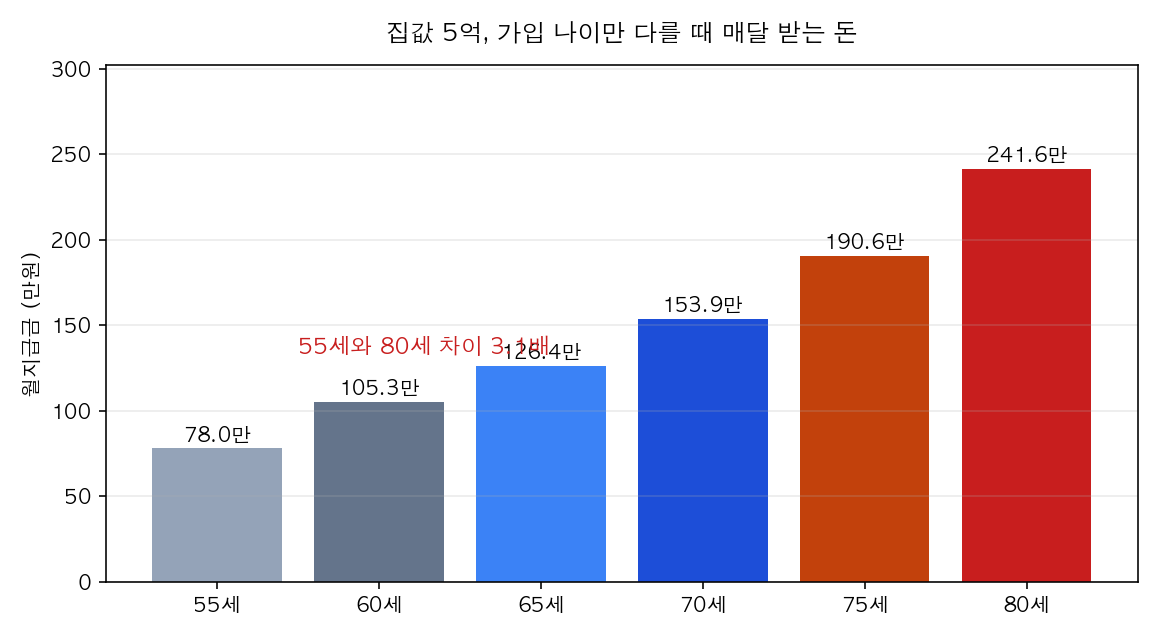
Hold home value steady at 500 million won and vary only age:
Author's compilation
Enrollment at 55 yields 780,000 won monthly. At 80, it's 2.416 million won. That's a 3.1-fold difference. Later enrollment dramatically increases monthly payments because the same home value is divided across a shorter remaining lifespan.
But delaying isn't automatically optimal. Enroll at 55 and draw for 25 years until 80, and you receive 234 million won total (780,000 won × 300 months). Enroll at 80 and draw for 10 years until 90, and you receive 289.92 million won total (2.416 million won × 120 months). Late enrollment produces more total lifetime income—but only if you don't need money for 25 years.
The real decision isn't about maximizing total payout. It's about when you actually need the income. Waiting until 80 doesn't make sense if you're short on cash at 65.
The Most-Missed Detail: Spousal Succession Requires Adult Children's Consent
This is the most critical detail—and it's rarely discussed.
When the account holder dies, payments stop immediately. The surviving spouse has six months from death to complete succession procedures to continue receiving income. This part is known. What follows usually isn't.
The process depends entirely on which collateral method was chosen at enrollment:
- Mortgage-lien method — The spouse must assume full ownership of the home. But the home is inheritance property, so consent from other heirs (typically adult children) is required. If the children refuse, the surviving spouse cannot continue receiving payments.
- Trust method — No ownership transfer is necessary. Only a succession application is required. No heir consent needed.
Even with good family relations, obtaining unanimous consent from multiple heirs within six months is daunting, especially in blended families. Choosing your collateral method casually at enrollment can leave your spouse's retirement dependent on your children's goodwill. Ask about this during your enrollment consultation—it matters enormously.
The succeeding spouse must independently report and pay inheritance tax, acquisition tax, property tax, and aggregate real estate tax if applicable. Continuing the pension isn't simply receiving a check; it carries tax filing obligations.
What If Home Values Decline? Do Children Inherit Debt?
This is the most common worry—and it's unfounded.
Author's compilation
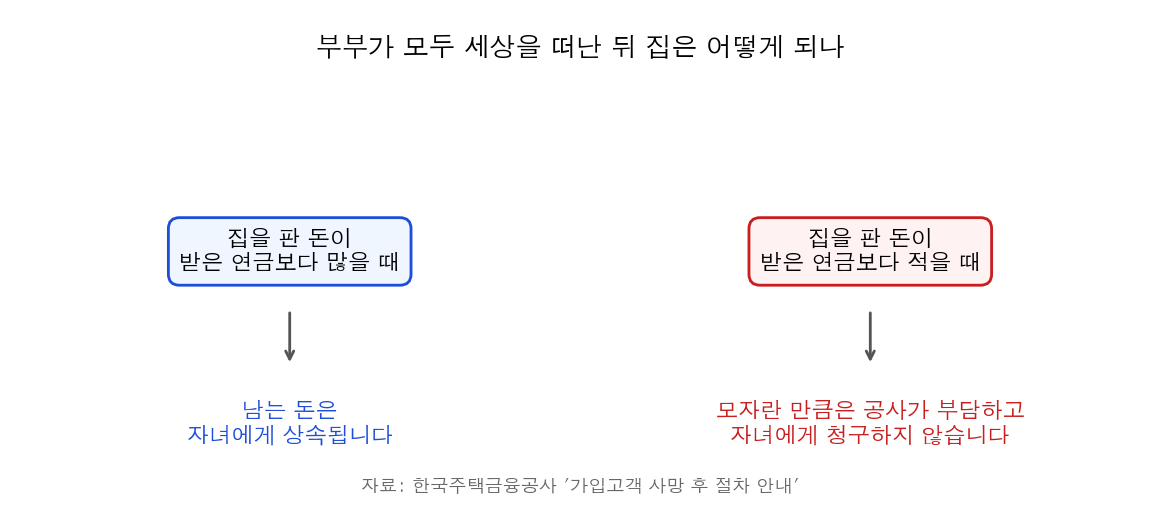
When both spouses pass, payments end and the corporation recovers its total disbursements by selling the home. Under the mortgage-lien method, sale occurs through court auction. Under the trust method, through public sale.
If the sale proceeds exceed total payouts, the remainder passes to heirs as inheritance. Conversely, if proceeds fall short, the corporation absorbs the loss—not the heirs. No debt passes to adult children, even if the home value halves.
Children who wish to keep the home can repay the debt directly. The corporation allows a negotiated period for either sale or cash repayment.
One important caveat: In the trust method, even if heirs repay the debt, title transfers to whoever is named as residual beneficiary in the trust agreement—potentially someone other than the party making repayment. Verify the beneficiary designation in your contract.
Tax Benefits
Property tax relief is commonly overlooked. Single-home households using the mortgage-lien method receive up to 25% base property tax reduction. Below 500 million won in official assessed value, the full 25% applies. Above that, property tax is calculated on a 500 million won base. This benefit runs through December 31, 2027.
Registration and local education taxes paid at enrollment are reduced up to 50%. However, if other property tax exemptions apply, only the larger benefit is granted—not both.
Summary
To enroll, one spouse must be 55 or older, and the home's combined official assessed value must not exceed 1.2 billion won.
Three things to remember: Monthly payments have a ceiling, so efficiency declines for high-value homes. If your spouse wants to continue receiving income, the mortgage-lien method requires adult children's consent—a choice at enrollment that later shapes your spouse's retirement security. And no debt passes to your children if property values fall; the corporation covers any shortfall.
All figures are direct from official corporation publications. Actual monthly payments are recalculated based on the home's market value or appraisal, not official assessed value. Use this table as a reference—verify your actual payment directly with the corporation.
Source: Korea Housing Finance Corporation (hf.go.kr)—monthly payout examples, succession procedures, and benefits pages. Terms and amounts are subject to corporation updates.
This article is for informational purposes only and does not constitute a recommendation to enroll in any specific financial product. Enrollment decisions and their outcomes remain your responsibility.
#Reverse Mortgage #Reverse Mortgage Payout #Reverse Mortgage Drawbacks #Death and Succession #Reverse Mortgage Eligibility #Reverse Mortgage Monthly Payment #Retirement Planning #Retirement Funds #Korea Housing Finance Corporation #Reverse Mortgage Enrollment #Trust Method Reverse Mortgage #Spousal Succession #Property Tax Reduction #Living on Annuity #Retirement Preparation #Senior Financial Planning #Parents' Retirement #Reverse Mortgage Continuation #Reverse Mortgage Settlement #Retirement Living Expenses #What Is a Reverse Mortgage #Reverse Mortgage and Age #Home Value and Payout #Inherited Property #Spousal Inheritance #Reverse Mortgage Taxation #Retirement Planning #Pension Comparison #Personal Finance
댓글
댓글 쓰기