[U.S. Market Brief] Why Apple Rose 3.56% When Treasury Yields Hit 19-Year Highs and Oil Broke Past $100
The three major U.S. indices declined for a fourth straight day as of September 10 (U.S. time). International oil prices topped $100 per barrel again. The 30-year Treasury yield climbed to its highest level in 19 years. Against this backdrop, Apple alone advanced—by 3.56%.
The KOSPI will track these overnight moves today. Its direction remains uncertain. The outcome hinges on two factors: whether large-cap semiconductor stocks hold their ground, and whether elevated oil prices and Treasury yields extend the selloff.
U.S. Three-Index Decline Extends to Fourth Day
The Dow Jones Industrial Average fell 316.56 points (-0.60%) to 52,064.10. The S&P 500 dropped 44.66 points (-0.58%) to 7,591.70. The Nasdaq Composite declined 171.62 points (-0.65%) to 26,081.73.
Four days without relief. Losses that began late last week carried into this week without pause.
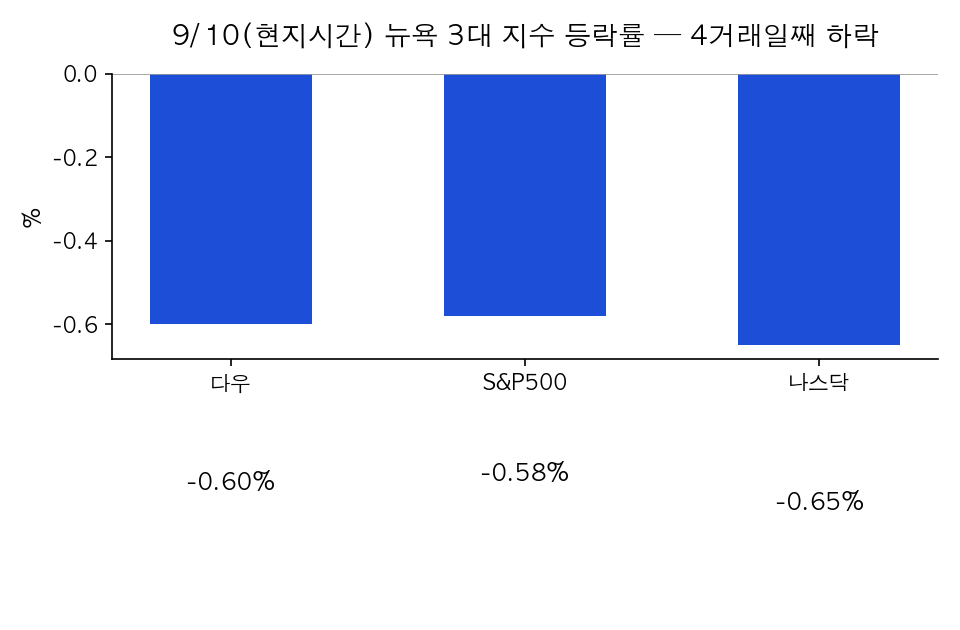
9/10 (U.S. time): U.S. Three-Index Daily Change
Three factors converged to drive the selloff. First: escalating Middle East tensions. Ongoing military activity between the U.S. and Iran has raised concerns about oil-shipping corridor risk. Second: producer inflation. The Producer Price Index jumped 5.4% year-over-year, signaling that price pressures may be re-emerging. Third: surging Treasury yields. All three arrived simultaneously, triggering immediate weakness in growth and tech equities.
Treasury Yields: 30-Year at 19-Year Peak
The U.S. 10-year Treasury yield rose to 4.95%, the highest level since 2023. The 30-year yield exceeded 5.35%, marking its highest point since 2007—a 19-year record.
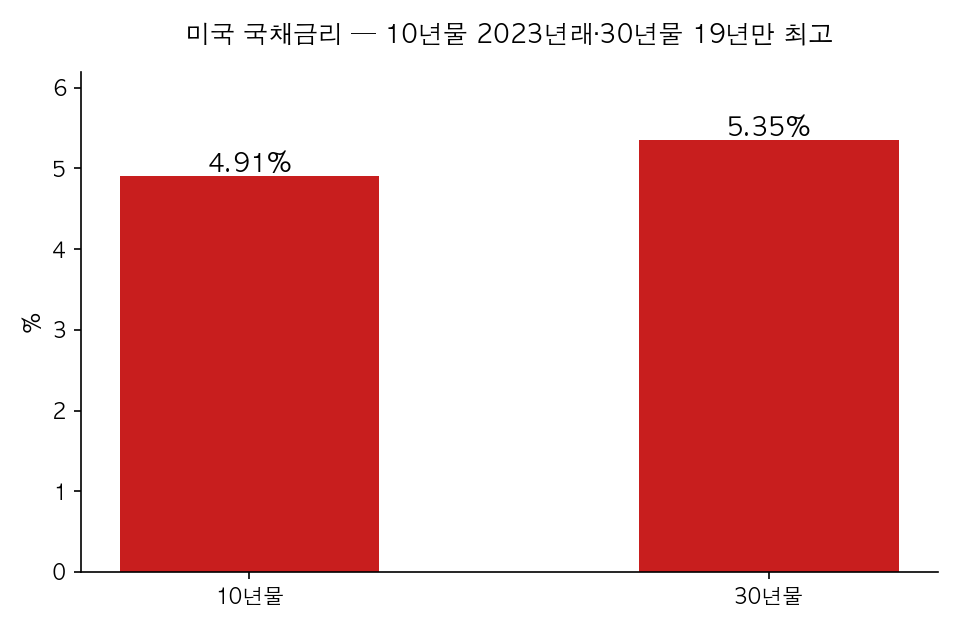
U.S. Treasury Yields: 10-Year and 30-Year
Why do rising Treasury yields shake stock prices? The mechanism is straightforward. Higher rates increase the discount applied to future profits when calculating their present value. Stocks with earnings concentrated years ahead—the Nasdaq cohort—bear the brunt. A 30-year yield at a 19-year high suggests long-duration borrowing costs have reset to a structural level unlikely to reverse easily. The math doesn't bend back.
Oil Tops $100 Per Barrel Again
West Texas Intermediate surged 6.7% to $102.48 per barrel—the highest close since May 19. Brent crude rose 5.94% to $107.63, also breaking through the $100 level. Both rallied sharply.
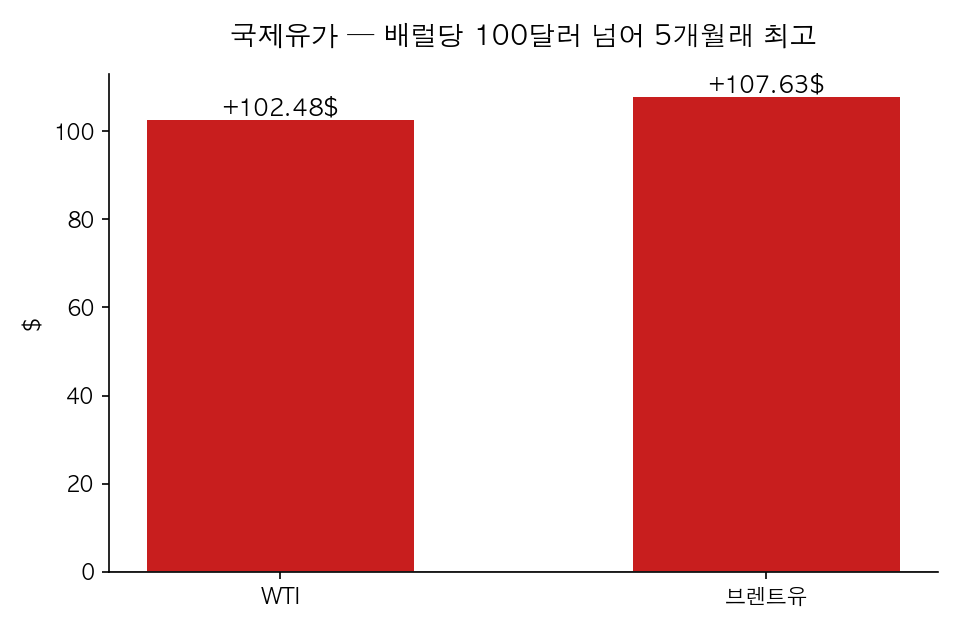
International Oil Prices: WTI and Brent Crude
Middle East tensions are cited as the primary driver. Reports of military activity near major shipping chokepoints have pushed supply-risk fears into prices. Oil above $100 per barrel is itself a catalyst—one that reignites inflation expectations. This is why the market will closely watch the U.S. Consumer Price Index (CPI), due later this week.
Semiconductors Under Pressure—Apple Diverges
Nvidia fell 2.26%. Micron declined 4.66%. The sensitivity of high-growth equities to Treasury yields was on full display. Yet Apple closed up 3.56%—a sharp divergence.
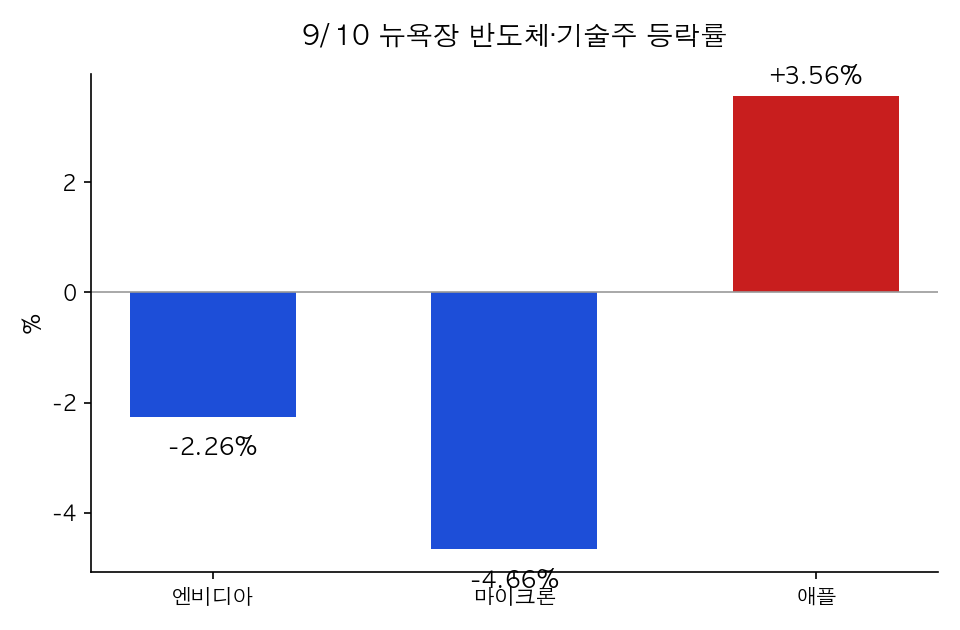
9/10 NYSE: Semiconductor and Tech Movers
Why Apple bucked the trend is not addressed in available reporting. Apple's revenue base is anchored in iPhone sales and services that are largely locked in already. This composition makes it structurally less sensitive to yield swings. Nvidia and Micron, by contrast, have priced in multiple years of AI demand upfront. Rising rates clip that future value first. The divergence matters today for U.S.-listed Korean semiconductor exporters: Samsung Electronics and SK Hynix ADRs typically track Nvidia and Micron, not Apple.
Asian Markets Overnight
On September 10, the KOSPI closed down 17.72 points (-0.25%) at 7,033.92. The Shanghai Composite fell 17.10 points (-0.43%) to 3,934.40. Hong Kong's Hang Seng Index dropped 320.49 points (-1.27%) to 24,954.47. The Nikkei 225 alone gained, rising 128.17 points (+0.20%) to 65,270.95.
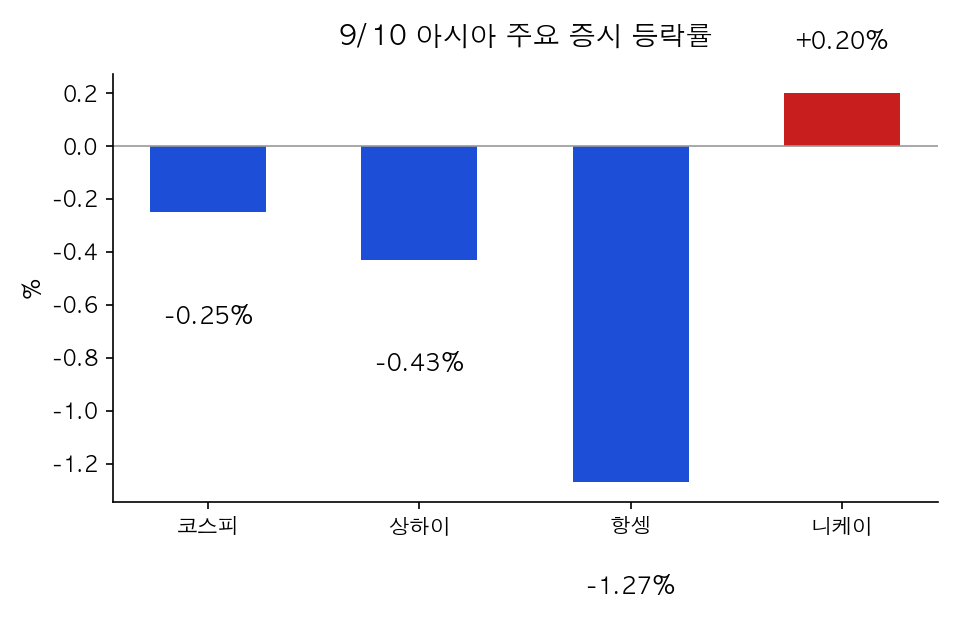
9/10 Major Asian Market Performance
What to Watch Today in the Korean Market
First: whether large-cap semiconductor stocks follow Nvidia and Micron lower. U.S. semis declined overnight. This will be the initial signal for KOSPI's opening direction.
Second: how $100 oil translates to refining and chemical stocks. Rising crude doesn't create a simple profit equation for refiners; margin structures are layered and sector-dependent.
Third: this week's U.S. Consumer Price Index, due later. The PPI already registered a 5.4% year-over-year jump. A hotter-than-expected CPI could re-accelerate Treasury yields and dollar strength in a single move.
The next inflection point arrives when the U.S. CPI prints later this week. Until then, both Treasury yields and oil remain on a hair trigger.
Summary
Overnight losses extended to a fourth straight day, with 30-year Treasury yields at a 19-year high and oil reclaiming the $100-per-barrel level. Apple's 3.56% gain stands as the day's most striking outlier. Whether the KOSPI absorbs these moves or large-cap semiconductors provide support is the question to settle at today's open.
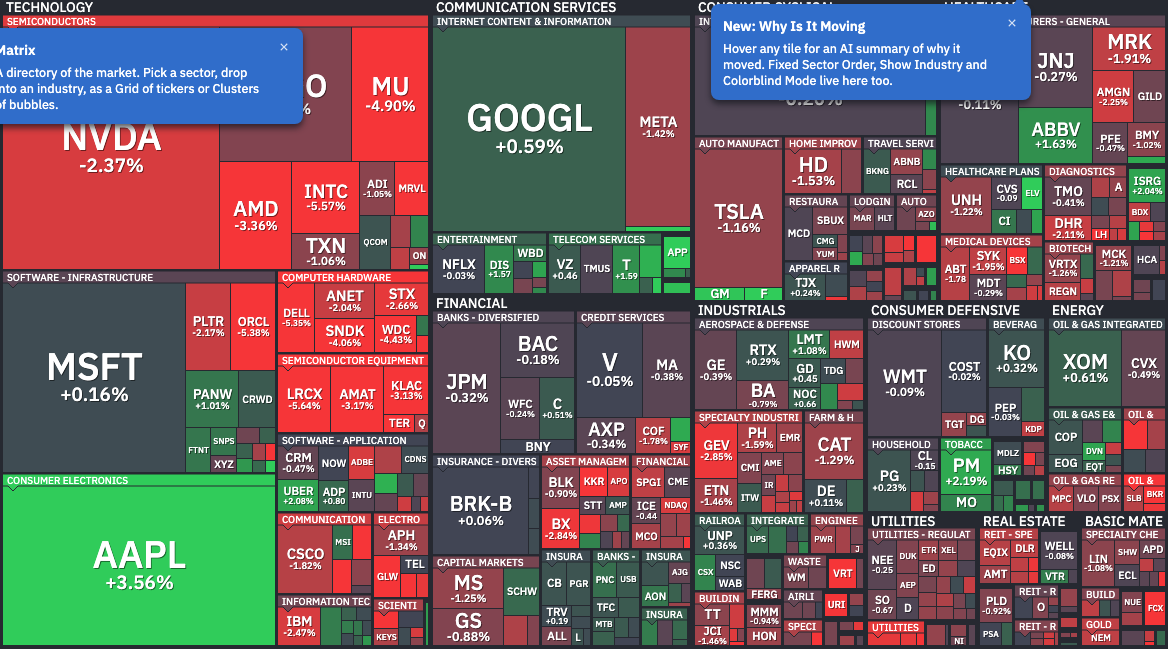
Overnight U.S. Market Heat Map (S&P 500) · Green = Gainers / Red = Decliners (Finviz color scheme)
Investment decisions and their outcomes rest with the individual investor.
#USMarketBrief #KOSPI #DowJones #SP500 #Nasdaq #TreasuryYields #OilPrices #WTI #BrentCrude #Semiconductors #Nvidia #Micron #Apple #SamsungElectronics #SKHynix #PhiladelphiaSemiconductorIndex #MarketAnalysis #KoreanStocks #CPI #PPI #MiddleEastTensions #DollarStrength #AsianMarkets #NikkeiIndex #ShanghaiComposite #HangSeng #StockMarket #FinancialNews
댓글
댓글 쓰기