On Friday, September 18, 2026, major U.S. indexes closed with mixed results. The Dow Jones fell while the S&P 500 and Nasdaq gained. The same day, U.S. Treasury 10-year yields surpassed 5% once again—a sign that rate pressures remain in play. But semiconductors told a different story. The Philadelphia Semiconductor Index surged 2.78% on its own, outperforming the broader market. Before the Korean market opens, here's what happened overnight on Wall Street.
Why the major U.S. indexes diverged
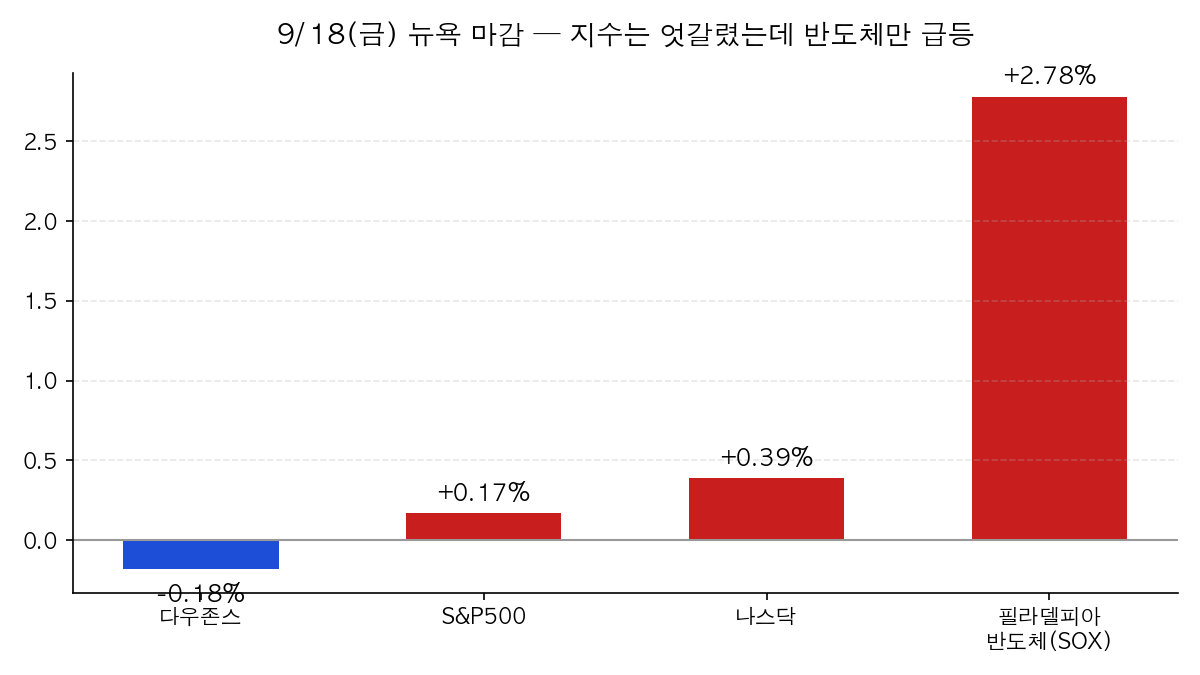
Sept. 18 (Fri.) close—indexes divided, but semiconductors led the charge
The Dow Jones Industrial Average fell 0.18% to 51,682.64. The S&P 500 gained 0.17% to 7,650.50. The Nasdaq Composite rose 0.39% to 26,522.55. None showed dramatic moves. The broader picture tells a different story for the week. The Dow fell for a third consecutive week, while the Nasdaq finished in positive territory.
The story traces back to Tuesday, when the Federal Reserve raised its benchmark rate by 25 basis points to 3.75%-4.00%—the first hike since July 2023, more than three years prior. New Fed Chair Kevin Walsh's hawkish-leaning remarks rattled markets through Thursday. By Friday, sentiment shifted. The market settled on the view that the decision was complete, entering a calmer phase.
Philadelphia Semiconductor Index outperforms on its own
The Philadelphia Semiconductor Index (SOX) rose 2.78% on the day, while broad indexes stumbled. The catalyst: Jensen Huang, CEO of Nvidia, appeared at an event in Scotland attended by King Charles III. He told reporters that Nvidia's chip shipments next year will double from current levels. The specificity marked a rare explicit forecast on volumes from the company.
Adding to the momentum, AI cloud provider Nebius announced it would raise rental rates on Nvidia GPUs (H100, H200, B200, B300) by up to 21% starting next month. As supply tightens, pricing power grows. The move signals sustained strong demand. Major semiconductor names—Nvidia, AMD, Micron, and TSMC ADRs—all rallied in tandem.
A focal point for Korean investors: Intel. Reports throughout the week that SK Hynix is in talks with Intel over memory-chip production in the U.S. buoyed Intel shares. While whether talks will result in an actual contract remains unconfirmed, the narrative itself influenced investor flows around SK Hynix domestically all week.
Treasury yields reclaim 5%
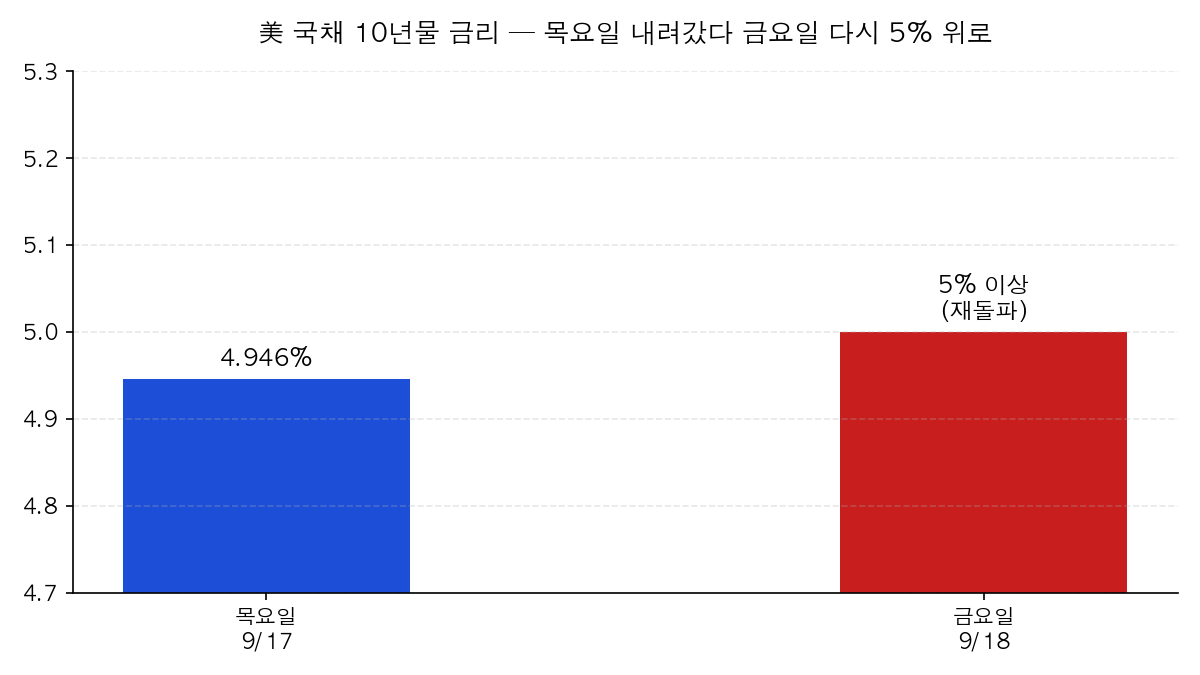
U.S. Treasury yields this week—after Tuesday's hike, the 10-year oscillated around 5%, reclaiming it Friday
The biggest variable this week was actually the bond market. After the Fed's Tuesday rate increase, the 10-year Treasury yield fluctuated around the 5% level. It breached 5% initially, then pulled back to the 4.9% range Thursday. By Friday, it surpassed 5% once more. The 2-year yield jumped to 4.741%, its highest since July 2024. Markets price in roughly 55% odds of another 25 basis point increase at October's FOMC meeting.
The dollar played a supporting role in the yield rebound. The Dollar Index rose to 100.4, its highest in seven weeks. It gained 1.2% this week alone. USD/JPY hit 158.05 yen, the highest in two weeks. Despite the Bank of Japan raising rates this week, its lack of clear signals on further hikes ironically weakened the yen.
Oil and the won
West Texas Intermediate crude for October delivery fell 1.58% to $100.30 a barrel—the fourth consecutive day of declines. Brent crude dropped 0.91% to $103.87. The backdrop: expectations that Saudi pipeline damage will be less severe than initially feared. While holding above $100, crude is pressured compared to early-week levels.
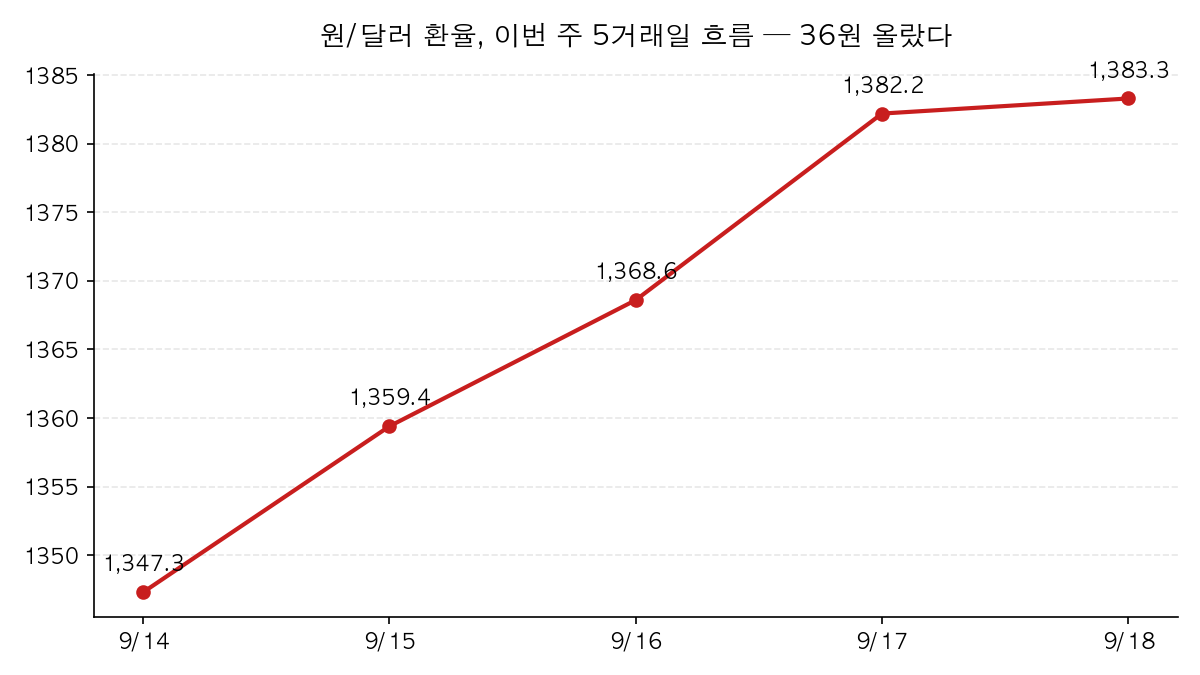
KRW/USD, the week's path—up 36 won from Monday to Friday
The KRW/USD rate closed at 1,383.30 won on September 18, rising nearly 36 won from Monday's 1,347.30. With the dollar broadly strong, the won came under pressure.
Asian markets react first
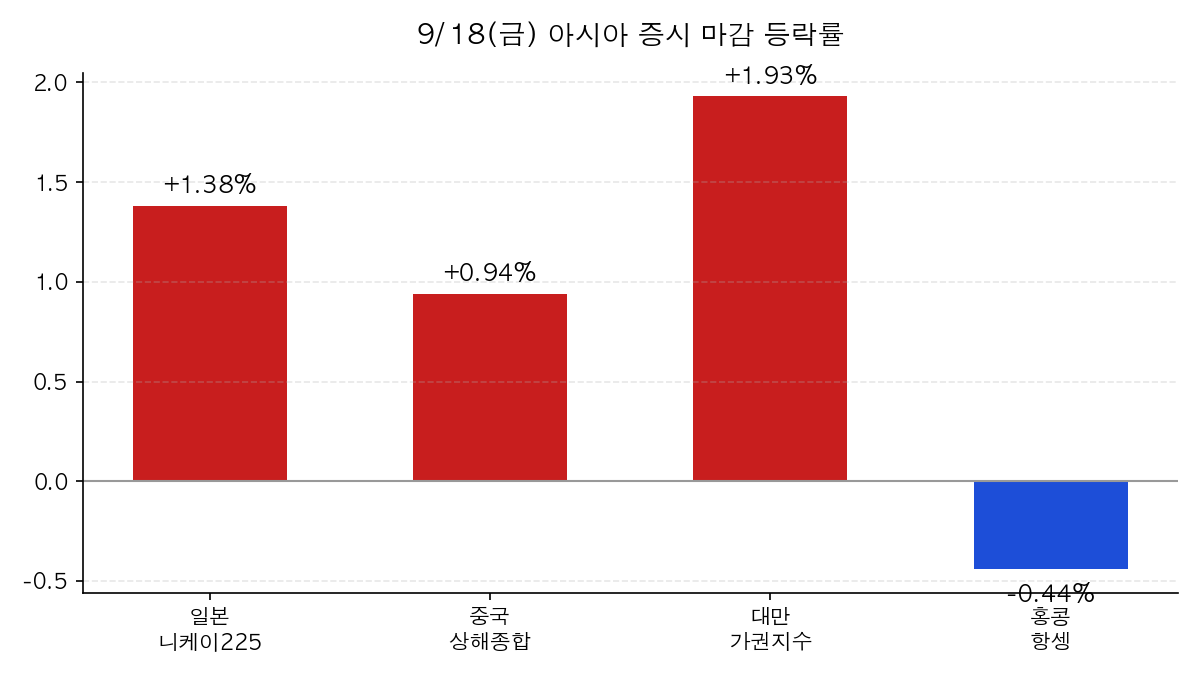
Sept. 18 (Fri.) Asian market close—Nikkei and Taiwan both lifted by semiconductor strength
Japan's Nikkei 225 rose 1.38% to 65,018.95, reclaiming the 65,000 level. The BOJ raised rates, though not unanimously—two of nine board members dissented. That clarity, rather than surprise, was viewed as uncertainty resolved. Semiconductor strength, including an 8.00% jump in Kioxia Holdings, also lifted the market.
China's Shanghai Composite gained 0.94% to 3,911.87. Taiwan's Taiex rose 1.93% to 47,180.75, its third consecutive day of gains. Taiwan's strength was also boosted by approval of a third-phase expansion at Longtan Science Park, set to house TSMC's sub-1.4-nanometer advanced-process capacity. Hong Kong's Hang Seng, meanwhile, fell 0.44%—a lone laggard among the region's exchanges.
What to watch as the Korean market opens
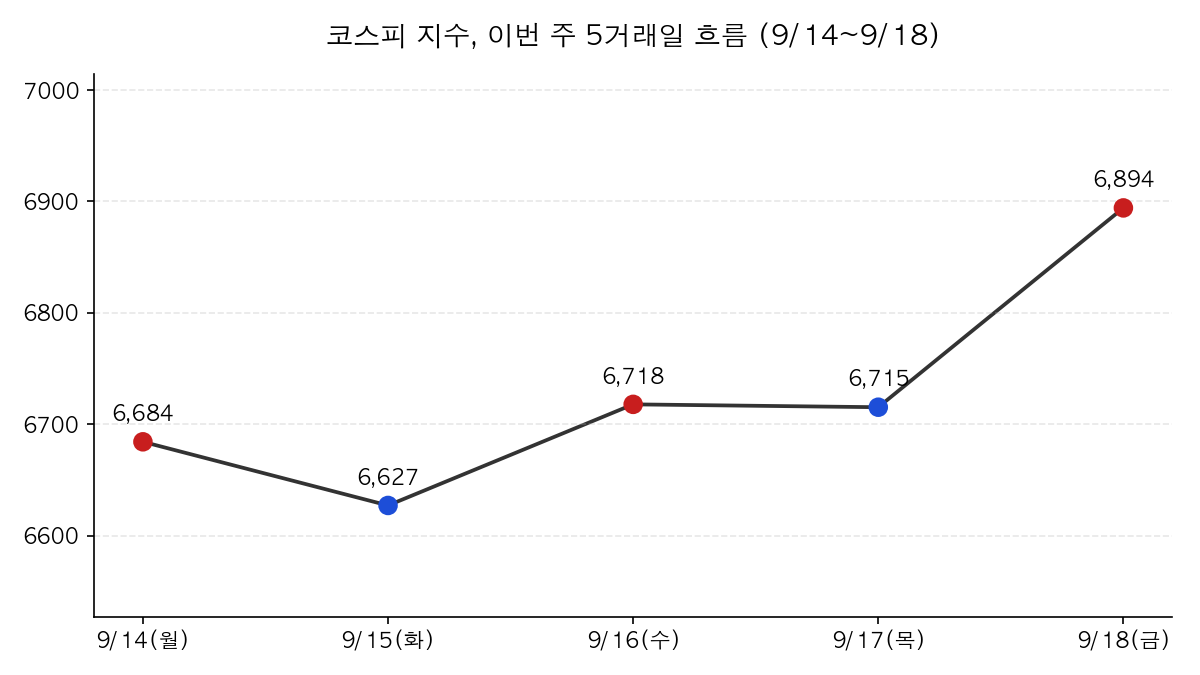
KOSPI, the week's five trading days—opened Monday with a 3.26% plunge, closed Friday with a 2.66% surge
The KOSPI surged 2.66% to 6,894.23 on September 18, finishing the week strong. It opened Monday with a 3.26% plunge—a rollercoaster of a week. On Monday, September 21, with overnight semiconductor strength, an upbeat opening for the KOSPI is possible. Nothing is certain yet.
The trading week is just three days. Markets will be open Monday through Wednesday only. The 24th and 25th close for Chuseok holidays. That compressed schedule packs in several events. Today brings September 1-20 export-import data. Investors will get concrete figures on semiconductor export growth.
Wednesday brings simultaneous PMI releases from the U.S., Europe, and Japan. These gauge the relative health of each region's manufacturing sector. The biggest variable lies elsewhere: on the 24th, while Korean markets are closed, a U.S.-China summit will be held at the White House in Washington, D.C. Depending on the outcome regarding AI and semiconductor export controls, the KOSPI's reopening on Monday, September 28, could absorb the full impact in a single session. Historically, the five days before Chuseok average -0.42%, while the period after averages +0.68% over the past decade. This year, however, a summit variable may alter that pattern. The market could deviate from the seasonal norm.
Today's data at a glance
| Index | Close | Change |
|---|---|---|
| Dow Jones | 51,682.64 | -0.18% |
| S&P 500 | 7,650.50 | +0.17% |
| Nasdaq | 26,522.55 | +0.39% |
| Philadelphia Semiconductor Index | — | +2.78% |
| U.S. Treasury 2-year | 4.741% | Highest since July 2024 |
| U.S. Treasury 10-year | Above 5% | Rebreached |
| WTI Crude | $100.30 | -1.58% |
| KRW/USD | 1,383.30 | +1.10 won |
Overnight U.S. market map
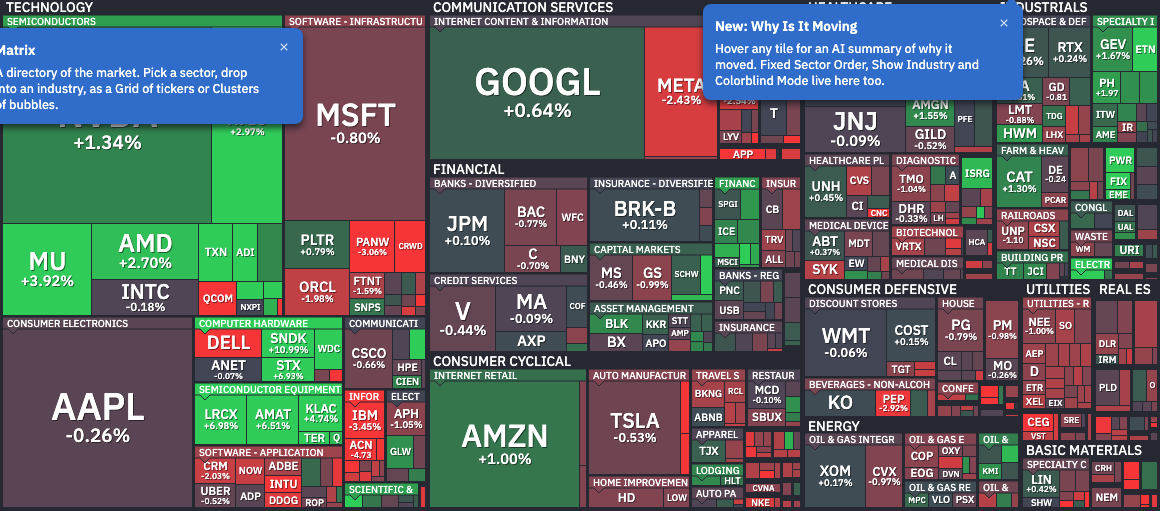
Overnight U.S. market map (S&P 500 heat map) · Green = gains / Red = losses (finviz color convention)
At a glance, green clusters in the semiconductor and technology sectors stand out. While broad indexes moved just 0.2-0.4%, the heat map makes clear that buying was concentrated in specific sectors.
In summary: overnight Wall Street appeared calm on the surface but ran deep underneath. The Fed's rate hike shook the bond market before stabilizing within a day, while semiconductors went their own way, unaffected by the noise. For the next three days, before Chuseok, there will be the week's final trading sessions. Short week, full agenda.
This article is for informational purposes only and does not constitute a recommendation to buy or sell any security. Investment decisions and their outcomes are your responsibility.
#USMarket #KOSPI #StockMarket #DowJones #Nasdaq #SP500 #Semiconductors #SOX #Nvidia #AMD #TSMC #SamsungElectronics #SKHynix #Intel #TreasuryYields #BondMarket #DollarIndex #WTIOil #ForexNews #AsianMarkets #Nikkei #TaiwanTaiex #HangSeng #Chuseok #FedRateHike #MarketAnalysis #FinancialNews #Investing
댓글
댓글 쓰기