Morning of September 9, 2026. Last night (local time, September 8), U.S. stocks retreated across the board. The Dow fell 1.17%, the S&P 500 declined 0.58%, and the Nasdaq dropped 0.32%. On the surface, one headline dominates: energy facilities in southern Saudi Arabia came under attack, sending crude prices higher. But dig into the declines and the story fractures. The Dow took the largest hit. The Nasdaq fared best. Tech and semiconductor shares held relatively steady. What to watch: how KOSPI absorbs this split-decision move when the Korean market opens.
Dow -1.17%, S&P -0.58%, Nasdaq -0.32% — Why the declines diverged
Start with the numbers. The Dow Jones fell 626.72 points to close at 52,787. The S&P 500 dropped 44.94 points to 7,673, and the Nasdaq lost 85.58 points to finish at 26,421. The Russell 2000 small-cap index also fell 0.52%. All three major indices posted red. On the surface, a broad selloff. Yet the gap between Dow and Nasdaq losses runs three-to-one. This was no simple synchronized decline.
Healthcare was the culprit. Novartis disclosed back-to-back clinical trial failures in cardiovascular disease and muscle-wasting disease treatments. Names tied to those programs took sharp hits. The Dow carries a higher weight in healthcare, absorbing the full impact. The technology shares that anchor the Nasdaq faced a different story.
Philadelphia Semiconductor Index climbs, optical modules gain, Nvidia and Micron falter
Temperature dispersion within semiconductors was sharp. OpenAI unveiled its new model, GPT-6 Astra. During the presentation, it highlighted demand for 800G and 1.6T optical modules. That single comment sent optical-network and nuclear-power-related names surging. The logic: as AI services scale, data-center networking equipment demand follows.
Yet Nvidia and Micron both declined. Nvidia closed at $225.73, down 2.01%. Micron finished at $1,000.26, off 1.61%. Micron's pullback stands out — the stock just crossed $1,000 for the first time. The reason: rates. The 10-year Treasury yield climbed to 4.796%. Growth stocks with sky-high valuations saw selling first, particularly AI chip leaders already trading on heavy optimism. The same sector moved in opposite directions. Opticals with near-term demand drivers performed differently than large-cap leaders whose upside is baked into current prices. One day, two different semiconductor stories.
SK Hynix and Samsung Electronics remain strong in global DRAM share by August sales. Global DRAM revenue surged 60% in the second quarter. Samsung held the top slot at 39.4% during that period — a figure that circulated in Korean news overnight. Still, whether that strength feeds into today's share prices remains to be seen. There have been many instances when U.S. large-cap weakness fails to drag Korean semiconductors down in lockstep.
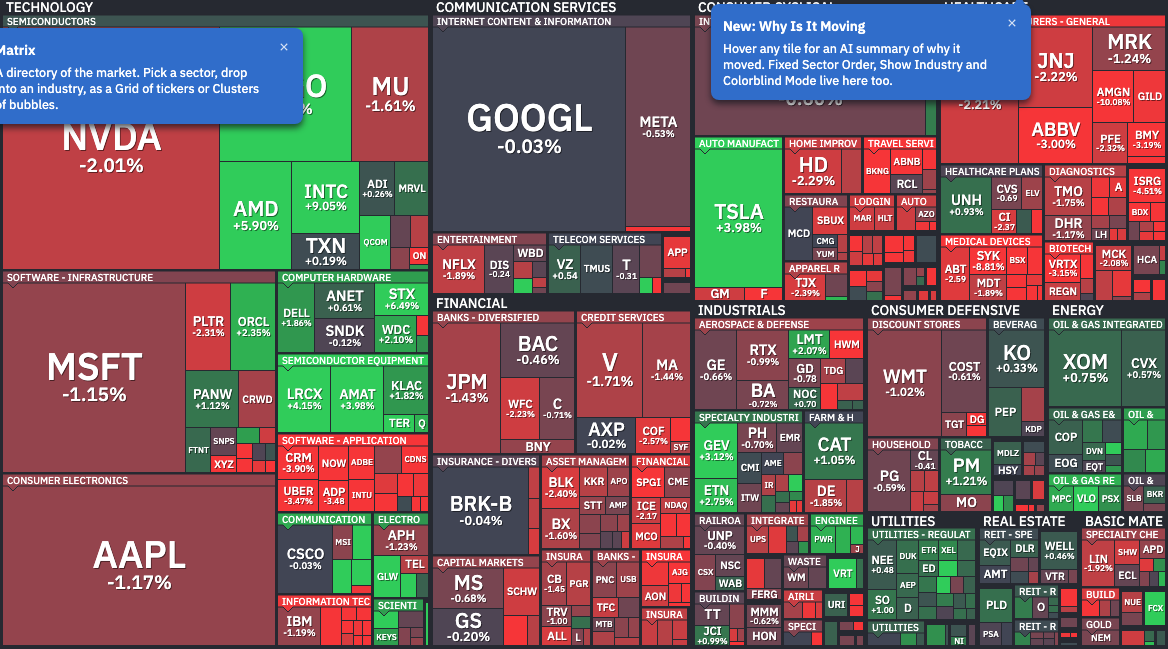
S&P 500 heat map from last night (green = gainers, red = decliners) via Finviz
Rates, currencies, oil — three axes moved at once
Wall Street, New York Stock Exchange
Start with Treasury yields. The 10-year rose 1.2 basis points to 4.796%. The 2-year climbed 1.46 basis points to 4.394%. Markets reopened after the Labor Day holiday carrying accumulated selling interest. U.S. inflation readings are scheduled for September 10 and 11. Ahead of those releases, the market moved cautiously.
Oil was ground zero. Yemen's Houthi forces attacked Saudi energy facilities and infrastructure in the south. Saudi Arabia's energy ministry officially confirmed partial operational suspensions at some sites. WTI crude rose 1.69% to $93.03 per barrel. Brent hit $97.92, the highest in six weeks. Escalating tensions between Iran and U.S. forces compounded pressure into the final hour, widening afternoon losses.
The Japanese yen was the currency story. Expectations that the Bank of Japan will accelerate rate hikes gained ground. The yen strengthened roughly 5% from the prior week, approaching seven-month highs. The move triggered concern over unwinding of yen carry trades. The global volume of yen-denominated cross-border borrowing stood at 360 trillion yen — roughly $2.35 trillion — as of March, according to Reuters, marking the highest figure in three decades of record-keeping. As the yen strengthens further, those positions could unwind and ripple through other assets. That is the market's worry.
The Korean won-to-dollar rate slipped 0.08% to 1,345.6 won on a closing basis. Yen strength is spilling into KRW. For export-dependent Korean manufacturers, yen strength and higher oil costs arriving together create a double squeeze.

Bank of Japan headquarters
| Metric | Level | Change |
|---|---|---|
| Dow Jones | 52,787 | -1.17% |
| S&P 500 | 7,673 | -0.58% |
| Nasdaq | 26,421 | -0.32% |
| U.S. 10-Year Yield | 4.796% | +1.2bp |
| WTI Crude | $93.03 | +1.69% |
| KRW/USD | 1,345.6 | -0.08% |
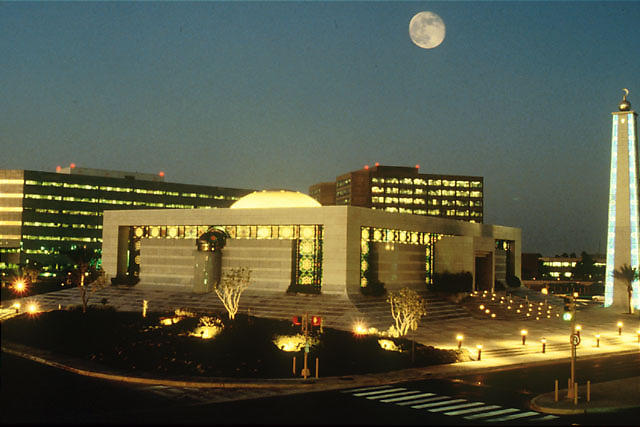
Saudi Aramco facility (file photo)
Oil tanker carrying crude (file photo)
Asian markets diverged yesterday
Before the Korean market opens, a look at Asian trading from September 8. Japan's Nikkei 225 fell 1.70%, the sharpest decline of the three. The yen tumbled to the 152 level (yen strength). Exporters took it on the chin: Toyota -4.12%, Honda -4.99%, Nissan -4.45%. Companies whose survival depends on selling overseas rarely celebrate their home currency appreciating. Yesterday laid that bare.
China's Shanghai Composite rose 0.20%. Dollar-denominated exports surged 25% year-over-year in August, in line with expectations. One detail stood out: imports from South Korea more than doubled. The read: global AI infrastructure demand is offering partial shelter against China's domestic slowdown.
Taiwan's Taiex fell 0.47%. This came after two consecutive days of gains exceeding 1% — short-term overbought conditions triggered profit-taking. Even so, TSMC gained 0.41%, outperforming in a down market.

TSMC semiconductor fab in Taiwan
What to watch in Korean markets today
Yesterday, KOSPI closed at 6,954.52, the first decline in four trading sessions. The intraday high was 7,171.52, a level 2.52% above the prior close. All gains erased in afternoon trading. The gap between high and low: 3.1 percentage points. Volatility was significant. Retail investors sold over 3 trillion won, marking four straight days of net selling. Foreign investors and institutional buyers stepped in on both sides, posting simultaneous net purchases. Investor flows completely diverged in one session.
Four interconnected factors shape today. First, oil. The fallout from the Saudi refinery strike is ongoing. Watch whether Brent climbs past $98. If it does, direction could split among refining, chemicals, and airline stocks. Second, semiconductors. Last night in the U.S., optical modules and component makers gained while Nvidia and Micron stumbled. Will the Korean market show a similar split, or will Samsung Electronics and SK Hynix draw strength from DRAM market-share leadership? That depends on which way investor flows tilt once the bell rings.
Third, currencies. Continued yen strength could pressure the won higher, a variable affecting foreign investor flows. Fourth, wariness ahead of U.S. inflation data on September 10-11. Yesterday's Treasury yield rise partly reflected that caution. Markets may move gingerly until those figures land. Fifth, Oracle reports results on September 10 — an event that straddles debt burdens from AI infrastructure investment and the growth narrative. The outcome could shape sentiment for AI-related names through the week's close.
Takeaway
Last night, all three major U.S. indices fell. But one number hides multiple stories. Healthcare stumbled. Semiconductors split: optical modules rose, large-cap chip leaders retreated. Oil, rates, and the yen all moved sharply at once. KOSPI, too, fell after touching a session high well into positive territory. Volatility dominated. Multiple crosscurrents colliding — not a single theme. Today, the pattern through the afternoon matters more than the opening signal.
Investment decisions and outcomes rest with the individual investor.
#KOSPI #KOSPIoutlook #USmarketclose #Dow #Nasdaq #SP500 #PhiladelphiaSemiconductor #SOX #Nvdia #Micron #crudeoil #WTI #Brent #SaudiAramco #HouthiForces #USTreasury10year #wontoUSD #yenstrength #yencarrytrade #BankofJapan #Nikkei #ShanghaiComposite #TaiwanTaiex #TSMC #Samsung #SKHynix #Oracle #USinflationdata #marketclose #todaysmarket
댓글
댓글 쓰기