[Korea Market Close] KOSPI Tumbles to 6,909 as Foreign Investors Pull KRW 2 Trillion; Insurance and Shipbuilding Rally
On September 11, 2026, the KOSPI closed at 6,909.91, down 1.76%, extending losses to a second consecutive day. The index had opened down more than 3%. Despite the rout, Samsung Fire surged over 6%, and HD Hyundai Heavy Industries climbed more than 5%. While the benchmark collapsed, insurance and shipbuilding stocks rallied alone.
The KOSPI opened at 6,802.50, a loss of more than 231 points, but recovered partway to 6,948.83 before falling back in the closing hour to finish at 6,909.91. Foreign investors sold KRW 2.3 trillion—a third consecutive day of selling. Institutional investors sold KRW 1.2 trillion, returning to selling after seven days of buying. Retail investors alone remained net buyers, accumulating KRW 1.9 trillion for a second day.
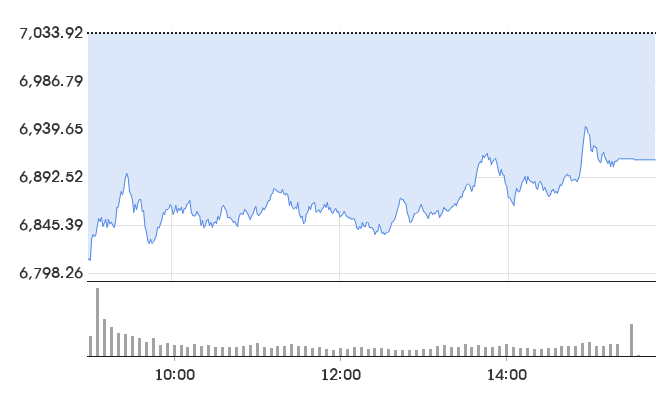
KOSPI daily chart (Naver Finance)
Middle East tensions ignite oil selloff
The catalyst was escalating Middle East oil tensions. Reports emerged of U.S. and Iranian naval forces attacking each other's tankers, while Iran-aligned Houthi forces in Yemen seized the strategic port of Mokha and advanced toward the Bab el-Mandeb Strait, a critical artery for crude shipments. October WTI crude surged to $102.48 a barrel, up 6.69% and extending an eight-day rally. Brent oil rose 6.34% to $107.63. Both grades hit their highest level since May.
Oil was not the only pressure. U.S. August producer prices (PPI) came in hotter than expected at 5.4% year-over-year, raising inflation concerns ahead of tonight's consumer price report. Federal funds futures showed a 71.1% probability of another rate hike in September. The 10-year Treasury yield jumped 8.7 basis points to 4.540%. Oil, inflation, and rate-hike expectations moved simultaneously—a trifecta of headwinds.
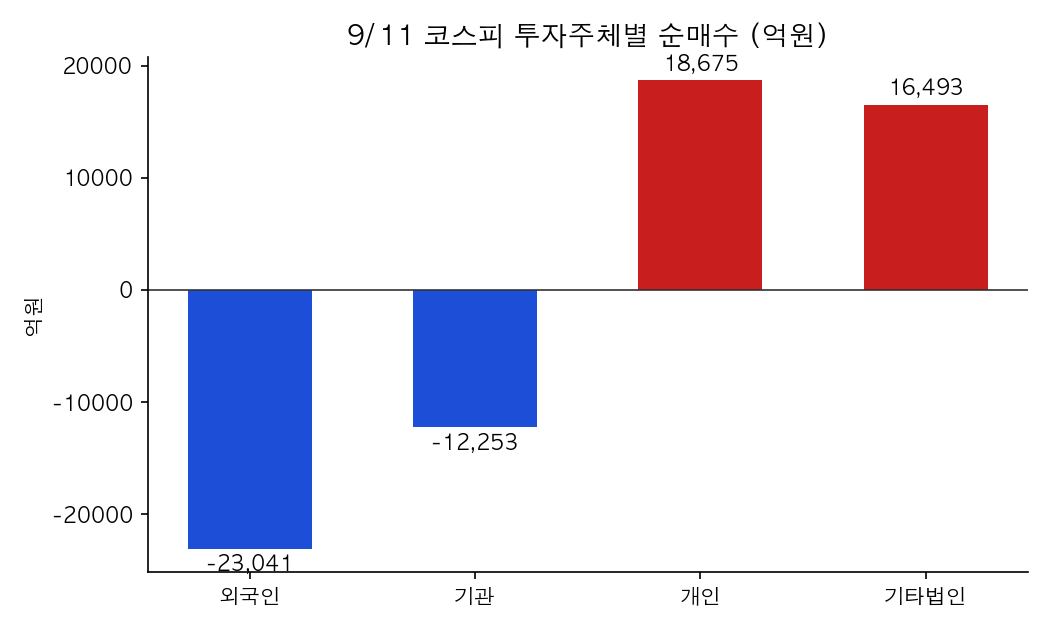
September 11 KOSPI investor flows by type, in billion KRW (direct tally, source: Infostock Korea Market Close)
Semiconductors hurt, but banks and insurance thrive on higher rates
The same rate-hike news triggered opposite reactions across sectors. Samsung Electronics fell 3.53%, SK Hynix declined 2.21%, and Hanmi Semiconductor slid 8.70%. Rising rates compress valuations for high-growth stocks, where terminal values carry more weight. Large-cap chipmakers bore the brunt.
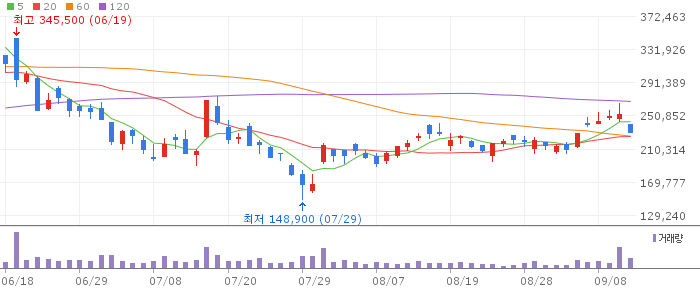
Hanmi Semiconductor daily chart (Naver Finance)
Financial stocks moved the opposite direction. Samsung Fire surged 6.03%, Shinhan Financial gained 2.36%, and KB Financial rose 2.60%. Higher rates expand net interest margins and improve returns on insurance asset portfolios. For financials, the rate rise offered a silver lining. The same macro shock drove semiconductors lower and financials higher—a clean divergence.
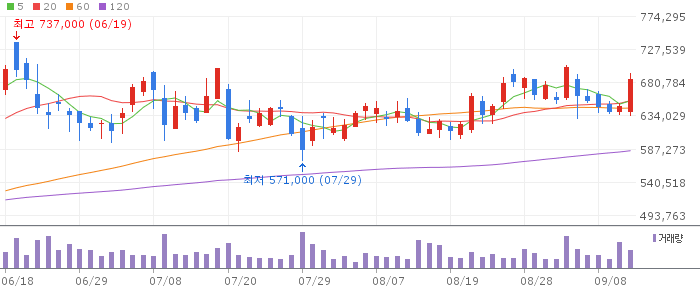
Samsung Fire daily chart (Naver Finance)
Shipbuilding stocks rally on data center power, not oil
HD Hyundai Heavy Industries climbed 5.62% and HD Korea Shipbuilding & Offshore Engineering rose 3.98%, but the driver was not oil. A separate catalyst emerged: reports of plans to expand data center power-generation engine production from 0.7 gigawatts to 4 gigawatts. Analysts raised price targets from KRW 700,000 to KRW 720,000. Against a backdrop of shipbuilding profit-taking concerns, the durability of engine maintenance revenue independent of new-ship orders came into focus.
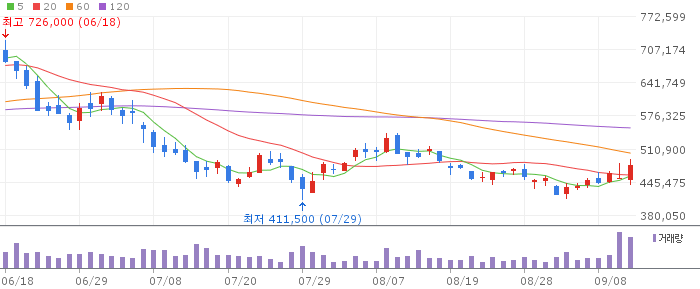
HD Hyundai Heavy Industries daily chart (Naver Finance)
KOSDAQ succumbs to chipmaking equipment stocks
KOSDAQ fell to 820.64, down 1.95%, snapping a two-day gain. Semiconductor suppliers weighed on the index. Wonik IPS fell 7.15%, TS&E dropped 15.01%, and Padu slid 13.62%—tracking the Philadelphia Semiconductor Index's 2.66% plunge. Foreign investors sold KRW 313.7 billion and institutions offloaded KRW 216.2 billion. Retail investors bought KRW 511.9 billion. The pattern mirrored the broader market.
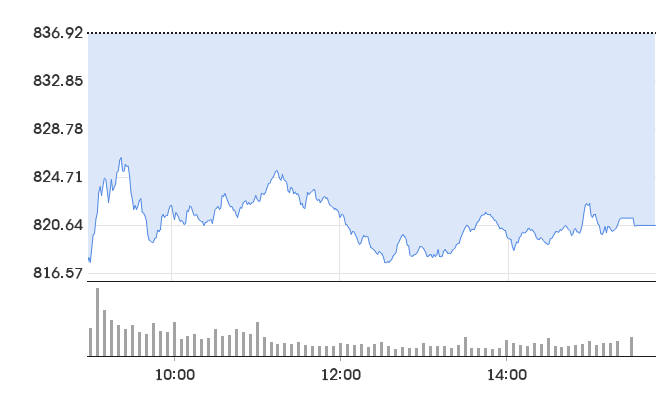
KOSDAQ index daily chart (Naver Finance)
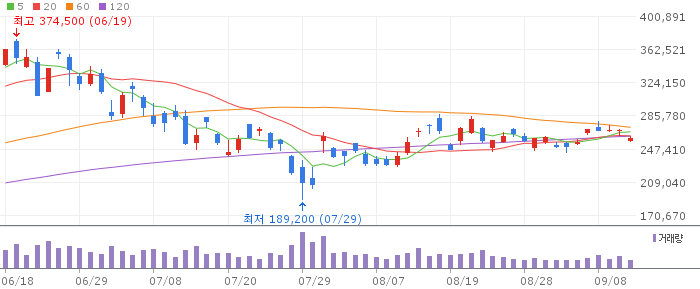
Samsung Electronics daily chart (Naver Finance)
Today's upper-limit stocks: Cybersecurity names soar on Jensen Huang remark
On KOSDAQ, Alpha Chips and Prettya extended upper-limit gains for a second consecutive day, while Espsoft, Xgate, and Sandslab hit the daily limit for the first time. The common thread: a remark by Nvidia CEO Jensen Huang. "The next great AI market is cybersecurity." That single comment set the information-security thematic ablaze. On KOSPI, G.I.E. surged 13.30% to the daily limit on news of selection as preferred bidder for the Siheung Baegot complex development project. Separately, talk of MLCC supply tightness boosted Amotech 29.98% and Samwha Capacitor 18.76%, both approaching limits.
This trend draws from a previous post on MLCC supply constraints, which provides more context on today's rallies.
What to watch next
Today's market action hinged on oil and interest rates. Whether those themes persist depends on tonight's U.S. consumer price report. If CPI surprises to the upside, rate-hike fears will mount again, semiconductor weakness will extend, and financial stocks will strengthen further. If inflation cools, a reversal is possible.
Watch whether foreign investors' third consecutive day of selling continues. Today, retail buyers absorbed the flows, but if selling pressure intensifies, retail support alone may not suffice. The trajectory of Middle East tensions—whether crude holds above $100—bears close attention in coming days.
This article is provided for informational purposes and does not constitute investment advice or a recommendation to buy or sell any security. All investment decisions and their outcomes rest with the reader.
#KOSPI #KOSDAQ #KoreaMarketClose #MarketClose #KOSPIIndex #ForeignInvestors #CrudeOil #MiddleEastRisk #InsuranceStocks #ShipbuildingStocks #SemiconductorStocks #SamsungFire #HDHyundaiHeavy #HanmiSemi #MLCC #CybersecurityStocks #KOSPIOutlook #Oil100 #MarketSummary #StockInvesting #KoreanMarket #CircuitBreaker #DailyLimitStocks #SurgingStocks #JensenHuang #G.I.E. #FinancialStocks #BankStocks #ShipbuildingIndustry #SemiconductorEquipment
댓글
댓글 쓰기