U.S. markets extended losses for a second consecutive session on September 15. The Dow Jones fell 0.63%, S&P 500 dropped 0.45%, and Nasdaq Composite declined 0.78%.
But the most striking figure isn't the indices—it's the 10-year Treasury yield. It climbed to 5.041% intraday, marking its highest level since 2007. Crude oil rallied in tandem. These moves provide essential context as Seoul markets prepare to open today.
U.S. Major Indices Extend Losses
On September 15, the Dow Jones Industrial Average closed down 328.09 points (-0.63%) to 52,093.11. The S&P 500 fell to 7,585.73 (-0.45%), and Nasdaq Composite declined to 25,981.57 (-0.78%).
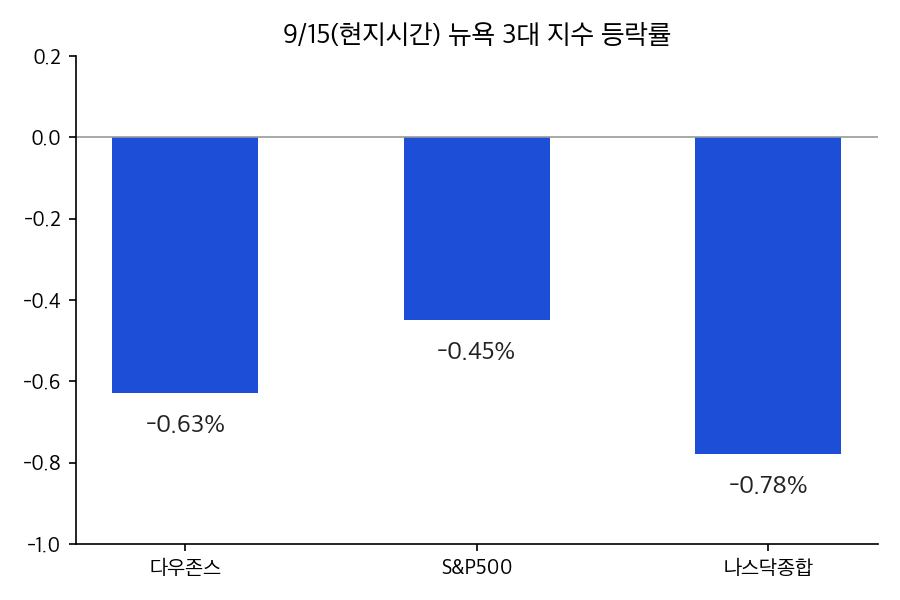
Sept. 15 (U.S. time): U.S. three major indices daily changes
This follows declines a day earlier: Dow -0.29%, Nasdaq -0.56%, S&P 500 -0.48%. That marks two straight days of weakness across the board.
Two factors are driving the selloff. First, there's growing self-scrutiny within the AI sector. Dario Amodei, CEO of Anthropic, has warned of safety risks from cutting-edge AI systems and called for slowing development pace. Sam Altman of OpenAI and Elon Musk have expressed similar concerns. President Trump, by contrast, sharply criticized this stance as "killing the goose that lays the golden egg." The fact that both camps may have valid points appears to have unsettled the market further.
The second factor involves the bond market, examined below.
Semiconductors: Why the Rebound Hasn't Taken Hold
The Philadelphia Semiconductor Index (SOX) plunged 5.86% on September 14 alone. Individual names fell broadly: SK Hynix ADR -7.60%, Intel -5.59%, AMD -4.40%, Micron -5.25%, Broadcom -4.77%, NVIDIA -3.36%, and TSMC ADR -3.52%. Major semiconductor stocks were uniformly weak.
The driver is the AI-slowdown concern mentioned above. Worries about delayed AI capex paybacks have directly weighed on semiconductor demand forecasts. Microsoft researchers went so far as to publish a principle that people matter more than AI. Altman announced he won't pursue an IPO this year. For semiconductor shares, it was a cascade of unwelcome headlines in a single session.
For Korean investors, the critical takeaway is this: SK Hynix ADR's -7.6% drop means SK Hynix and Samsung Electronics are unavoidable focal points in today's Seoul market. Korean semiconductor giants already felt the spillover yesterday—one factor in KOSPI's fourth consecutive decline. What to watch: whether this pressure continues today.
Treasury Yields and Oil: The Real Variables
On September 15, the 10-year Treasury yield climbed to 5.041%, marking its highest level since 2007. West Texas Intermediate crude rose 2.64% to $104.10 per barrel.
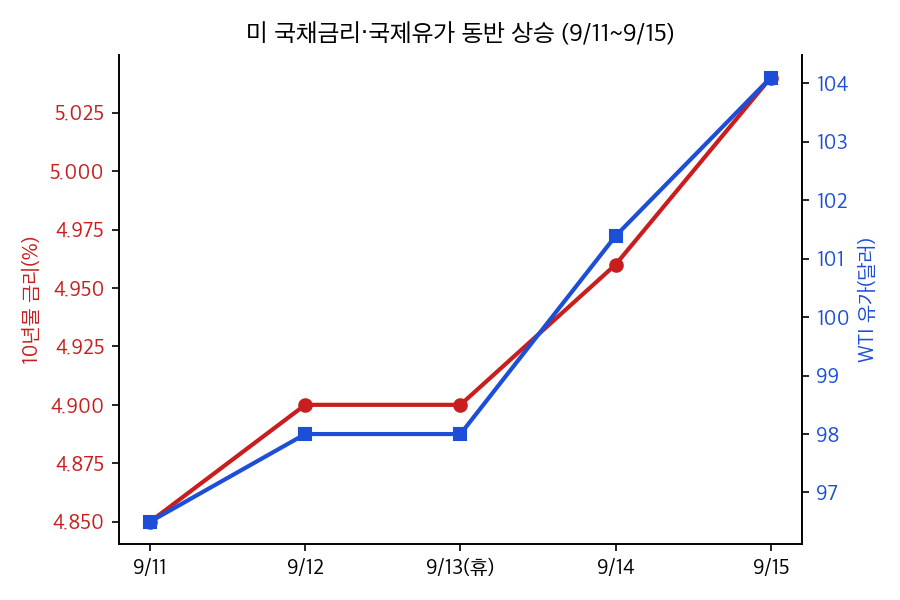
Treasury yield and WTI trending higher (Sept. 11-15)
The reason for rising oil is clear: Saudi Arabia's East-West Pipeline, a critical crude conduit, was struck by a drone attack and suspended operations beginning September 11, with repairs expected to take 3 to 5 weeks. The pipeline carries crude from Saudi's Eastern Province to Yanbu on the Red Sea coast. Regional supply concerns are being compounded by the abrupt postponement of high-level talks between Iran, Iraq, and Gulf Cooperation Council (GCC) nations.
The case for rising Treasury yields is more nuanced. As oil prices climb, inflation pressures build. That's compounded by heavy U.S. Treasury auctions, straining bond supply dynamics. The result: inflation pressures and heavy bond supply are both pushing yields higher simultaneously.
So Why a Fed Rate Hike Today?
Normally, with stocks falling two days running and yields at 19-year highs, investors would expect the Fed to cut rates and ease market tensions. Not this time.
The Federal Open Market Committee (FOMC) meets September 15-16. According to CME FedWatch, markets are pricing in roughly a 90% probability of a 25-basis-point rate increase. In short, markets are betting on tightening, not easing.
The reason: oil-driven inflation. Saudi pipeline disruptions have reignited inflation pressures. The prevailing view is that a rate cut now could feed inflation—a concern that apparently outweighs growth worries at the moment. The FOMC announcement is scheduled for this afternoon, U.S. Eastern Time (September 16), or early tomorrow Seoul time. This means today's Korean market trading will unfold before the announcement, priced on expectations alone.
Asia Overnight—KOSPI on Four-Day Skid
Asian markets were mixed on September 15. Japan's Nikkei 225 traded up 0.96% intraday but finished nearly flat at -0.01% as semiconductor and financial shares came under pressure. The Shanghai Composite fell 0.54%, weighed by weak retail sales and investment data. Taiwan's benchmark declined 0.77%, marking a fourth consecutive day of losses. Hong Kong's Hang Seng bounced 0.45%.
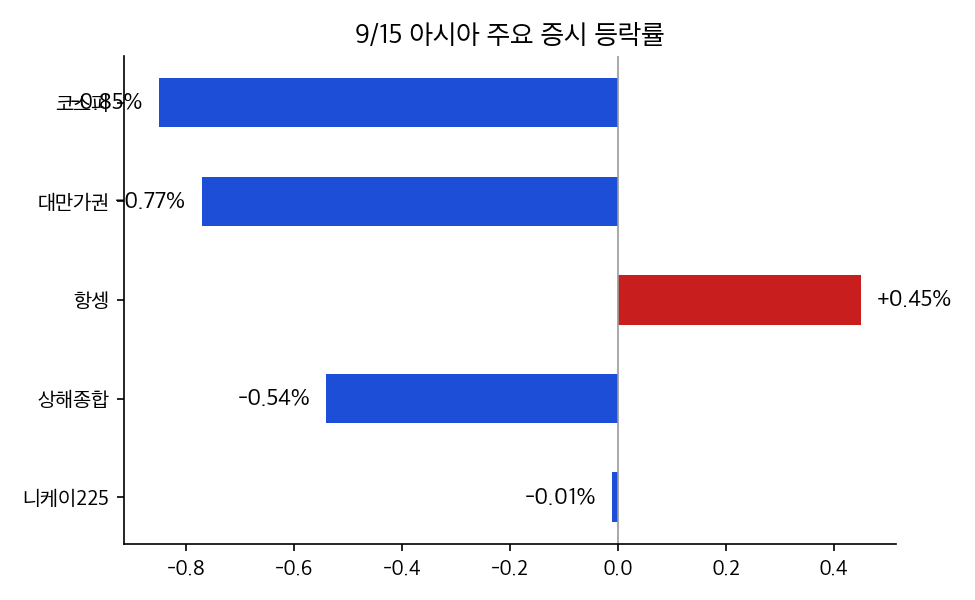
Sept. 15 Asia-Pacific major indices performance
KOSPI fell 0.85% to 6,627.26 for a fourth straight daily loss, as foreign investors and institutions were net sellers amid concerns about rates, oil, and AI development pace. By contrast, KOSDAQ bounced 0.70% with foreign and institutional net buying after three straight declines. The divergence between KOSPI and KOSDAQ is worth monitoring—will it persist today?
The Korean won weakened to 1,359.4 per dollar, up 13.2 won (+0.98%), reflecting both dollar strength and net foreign outflows.
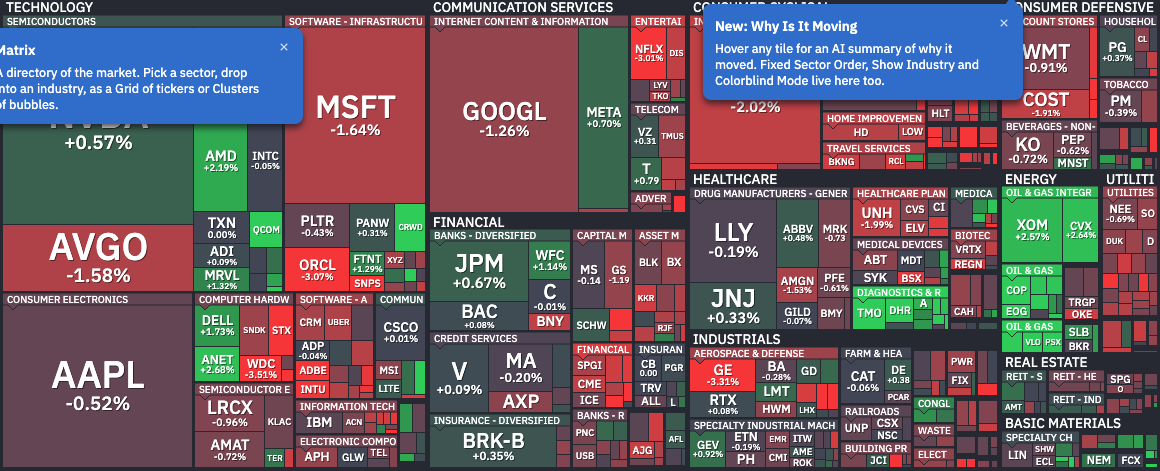
S&P 500 sector heatmap as of Sept. 15 market close (green = gainers, red = decliners)
What to Watch Today in Seoul
Forecasting is difficult, but several points deserve attention:
| What to Watch | Why It Matters |
|---|---|
| SK Hynix and Samsung opening flow | SK Hynix ADR fell 7.6%; Philadelphia Semiconductor Index dropped 5.86% on Sept. 14. Will the selloff continue? |
| KOSPI and KOSDAQ alignment | Sept. 15 saw them diverge sharply (KOSPI -0.85% vs. KOSDAQ +0.70%). Watch whether they reconverge today. |
| Oil-sensitive sectors (energy, shipbuilding, airlines) | WTI at $104.10; Saudi pipeline repairs expected to take 3 to 5 weeks. Higher energy costs likely to persist. |
| FOMC decision (early tomorrow Seoul time) | Markets pricing in roughly 90% odds of a 25-bp increase. Announcement after today's Seoul close. |
If the Fed actually raises rates when Treasury yields are already at 19-year highs, the fallout will likely extend well beyond today. Conversely, a hold—defying market expectations—would be significant news in its own right. The next key moment comes with tomorrow's early-morning Seoul-time FOMC announcement.
Takeaway
U.S. markets fell for a second straight session, driven by AI-development concerns and a rise in both Treasury yields and crude oil prices. The 10-year yield's climb to 5.041%—its highest since 2007—is the number to take seriously. Today's Seoul session will likely focus on semiconductor heavyweights and expectations ahead of tomorrow's FOMC announcement.
This article is provided for informational purposes only and does not constitute investment advice or a recommendation to buy or sell any security. Investment decisions and their outcomes are solely the reader's responsibility.
#USMarkets #KOSPI #KOSPIOutlook #NasdaqIndex #DowJones #S&P500 #SemiconductorIndex #TreasuryYields #USBonds #CrudeOil #WTI #SaudiPipeline #FederalReserve #FOMC #RateHike #SKHynix #Samsung #SemiconductorStocks #USDWon #AsiaStocks #Nikkei #ShanghaiComposite #TaiwanIndex #HangSeng #KOSDAQ #AIRiskDiscussion #NVIDIA #Micron #Broadcom #MarketOutlook #DaysTrade
댓글
댓글 쓰기