[Korea Market Close] KOSPI Plunged to 6,562: Geopolitical Crisis Split Sectors, Crushing Semiconductors While Lifting Inter-Korean Themes
On September 2, 2026, the KOSPI closed at 6,562.72, down 3.99%. In a single session, 273 points vanished. The U.S. launched fresh strikes on Iranian targets. Crude prices and government bond yields spiked in tandem. Everything from semiconductors to shipbuilding fell broadly.
Yet among five daily-limit gainers, three rose on different geopolitical news—not Iran, but North Korea. A single crisis pushed one group of stocks down while propelling another sharply higher.
Index and flows: Buybacks could not hold the line
The KOSPI opened with a gap-down at 6,625. Early in the session it recovered to 6,694, only to retreat again in afternoon trading. The intraday low was 6,558.30, closing at 6,562.72. KOSDAQ fell 2.10% to 803.98.
Foreign investors sold KRW 1.92 trillion—their fourth straight day of net selling. Institutional investors sold KRW 2.04 trillion, also their fourth consecutive session of outflows. When both anchors retreat together, indices struggle to hold ground.
Notably, retail investors returned to net buying after three sessions, accumulating KRW 2.30 trillion. Other corporate entities bought KRW 1.65 trillion net, much of it reflecting Samsung Electronics and SK Hynix share buybacks. Yet Samsung Electronics finished down 4.02% and SK Hynix down 4.73%—even their own repurchase programs could not prop up the market. The scale of selling was overwhelming.
Bond markets moved in step. The 3-year government bond yield rose 5.2bp to 3.93%, and the 10-year 4.7bp to 4.42%. The U.S. 10-year touched 4.8% intraday, the highest since January 2015. Rising crude pressures inflation, rising inflation drives rates higher, and higher rates depress equities. Today played out that sequence exactly.
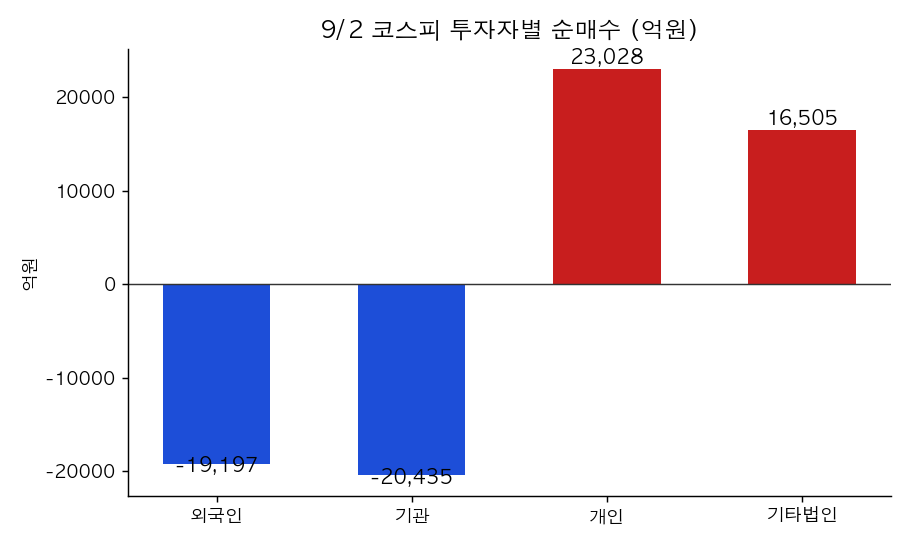
September 2 investor flows by type; compiled and charted in-house
The basis: Iranian escalation, Hormuz risk, and the rate shock
Over the weekend, U.S. forces struck Iranian rocket-launch facilities near the Strait of Hormuz. U.S. Central Command subsequently announced additional strikes against Islamic Revolutionary Guard Corps targets. President Donald Trump warned Iran that if it retaliated, there would be "nothing left for you." Iran struck back, downing a U.S. drone and tightening its blockade of the Strait. Iran's parliament speaker asserted that if the blockade continued, no nation would be able to export oil through the Strait.
The Strait of Hormuz is the critical chokepoint for global crude flows. The mere threat of closure is enough for markets to price in worst-case scenarios. WTI crude climbed 5.20% overnight to $90.22 a barrel. Higher energy costs amplify inflation expectations, which in turn push rates upward. This is the same sequence we outlined in yesterday's piece on the initial strikes. Today represented the follow-through. (Related: [Korea Market Close] The Day the U.S. Struck Iran, the Daily-Limit Gainers Were Hair-Loss Drugs)
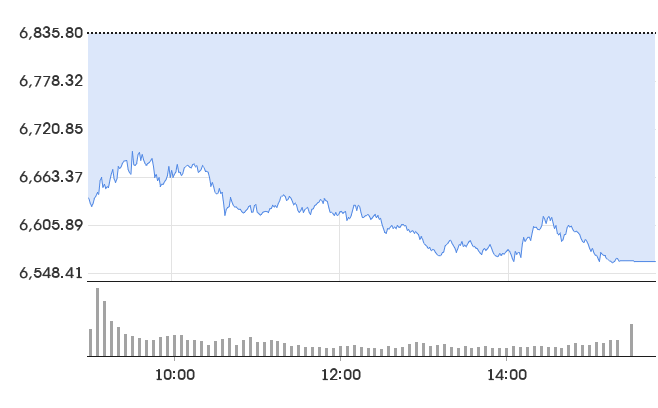
KOSPI, three-month daily view (Naver Finance; red=up, blue=down)
Semiconductors, autos, and shipbuilding fell together
Sector performance was nearly universally negative. Transportation equipment and components fell 5.34%, electrical and electronics 4.34%, machinery and equipment 4.32%, and manufacturing 4.19%. Only one sector rose: medical devices and precision instruments, up 0.97%.
Samsung Electronics and SK Hynix slipped into the -4% range. Samsung-affiliated names moved in sympathy: Samsung Electro-Mechanics down 2.10%, Samsung Life down 5.01%, Samsung C&T down 4.48%. This followed a 2.14% overnight decline in the Philadelphia Semiconductor Index.
Hyundai Motor fell 5.62%, Kia 5.18%, and Hyundai Mobis 6.31%. The auto and battery sectors, vulnerable to surging rates, felt the pressure acutely. HD Hyundai Heavy Industries, down 6.84%, was further dragged by a partial union strike.
KOSDAQ fared no better. Ecopro BM fell 7.06%, Ecopro 5.96%, and Seonjin Systems tumbled as far as 9.24%. Biotech and pharma names mostly retreated: Rigakemabio down 4.32%, Samchundang Pharmaceutical down 3.81%.
Market-cap leader Alteo Genesis stood apart, surging intraday on news of a potential technology-transfer deal with Novartis worth up to KRW 4.4 trillion. Even so, it closed essentially flat at down 0.83%. Strong fundamentals had no sway on a day like this.
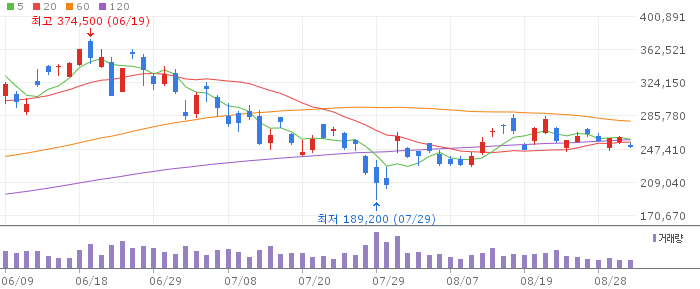
Samsung Electronics, three-month daily view (Naver Finance; red=up, blue=down)
The same crisis, different winners
Five daily limits rose today. Three shared a single catalyst: the White House's remark that it remains open to dialogue with Kim Jong-un without preconditions reignited inter-Korean economic cooperation themes.
Good People rose to its daily limit at +29.94%. Namhwa E&C surged 20.93%. JST Inc. gained 17.53% and C-SITE 11.83% on the same theme. Iran news depressed the broad market. North Korea news moved in the opposite direction. It became the lifting factor for a specific cohort. Even within geopolitics, direction diverged based on which country was the focus.
Not all daily limits were thematic. MiQube Solutions rose 30.00% flat on news of selection for two government-backed physical AI projects. Dongyang File and Seosan each gained around 29.9% following reports that next year's government budget includes KRW 1.5 trillion for a Honam semiconductor cluster. D&I climbed 14.82% on improving profitability prospects for its HBM4 testers. On a day when the entire market was liquidating semiconductors, one chip equipment maker held ground on earnings fundamentals.
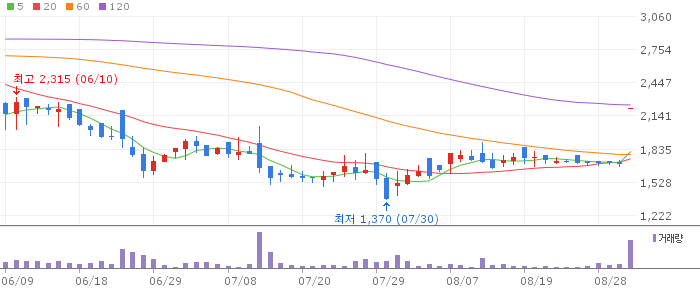
MiQube Solutions, daily view (Naver Finance; red=up, blue=down)
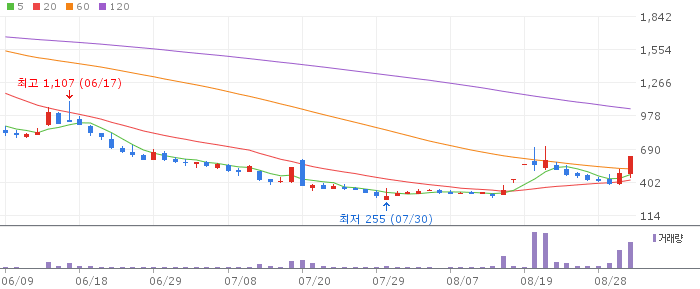
Good People, daily view (Naver Finance; red=up, blue=down)
KOSDAQ told a different story
KOSDAQ saw most large-cap names decline. ISC stood alone with a +8.53% gain. IOTECH Precision (+2.03%) and Joosung Engineering (+0.40%) also held in the black.
From a flows perspective, institutions sold KRW 232.2 billion—their sixth straight day of net outflows. Retail investors bought KRW 172.8 billion and foreign investors KRW 63.0 billion. The opposite of KOSPI: this was the day foreign investors returned to net buying after four consecutive sessions of selling.
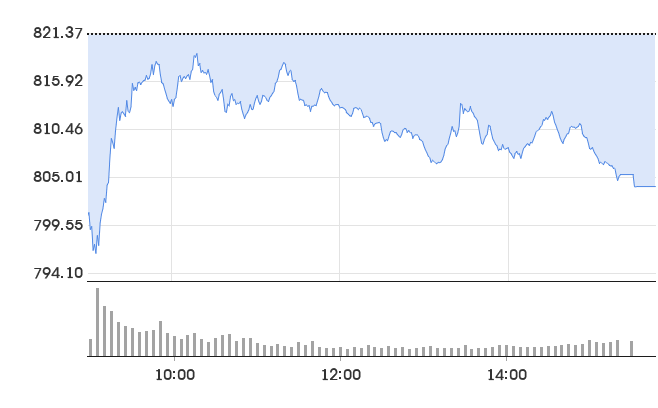
KOSDAQ, three-month daily view (Naver Finance; red=up, blue=down)
What to watch
Two points merit watching. First, whether the Hormuz blockade threat translates into concrete action or remains rhetoric. Second, whether the U.S. 10-year yield tests 4.8% again.
Today's decline was led by large-cap exporters—semiconductors, autos, and shipbuilding. The question is whether this is a one-day shock or the start of a multi-day retracement. The answer hinges on when foreign investors and institutions stem their selling. Both remain four sessions into consecutive net outflows.
This article is for informational purposes and does not constitute a recommendation to buy or sell any security. All investment decisions and outcomes remain your responsibility.
#KOSPI #KOSPIPlunge #MarketClose #MarketBrief #KOSDAQ #ForeignSelling #InstitutionalSelling #ShareBuybacks #SamsungElectronics #SKHynix #CrudeOil #WTI #USYields #StraitOfHormuz #IranStrikes #Inter-KoreanThemes #DailyLimitGainers #SemiconductorIndex #AutoStocks #ShipbuildingStocks #BatteryStocks #BiotechStocks #MiQubeSolutions #DandI #ISC #AlteoGenesis #GovernmentBondYields #KOSPIOutlook #MarketSummary
댓글
댓글 쓰기