On September 22, 2026, GNC Energy's stock touched an intraday high of 58,000 won, matching its record set on August 7. The close came in at 54,800 won, up 3.4% from the prior trading day.
But the catalyst was not a Korean company announcement. Days earlier, Amazon signed a long-term backup-power supply contract with Generac, a generator manufacturer. The deal is valued up to $8 billion. Korean retail investors, spotting a parallel opportunity in GNC Energy's power-generation business, rushed to buy.
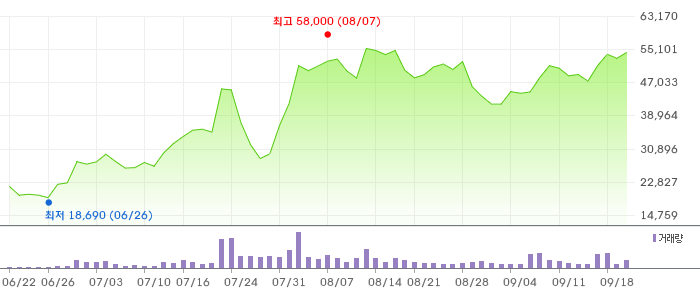
GNC Energy, three-month price action
The sector stayed quiet. Only this stock ran.
Three comparable companies in power equipment show a different picture: HD Hyundai Electrics, Hyosung Heavy Industries, and LS Electric.
· Three-month returns: HD Hyundai Electrics -18.9%, Hyosung Heavy Industries -5.9%, LS Electric +3.9%. The median: -5.9%.
· GNC Energy, over the same period, returned +186.8%.
While the power-equipment blue chips retreated, GNC Energy's move was a solo story, not a sector surge. Valuations tell the same tale: P/E multiples of 35x for HD Hyundai, 52x for Hyosung, and 110x for LS Electric contrast with GNC Energy's 22.5x—cheaper, not richer. This is not a story of overpaid gains.
Why a Generator Maker Became a Data-Center Play
GNC Energy, founded in 1989, has built backup power generators and combined heat-and-power systems—originally for facilities protecting against outages. But over the past two to three years, its customer mix shifted. A boom in AI-driven data centers brought a flood of new demand. When an outage shuts down an entire service, operators rush to secure backup-power infrastructure. Data centers are now racing to secure these units.

Byeong-chul Ahn, Chief Executive Officer, GNC Energy
GNC Energy commands an estimated 70% share of the Korean data-center backup-generator market. The company is shifting product mix toward gas-turbine systems, which carry 10–30 percentage-point higher margins than diesel units. Same top line, better bottom line.
One U.S. Contract Shook a Korean Stock
On September 16, Generac signed a long-term backup-power supply deal with Amazon Data Centers. The initial order is $2.4 billion. The total contract could grow to $8 billion. Generac's backlog for data-center power, which stood at $400 million in early 2026, swelled to $4 billion by September.
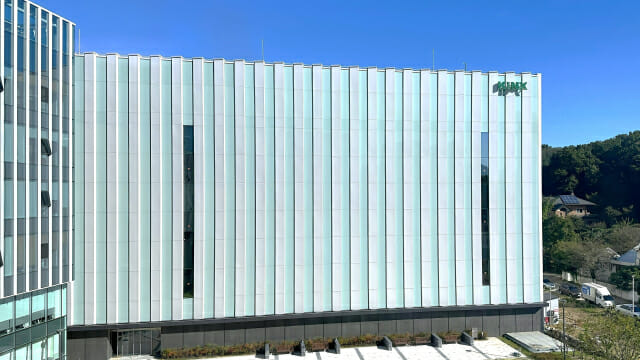
KINX data center (where GNC Energy supplied gas-turbine generators in August)
Korea mirrors the trend. In early August, GNC Energy secured a gas-turbine supply contract with KINX's Siheung facility for 32.8 billion won—equivalent to 12.5% of recent quarterly revenue. Since July, six new data-center orders landed: 254.1 billion won combined. Against a first-half backlog of 414.7 billion won, the influx in a matter of weeks is significant.
By the Numbers: Strong Last Year, Stalled This Quarter
Fiscal 2025 consolidated revenue: 262.6 billion won, up 16.1% year-over-year. Operating profit: 49.4 billion won, up 55.7%. Operating margin: 18.8%.
But 2026's second quarter struck a different tone. Revenue: 133.0 billion won, up 9.3% year-on-year. Operating profit: 20.3 billion won, down 16.8%. Operating margin: 15.3%, below year-ago levels. Orders pile up in the backlog; the recognition of those orders in earnings lags behind.
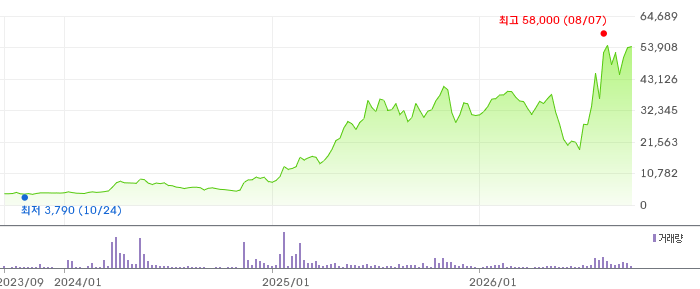
GNC Energy, three-year price action
Current market cap: 898.1 billion won. P/E: 22.5x; P/B: 4.0x. Foreign-investor ownership: 7.6%. On September 22 alone, foreign investors bought a net 85,000 shares.
The Gap Between Target and Market Price Narrows
On September 9, IBK Investment & Securities initiated coverage with a buy rating and a 70,000-won target price. At that day's close of 44,800 won, the upside implied 56%. At today's 54,800 won, the gap narrows to 28%.
IBK forecasts new orders rising from 468.6 billion won in 2026 to 1 trillion won by 2028. But IBK remains the only house to publish formal coverage on the stock. Worth noting: multiple aggregator sites display target prices ranging from the 20,000-won to 70,000-won range, with unclear sourcing. For this article, only the IBK report is cited as fact.
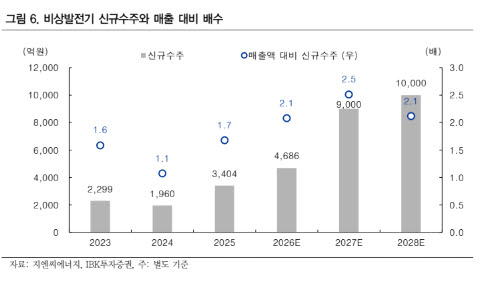
IBK Investment & Securities forecast for GNC Energy new orders (2023–2028)
So Where Does This Stock Stand?
A Korean mid-cap stock rebounded to its all-time high in two months on news from a U.S. company's contract—an uncommon picture. Yet the most recent quarter saw operating profit decline. A gap persists between the price action's implied optimism and the earnings reality.
The next test: third-quarter results. How much of the backlog orders signed since July flows into top-line and bottom-line revenue will become clear then.
A generator maker's stock moving on Amazon news feels odd and yet entirely ordinary in times like these.
This article is for informational purposes and does not constitute a recommendation to buy or sell any security.
#GNCEnergy #BackupPower #DataCenter #Generac #Amazon #GasTurbine #KOSDAQ #PowerEquipment #ArtificialIntelligence #CombinedHeatPower #KINX #IBKInvestmentSecurities #TargetPrice #KOREAMarket #EquityResearch #StockAnalysis
댓글
댓글 쓰기