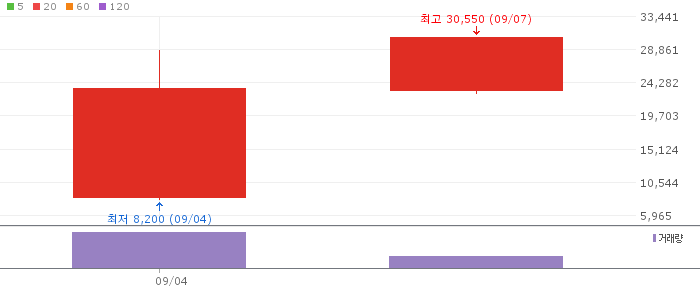
SKY LABS shares surged again on the second day of trading, now trading at more than triple the IPO price of 10,000 won.
Over the same period, KOSPI rose about 3% and KOSDAQ gained roughly 1%—the broader market was quiet. This is purely a SKY LABS story.
What happened today
The session opened with a jolt. At 9:01 a.m., only two days into the listing, a sidecar—which temporarily halts program-trading orders after a sharp futures-market move—was triggered. It lasted two minutes. It was triggered again at 11:02 a.m. Two sidecars in a single session. This typically occurs when buy orders flood the market in a compressed window.
Context from day one
Yesterday's trading (September 4, the first day of listing) provides necessary context. The IPO price was set at 10,000 won, below the lower end of the target range of 13,000-16,000 won. The opening price came in at 8,500 won, down 15% from the offer price—the stock opened underwater. Sentiment appeared tepid. But the intraday picture shifted sharply. After declining in early trading, the stock reversed course in the afternoon, climbing steeply. Investors who sold on the opening would have regretted the decision.
Why the outsized move?
New listings have limited float. Much of the allocation to largest shareholders and institutional investors sits under lock-up. The volume actually trading is small. When even modest buy orders pile up, share prices can surge materially. Two sidecar triggers in one day fits this structure.
The IPO process itself showed tepid demand. Institutional subscription ratio came in at 63.41:1; retail subscription was 2.85:1—both unremarkable by Korean IPO standards. Lock-up commitments, measured by share count, totaled only 0.17% of the offering, meaning a large volume could potentially flow to the market with minimal self-imposed constraints. The offering did not excite. What followed was a sharp reversal in investor interest.
What does SKY LABS do?
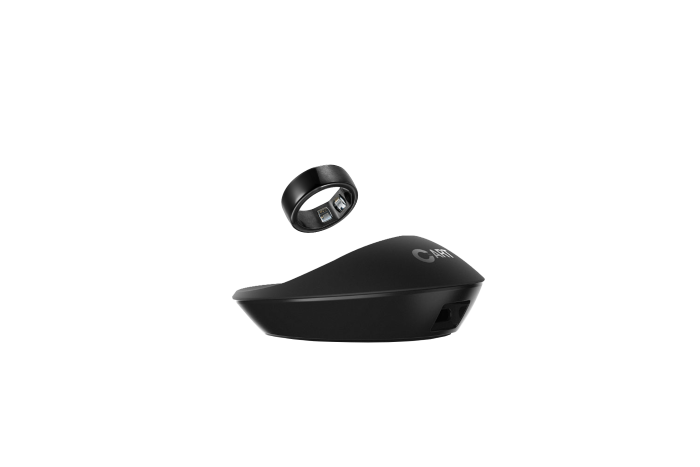
One ring takes your blood pressure. SKY LABS commercialized the world's first cuffless blood-pressure monitor—no inflatable cuff required. Its two flagship products are a hospital-grade 24-hour continuous monitor called CART BP Pro and a consumer device, CART BP. A photoplethysmography sensor embedded in the ring measures blood flow; proprietary artificial intelligence converts that signal into a pressure reading.
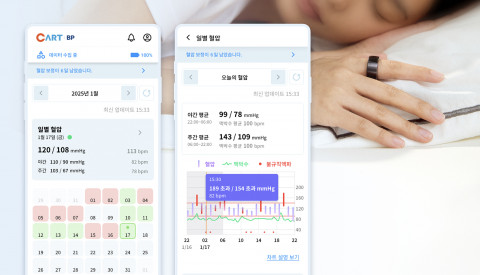
Approximately 2,000 domestic clinics and hospitals have adopted CART BP Pro. In the market for ambulatory blood-pressure monitoring, the company holds a 52.4% share. Overseas revenue accounted for 52% of total revenue in the first half of this year. At the listing conference, CEO Lee Byung-hwan outlined expansion plans: the company aims to evolve beyond blood-pressure devices into a broader "medical data platform" that aggregates diverse biometric signals.
Revenue climbs; losses climb too
Revenue, per the prospectus, reached 600 million won in 2023, 4.1 billion won in 2024, and 7.9 billion won in 2025. Growth is steep. Yet operating losses widened in parallel. A 11.7 billion-won operating loss in 2024 expanded to 14.7 billion won in 2025.
| Category | 2024 | 2025 |
| Revenue | 4.1 billion won | 7.9 billion won |
| Operating loss | 11.7 billion won | 14.7 billion won |
| Gross profit | -1.1 billion won | 3.9 billion won |
Gross profit swung from a loss of 1.1 billion won in 2024 to a profit of 3.9 billion won in 2025, signaling that underlying unit economics improved. However, SG&A expenses also climbed sharply, offsetting the gains and leaving operating losses still in the red. The critical watch point is sustainability: whether the first-half growth momentum persists across full-year results.
One concentration risk stands out: SKY LABS derives 98.2% of revenue from Daewoo Pharmaceutical (as of 2025), meaning the company has essentially outsourced domestic distribution to a single partner. Any disruption in that relationship could shake the entire revenue base.
Bottom line
SKY LABS is experiencing a classic post-IPO float squeeze—investor inflows driving the move, not underlying fundamentals. The accurate frame is thin float volatility, a routine phase for new listings. The technology is real: the company pioneered a cuffless monitor, has hospital adoption, and is generating overseas revenue. But today's 30%-plus swings are a separate matter from the company's business.
Two metrics matter going forward. First: when lock-up restrictions expire and insider shares hit the market. Second: whether the revenue growth visible in the first half continues into Q3 and across the full year. Whether this threefold surge reflects structural tightness in the float or a genuine re-rating of fundamentals will depend on what those numbers reveal.
This article is for informational purposes and does not recommend trading any specific stock.
#SKYLabs #386380 #SKYLabsStock #KOSDAQNewListing #IPO #OfferingShares #CufflessBloodPressure #WearableHealthcare #DigitalHealth #CARTBPPro #RingBloodPressure #KOSDAQStockFocus #SidecarTriggered #NewListingStock #MedicalDataPlatform #DaewoPharmaceutical #Surge #VolatilityEvent #OfferingPrice #KOSDAQ
댓글
댓글 쓰기