Tuesday morning, September 1, 2026. After-hours Monday in New York, all three major indices retreated. The Dow fell the most at -0.7%, while the S&P 500 dropped -0.33%. The Nasdaq showed relative resilience at -0.12%.
The driver was unmistakable: the U.S. struck Iranian missile launchers near the Strait of Hormuz, and Iran retaliated with an immediate attack on a U.S. military base in Jordan. The Middle East flared up again. Treasury yields jumped, and crude prices climbed.
The KOSPI had already fallen -1.79% to 6,788.88 on Monday, August 31—before this news reached headlines. That move reflected lingering weakness from semiconductor losses (the Philadelphia Semiconductor Index fell -3.47% on August 28). Now, with geopolitical risk re-emerging in the U.S. overnight, the Korean market faces a dual shock on Tuesday. Two separate pressures, one session to digest.
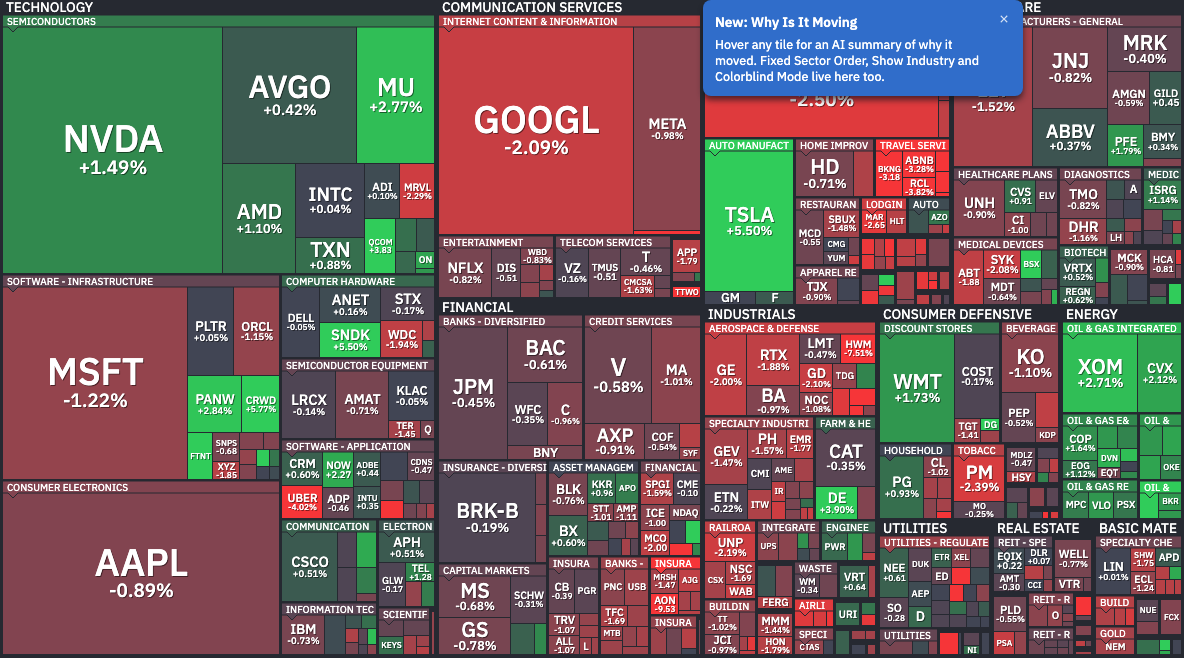
U.S. market heatmap, S&P 500 breakdown Monday night—green = gainers, red = decliners (finviz color scheme)
Dow took the biggest hit; Nasdaq weathered the storm
The Dow closed at 53,185.90, down -0.70%. The S&P 500 finished at 7,686.14, -0.33%. The Nasdaq Composite ended at 26,370.89, -0.12%. All three were in the red, but severity varied. The Dow bore the brunt; the Nasdaq barely flinched.
Why did the Dow underperform? Monday's selling pressure concentrated in cyclicals—airlines, energy, industrials—sectors where supply disruptions and fuel costs cut deepest. The Dow holds a heavier weight of these names. Large-cap technology, which anchors the Nasdaq, showed relative steadiness by comparison.
Over the full month of August, however, all three indices posted gains. The S&P 500 was up 2.5%, the Nasdaq 3.0%, and the Dow 1.3%. One day's pullback does not establish a trend reversal.
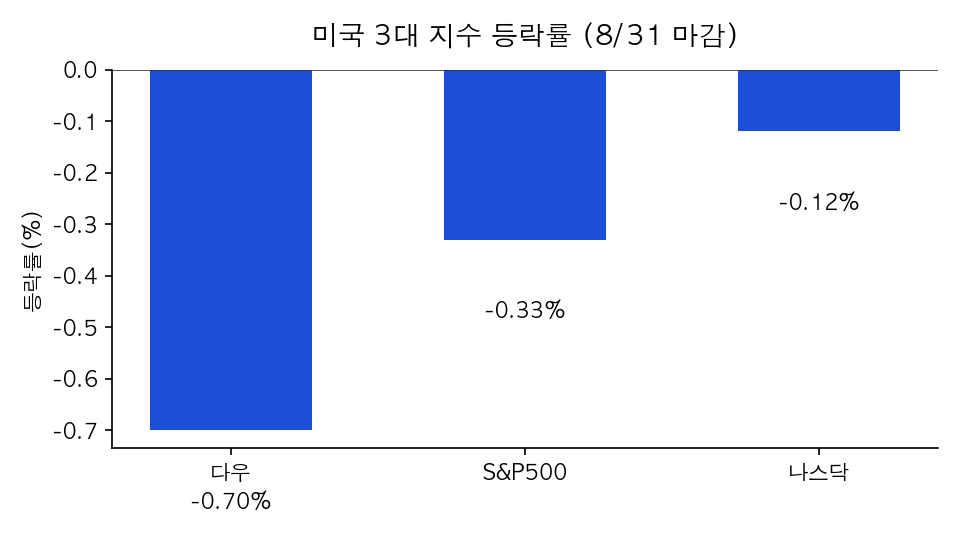
U.S. major indices, daily change as of August 31 close
Semiconductors catching their breath after Friday's rout
Last Friday, August 28, semiconductor shares took a particular beating on hawkish commentary from Fed Chair Kevin Wash. The Philadelphia Semiconductor Index dropped -3.47%; Nvidia fell -4.58%; Marvell Technology plunged -10.28%. Sharp declines. Yet the mood shifted by Monday.
Nvidia announced a $3.5 billion investment in Taiwan's MediaTek and actually rose roughly 1% in response. In other words, shares beaten down hard on Friday bounced back a day later—a classic oversold rebound. The final Monday SOX reading is not yet confirmed in this report; we will verify pre-market Tuesday before the Korean open.
Domestic chip news also broke Monday. SK Hynix will subcontract next-generation HBM base-die production to Intel; it is also reviewing a joint manufacturing plant in Japan. Against this backdrop, analyst target prices for Samsung Electronics' semiconductor business rose on the view that HBM supplier competition is normalizing. Tailwinds are accumulating. While U.S. semiconductors regain footing, Korean players are advancing on their own terms.
Treasury yields surge to 4.76%—highest since January 2025
The U.S. 10-year Treasury yield climbed 4 basis points to 4.76%, hitting its highest level since January 2025 intraday. The 30-year rose 5 basis points to 5.26%. Both pushed higher.
Two factors converged to lift rates. First, geopolitical risk drove crude prices up, raising inflation expectations. Second, Fed Chair Wash had already signaled last week that a September rate hike remained possible. Both pressures pointed in the same direction—higher rates.
The Korean bond market was already adjusting. As of August 31, Korea's 3-year Government Bond yield stood at 3.788% (up 3.3bp), and the 10-year at 4.284% (up 4.6bp). Rates here were already climbing. If U.S. yields continue rising, this uptrend could persist.
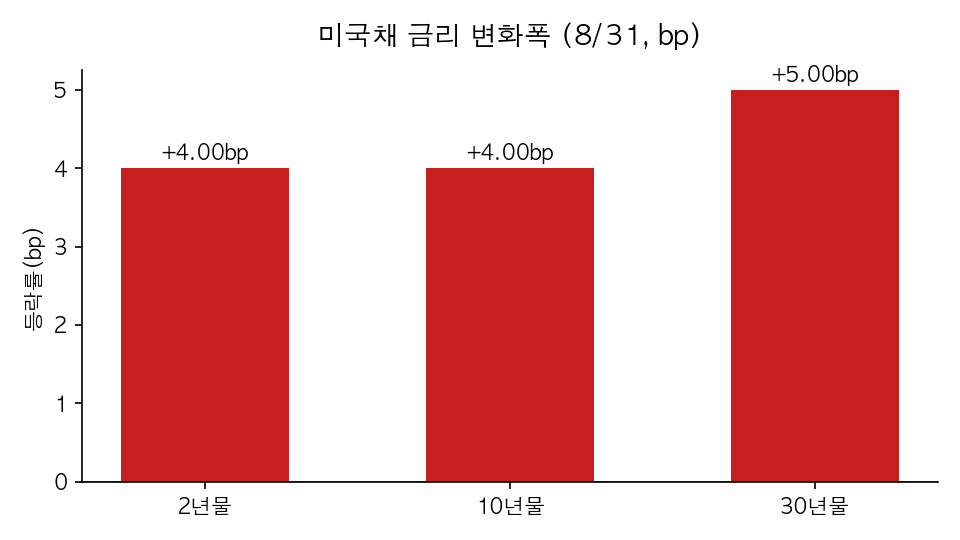
U.S. Treasury yield moves in basis points, as of August 31 close
Oil and the dollar react; geopolitical risk baked in
WTI crude climbed toward $86 per barrel; Brent crude topped $88 and edged closer to $90. The choke point is real. The Strait of Hormuz channels a material fraction of global crude supply. Any military disruption there triggers immediate worry about production outages.
The won took a different path. As of 3:30 p.m. on August 31, the dollar-to-won rate stood at 1,368.6—down 10.9 won from the prior day (won strength, dollar weakness). Month-end hedging flows from Korean exporters converting dollars to won appear to have outweighed the hawkish Fed rhetoric. That snapshot predates the Iran headlines; we need to re-check the opening won rate Tuesday morning to capture the full impact.
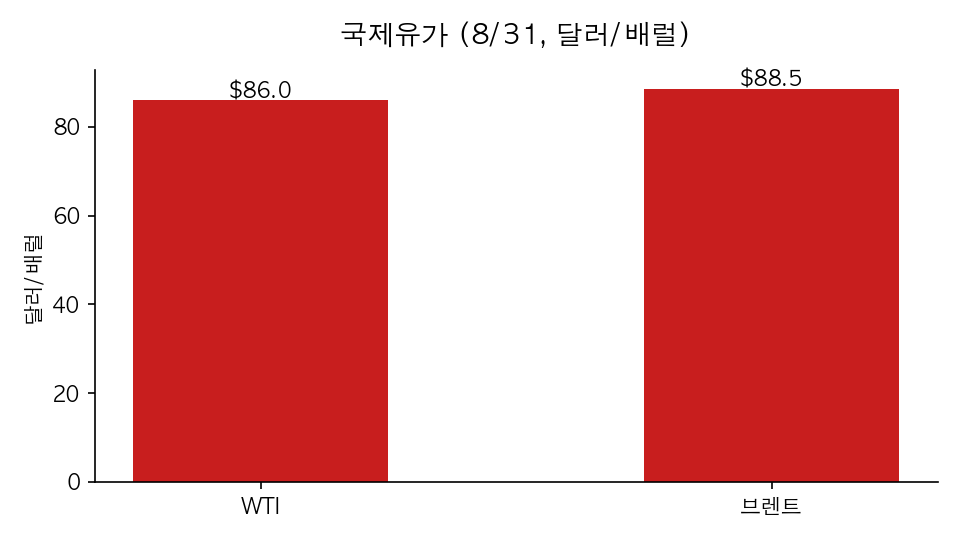
Crude oil prices, as of August 31 (dollars per barrel)
Asia: Shanghai gained, Japan and Taiwan retreated
As of August 31 close, China's Shanghai Composite Index rose +0.86% to 3,986.30. August manufacturing PMI came in at 49.8, beating the forecast of 49.5, and tech shares attracted dip-buying. Still, the reading stays below 50, signaling contraction. The slowdown persists.
Japan's Nikkei 225 fell -0.14% to 66,311.93, dragged by U.S. weakness. Japan's 10-year yield hit 2.95% intraday—its highest level in roughly 30 years since September 1996—adding pressure. However, July industrial production came in well ahead of expectations, limiting losses.
Taiwan's Weighted Index dropped -0.44% to 46,128.47, pressured by semiconductor weakness and reports that the Trump administration is considering additional chip-related tariffs. Among the three, only China closed in the black, and only by +0.86%.
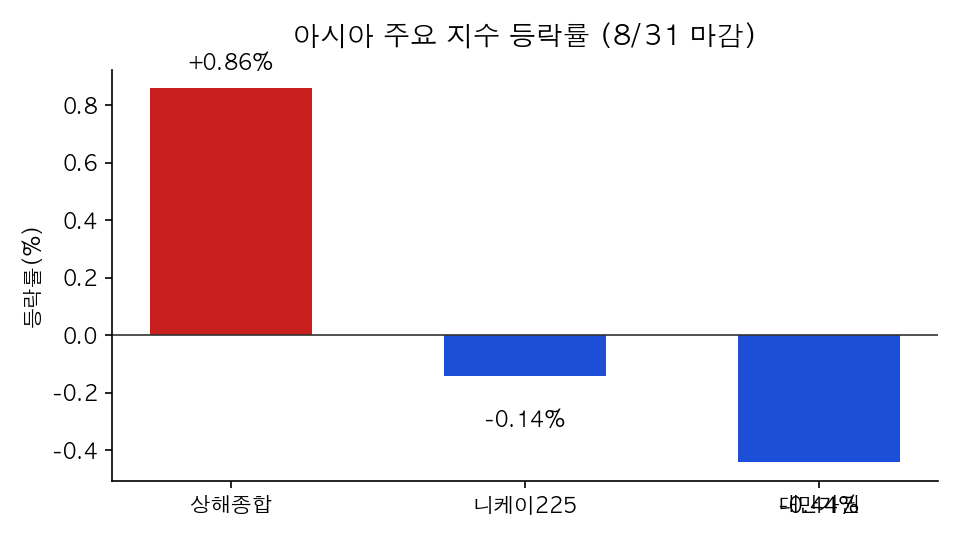
Asian major indices, daily performance as of August 31 close
What to watch: KOSPI's digest of multiple shocks
The KOSPI already absorbed a -1.79% decline on Monday (closing at 6,788.88). Now, add overnight U.S. geopolitical risk and a Treasury yield surge. The question is how these inputs compound or offset on Tuesday's Korean session.
Watch how the 4.76% U.S. Treasury yield filters into Korean growth-stock and semiconductor valuations. Note that the Nasdaq held at only -0.12%, and Nvidia bounced on the MediaTek news. Both can set the tone for domestic chip stocks.
Monitor oil-sensitive sectors—refining, chemicals, airlines—for cost-pressure responses. Also track defense and aerospace names, which often attract flows during geopolitical flare-ups. Korea Aerospace announced K9 self-propelled howitzer exports to Spain on Monday, for instance.
Finally, the SK Hynix base-die and Intel supply news and Samsung's upgraded analyst targets on HBM normalization could drive individual stock moves. These developments intersect with U.S. semiconductor momentum and may shape sector leadership.
Watch how these three currents interplay. Whether KOSPI extends Monday's losses or stabilizes will depend on the balance between yield pressure, geopolitical premia, and semiconductor-specific flows.
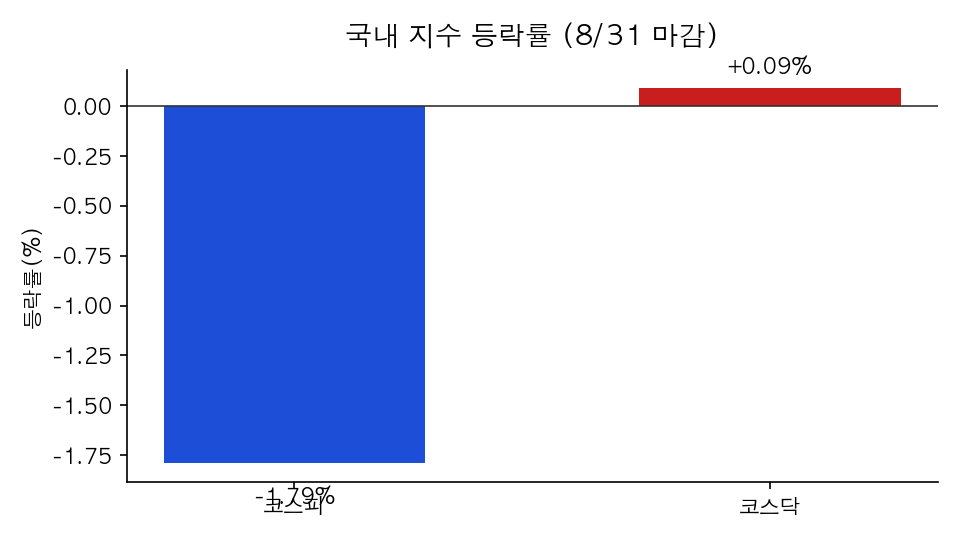
Korean indices, daily performance as of August 31 close
Summary
Monday night in New York, the Dow fell the most at -0.7%; the Nasdaq held at -0.12%. Cause: a fresh U.S.-Iran military clash. Treasury yields spiked to 4.76%—the highest mark since January 2025. Crude jumped alongside. Semiconductors, after Friday's rout, steadied Monday, with Nvidia rebounding on MediaTek investment news.
The KOSPI fell -1.79% on August 31. Tuesday's session must now absorb three concurrent pressures: rising Treasury yields, geopolitical risk premium, and semiconductor-specific developments. Track how yield headwinds, oil dynamics, and chip-sector news layer together. The result will signal whether the Korean market is absorbing these shocks or headed lower.
This article is for informational purposes only and does not constitute a recommendation to buy or sell any security. Investment decisions and their consequences remain the sole responsibility of the reader.
#USMarket #KOSPI #Nasdaq #DowJones #SP500 #TreasuryYields #CrudeOil #DollarWon #Semiconductors #Nvidia #SKHynix #Samsung #HBM #Intel #MediaTek #MiddleEastNews #GeopoliticalRisk #FedChair #RateDecisions #KoreanEquities #MarketAnalysis #StockMarket #FinancialNews #DayAhead #EquityTrends #AsiaPacific #TradeNews #InvestmentUpdate
댓글
댓글 쓰기