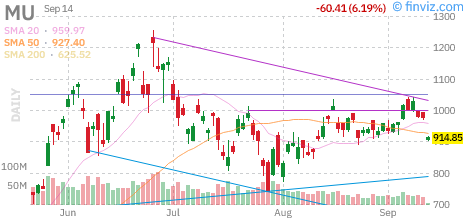
Micron Technology (MU) fell -6.59% on September 14, closing near $910 after trading at $977 the previous day. The single-day loss exceeded $60 per share. A 6-7% drop for a major semiconductor stock is not routine.
The decline, however, did not originate within Micron itself. It traced to comments from outside the company—and from people with no obvious semiconductor expertise.
Why AI executives rattled the memory-chip sector today
Anthropic Chief Executive Dario Amodei published an essay titled "We Must Pace the Frontier," arguing that AI model improvements should intentionally slow. OpenAI Chief Executive Sam Altman quickly agreed. Elon Musk reinforced the message on X, stating "Dario is right."
All three build AI systems. When builders call for slower progress, markets interpret it differently: if the pace of AI infrastructure spending—a multi-billion-dollar annual commitment—decelerates, outlays for data centers, GPUs, and memory chips may follow. Barclays strategist Emmanuel Cau told the Financial Times that the message amounts to asking "if a focus on AI safety means slower and lower capital spending."

Micron faced additional headwind: reports that the Trump administration is reviewing semiconductor tariffs that could extend to downstream products such as data-center servers and laptops.
This was not a Micron-specific selloff—the entire memory sector fell
That detail matters. SK Hynix, SanDisk, and Western Digital each fell more than 5% the same day, and Korean market semiconductor shares fell in sympathy. Micron was not singled out by company-specific news or earnings misses. The entire memory-chip sector absorbed the same headwind simultaneously.
Micron fell 7.7% on July 28 following a Broadcom earnings report that triggered sector-wide selling, and dropped nearly 7.4% on August 24 when patent disputes intersected with reports that Apple was reviewing Chinese-sourced memory components. This marks the third sharp decline in two months. The pattern suggests sector volatility tied to the AI cycle rather than isolated bad news.
What is the company's actual condition?
Micron manufactures DRAM and NAND flash memory. Recently it has ramped production of HBM4 memory for Nvidia's next-generation Vera Rubin GPU platform, rapidly growing its AI-server revenue share.
Fiscal 2025 revenue reached $37.38 billion, up 48.9% year-over-year. Net income was $8.54 billion—a climb of nearly 998%, not merely a return to profitability but a wholesale earnings rewrite.
Valuation stands out. The current P/E sits at 22x; on a forward basis (next fiscal year), it compresses to 6.76x. The market is pricing in continued earnings expansion. The next measurement point arrives September 30 with fourth-quarter results. Company guidance calls for revenue near $50 billion; Wall Street consensus is $50.8 billion.


Yet analyst price targets remain elevated
This detail reveals the character of today's decline. Analysts have not adjusted targets downward in response.
| Firm | Rating | Price Target |
|---|---|---|
| Morgan Stanley | Overweight | $1,050–1,200 |
| Citigroup | Buy | $1,150 |
| Wall Street Consensus | Buy | $1,295.63 |
Against current price near $910, consensus sits roughly 40% above. This contradicts any "overvaluation" narrative. Today's decline stems not from company results or valuation concerns. It reflects how a single statement from outside the AI industry can unsettle the entire sector's investment psychology.
What risks remain?
· Statements about AI slowdown have not yet translated into actual capital-spending cuts. One comment does not set policy.
· Semiconductor tariff extension to finished goods such as servers and laptops remains under review, not yet decided.
· The stock trades 27% below its 52-week high of $1,255. High intraday volatility leaves room for further swings.
· Major customers such as Apple moving portions of memory purchasing to Chinese suppliers remains a factor that rattled shares in August.
· If September 30 fourth-quarter results fall short of the $50 billion guidance, the pullback could extend.
Bottom line
Today's decline does not reflect deteriorating Micron operations. It is a sector-wide correction triggered by AI industry leaders suggesting a slower growth path. Earnings are expanding at multiples of prior-year levels. Forward P/E stands at 6.76x, and analyst consensus targets remain 40% above current price.
One date matters: September 30, when fourth-quarter results arrive. The test is whether guidance of $50 billion holds and whether forward guidance addresses AI-demand slowdown concerns. Today reconfirmed what investors already knew—a stock swinging 6% on sentiment alone.
U.S. listed security. This article is factual analysis, not a buy or sell recommendation. Investment decisions and outcomes are your own.
#Micron #MU #semiconductor #memory chips #HBM #AI #stock #Nasdaq #SK Hynix #SanDisk #Western Digital #Nvidia #AI safety #capital spending #tariffs #earnings #price target #stock volatility
댓글
댓글 쓰기