Many people researching a job change start by looking up unemployment insurance. But the details split into two separate questions: how much you get, and whether you qualify at all.
Reviewing the rules again, one thing stood out. Whether your salary is 2.5 million won or 4 million won, the daily benefit amount barely differs. Why? Here's what you actually receive—and the 13 disqualifying circumstances most people don't know exist.
Daily payment: how much?
Unemployment insurance, formally called the job-seeker benefit, is calculated at 60% of your average salary over the three months before separation, paid daily. Most people know this part.
What follows is where it gets tricky. The Ministry of Employment and Labor has announced a 2026 amendment to implementing regulations, setting the daily maximum at 68,100 won. This is the first increase since July 2019—more than six years.
But the daily minimum rose too. South Korea's 2026 minimum wage is 10,320 won per hour. Calculate 80% of that times 8 hours, and you get a daily minimum of 66,048 won. The gap between minimum and maximum is just 2,052 won.
Those numbers are hard to visualize. Here's what you actually receive by salary level.
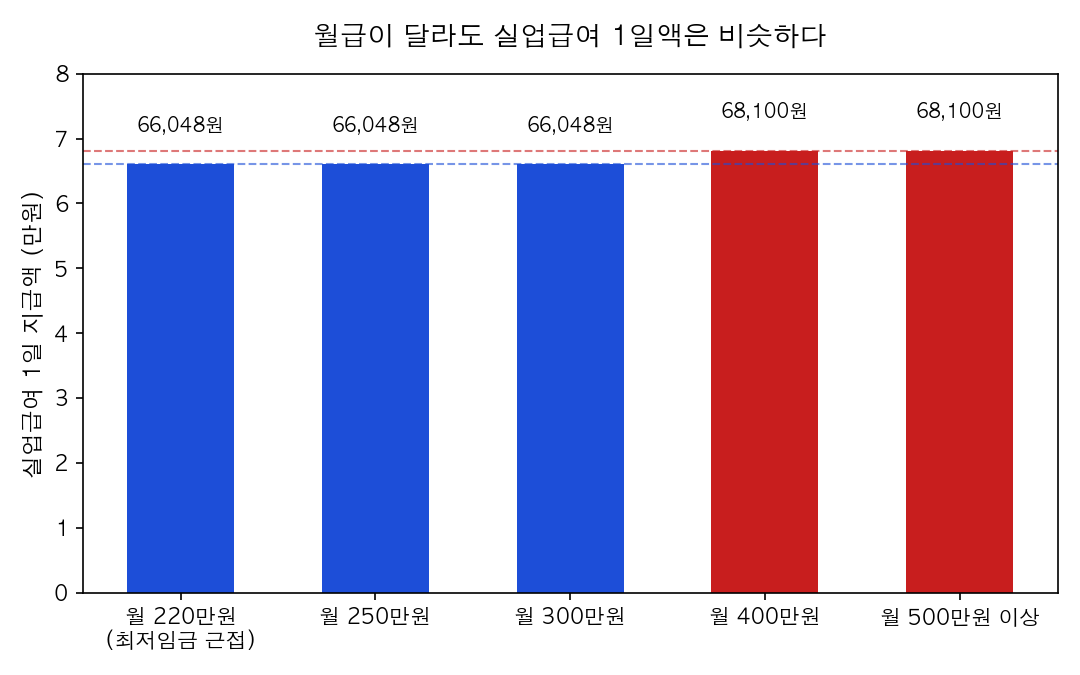
Own calculation (simulation using 2026 minimum and maximum rates)
Salaries in the 2.2–2.5 million won range hit the daily minimum of 66,048 won even after calculating 60%. At 3 million won, the amount is little different. Most mid-income earners get roughly the same benefit. Only once salary exceeds 4 million won does the daily amount rise meaningfully.
Annualized to a month, the minimum is roughly 1.98 million won and the maximum roughly 2.04 million won (on a 30-day basis). You might think that's low. But the system doesn't replace your full previous salary. It's designed to cover basic living expenses until you find new work.
For how many days?
More often confused than the amount is the duration. The specified number of benefit days depends on your age and how long you've paid unemployment insurance. The range is 120 to 270 days.
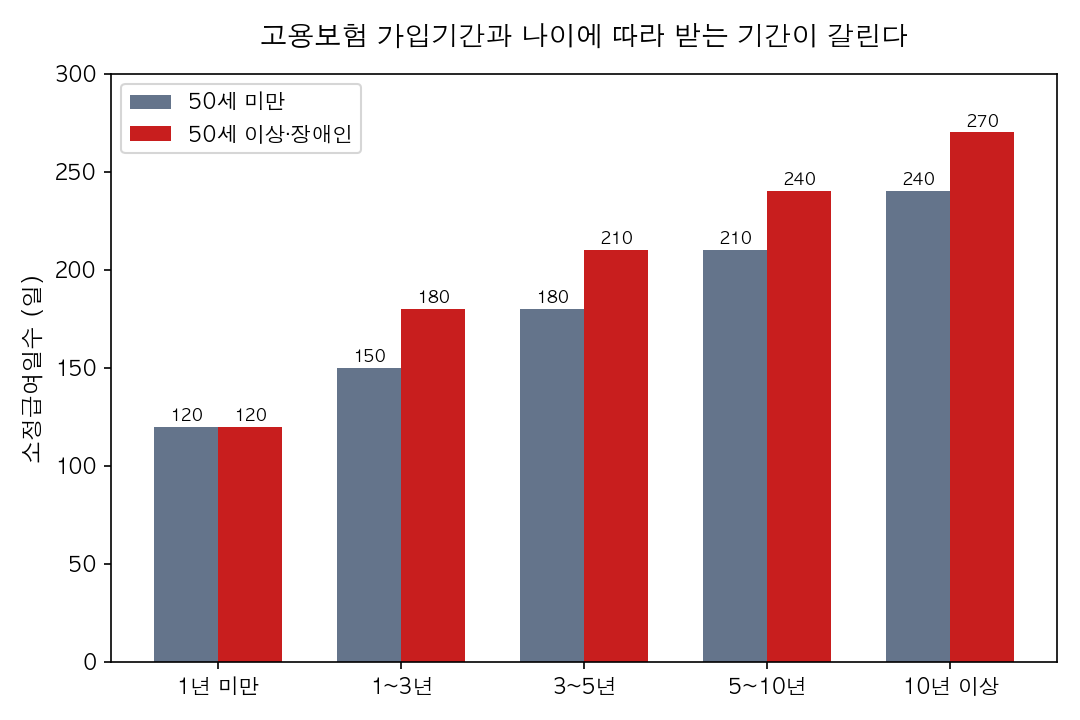
Own compilation (Ministry of Employment and Labor basis)
| Contribution Period | Under 50 | Age 50+, Persons with Disabilities |
|---|---|---|
| Less than 1 year | 120 days | 120 days |
| 1–3 years | 150 days | 180 days |
| 3–5 years | 180 days | 210 days |
| 5–10 years | 210 days | 240 days |
| 10+ years | 240 days | 270 days |
Here's the surprise: whether you're in your 20s or 40s, 10 years of contributions earn the same benefit period. Age is divided into only two brackets—before and after 50. You might expect your 30s and 40s to be treated differently, but they're not.
Multiply the daily minimum of 66,048 won by 240 days and you get roughly 15.85 million won—not trivial. But first you have to qualify.
More reasons to be disqualified than you'd think
The most common misconception is this: "I quit voluntarily, so I won't get benefits."
The principle is sound. Voluntary resignation ordinarily disqualifies you. But principles have exceptions.
South Korea's Unemployment Insurance Act lists 13 circumstances of "just cause for job separation"—situations where you voluntarily left but still qualify. Resignation within these circumstances does not disqualify you.
The catch: these aren't hard-and-fast rules. The Korea Workers' Compensation & Welfare Service reviews each case individually. Two people claiming "unpaid wages" can get opposite decisions depending on how long wages were delayed and how much money was involved. "Commute became difficult" is evaluated by distance and time.
That's why checking your circumstances in advance makes sense. Contact Work24 or call 1350. Many people assume they won't qualify and don't even apply—the biggest mistake of all.
On the other end, the company may initiate separation through layoff, incentivized resignation programs, or contract expiration. Most such cases raise no eligibility issue. But terminations for serious misconduct—embezzlement, grave rule violations—can still disqualify you.
One more threshold: if your unemployment insurance contribution period is less than 180 days in the 18 months before separation, you're disqualified regardless of the reason. If you've held a job only briefly, check this baseline first.
So what's your situation?
Three things to verify:
First, confirm 180+ days of contributions in the 18 months before separation. Second, verify your separation reason—whether it was employer-initiated or, if voluntary, whether it falls under one of the 13 qualifying causes. Only if both pass does calculation matter. Then determine your benefit period by age and contribution history, and calculate your daily amount at 60% of average wages.
Step three: almost all amounts converge between a daily minimum of 66,048 won and maximum of 68,100 won. That's the takeaway. Your salary difference doesn't translate into benefit difference. Knowing this in advance softens disappointment.
If your reason is borderline, verify before you resign. Once you leave, you can't change your stated reason.
When you qualify but still lose money
Even with approved eligibility, procedural mistakes can cost you real money.
You can apply the day after separation, but you must do so within 12 months. Miss the deadline and payments stop—regardless of other circumstances or remaining benefit days. Some people delay applying to receive everything in a lump sum and end up missing the window.
While receiving benefits, you must obtain unemployment certification at regular intervals—proof you've been job-hunting. Miss one and that payment disappears. It doesn't carry forward to the next cycle.
One commonly missed detail: reporting earned income. If you take part-time or gig work while receiving benefits, you must report it. Failing to do so and getting caught is far worse than missing a certification. You'll have to repay what you received, plus a penalty of up to 5 times the amount.
Clearing eligibility review and actually receiving all your money are different matters. Application deadline, certification cycle, income reporting—these three are where money slips away.
This article is for informational purposes and does not recommend any specific claim or appeal. Regulations and amounts can change; before applying, verify your situation at Work24 (work24.go.kr) or by calling 1350.
Sources: Ministry of Employment and Labor press release (job-seeker benefit maximum and minimum amendments), FAQ (payment duration and amount), 1350 customer service FAQ (just cause for separation)
Your personal circumstances determine your eligibility and benefits.
댓글
댓글 쓰기