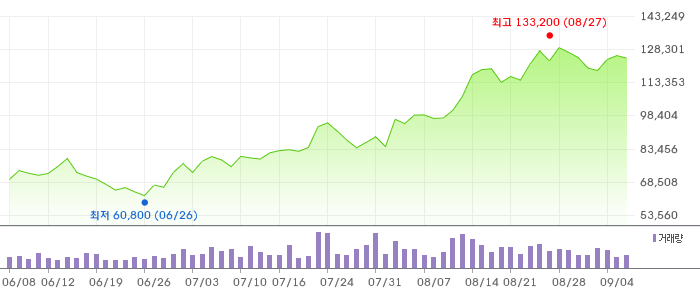
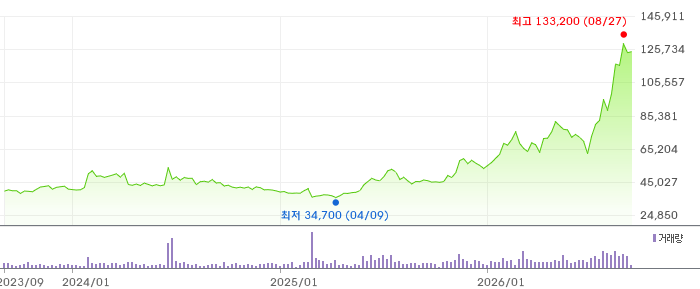
GS Holdings closed at KRW 124,500 on September 8, trading near its 52-week high. That's up 41.84% from KRW 84,600 on August 3. A holding company doesn't typically rally 40% in a month.
The market cap stands at KRW 11.57 trillion. For a conglomerate housing GS Caltex, GS Retail, and GS E&C, it's a modest valuation—yet GS has become the hottest holding-company stock in the KOSPI lately.
So why is GS racing ahead of other holding companies?
Compare three-month returns across four major Korean holding companies: GS +71.7%, LG +11.6%, SK +1.7%, Lotte Holdings -8.5%. The median is +1.7%. The sector as a whole is flat. GS is an outlier.
SK trades at 27.6x P/E and LG at 25.7x—both pricier than GS's 14.8x—yet GS has delivered the strongest three-month performance by far. It's not simply a matter of cheaper valuation rising faster. Lotte Holdings, which carries a negative P/E (the company is loss-making), has actually fallen the most, down 8.5%.
The divergence boils down to one thing: not holding-company premium, but subsidiary earnings—specifically, the oil refining business.
The numbers themselves
GS reported Q2 2026 revenue of KRW 7.4131 trillion and operating profit of KRW 1.7174 trillion, up 253.37% from KRW 486 billion in the prior-year quarter. Net income reached KRW 1.132 trillion, up more than 12-fold from KRW 88.4 billion.
For the first half, cumulative revenue was KRW 14.2555 trillion and operating profit KRW 2.976 trillion—up 130.8% from H1 2025's KRW 1.2893 trillion. GS's entire 2025 operating profit was KRW 2.9361 trillion. The company generated that in six months.
The driver is GS Caltex. Rising crude prices and higher petroleum-product export prices have expanded refining margins. The lubricant division posted record earnings amid a global supply shortage. Shinhan Investment Corp. projects H2 2026 combined refining margin will reach $30 per barrel—three times the prior-year Q4 figure of roughly $10 per barrel.
Target prices are already in the rearview mirror
On May 13, KB Securities assigned GS a Buy rating with a KRW 115,000 target price, citing sequential improvement across all business lines—crude production, refining, chemicals, lubricants, and power generation—following geopolitical tensions, plus 2026 earnings projected at 3.2 times the 10-year average.
The stock is now at KRW 124,500, well above that target. The market isn't stopping. Analysts tracking recent momentum note that refining earnings gains are being accompanied by enthusiasm around the company's AI data-center ambitions. The rally's magnitude suggests sentiment beyond one quarter of refining results.
Dividend appeal is expanding too. KB expects the dividend yield to expand from 6.4% to 8.2% across 2026-2028, as a refining boom pushes through to shareholder returns.
But refining margins don't last
A $30-per-barrel refining margin is anomalous. It reflects supply-chain stress from geopolitical risk and lower Asian pricing from Saudi Aramco. Neither condition is permanent.
If geopolitical tensions ease or refining utilization normalizes, margins will compress. And there's another concentration risk: most of GS's earnings now come from GS Caltex alone. Operating profit is highly concentrated. A downturn in refining ripples across the entire holding company.
GS Retail and GS E&C lack the earnings scale to offset a refining-profit decline.
What to watch
GS is the only holding company in the peer group where earnings and stock price are rising in tandem. But the fuel is a single business—refining—dependent on margins that are cyclically elevated.
The key question: Does refining margin stay above $20 per barrel in the next quarter? If yes, the rally is a re-rating supported by fundamentals. If it collapses, the stock follows.
For now, one refining business sustains the entire holding company. The crude oil market holds the answer to how long that lasts.
This article provides information to support investment decisions and does not recommend buying or selling any specific security.
#GS #GSHoldings #GSCaltex #078930 #HoldingCompanies #OilRefining #RefiningMargins #NewHigh #CrudeOil #KOSPI #Dividends #TargetPrice #KBSecurities #ShinhanInvestment #GSRetail #GSE&C #Geopolitics #AIdatacenters #StockMarket
댓글
댓글 쓰기