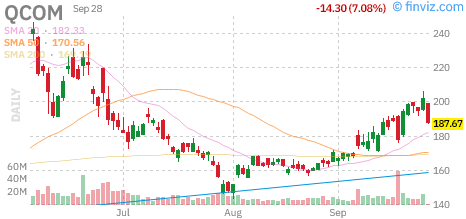
On the morning of September 28 (US time), Qualcomm stock slid nearly 7% from the previous close of $201.97, now trading around $187. This reversal came just one day after the company had climbed over 23% in a month—giving back a substantial portion of those gains in a single session.
Did other semiconductor leaders fall with it?
A single stock's decline can be misleading without context. Here's how other semiconductor leaders moved during the same period:
· Semiconductor sector index (SOXX): -1.74%
· Broadcom: -0.12%, essentially flat
· Skyworks Solutions: -1.74%
· Qualcomm alone: around -7%
The numbers tell a clear story: the broader sector held steady while Qualcomm stumbled. This wasn't a sector-wide issue. The pressure on Qualcomm reflects something specific to the company itself.
So what exactly happened?
There is no single company announcement or headline that explains today's move cleanly. As of this morning, there were no negative disclosures from Qualcomm. However, the pattern of the past several days suggests an underlying dynamic.
Qualcomm hit a two-month high on September 15. On the 21st, it jumped on news of a US-China summit meeting. It climbed again on the 25th. That's one month of relentless gains—more than 23% cumulatively. When a stock rises that steeply without pausing, profit-taking eventually arrives without any news catalyst at all. Today's decline reads as a correction.
On September 24, Qualcomm announced a renewal of its global patent license agreement with Apple, effective April 2027. Normally that would be bullish. Yet the stock fell that day too. Good news didn't lift it. That suggests the market is worried about something else.

Snapdragon Summit in Maui, September 22–24, where new chipsets were unveiled
What the market is really worried about: Apple
Qualcomm's long-standing vulnerability is Apple. Apple has been rolling out its own modem chips—C1 and C2—and stripping Qualcomm parts out of iPhones one by one. The company itself has acknowledged this. It now expects its modem's share in the next iPhone to fall significantly below the prior forecast of around 20%.
The most recent quarter—fiscal year 2026 Q3—showed this fracture in the numbers. Handset chip revenue fell 20% year-over-year. By contrast, automotive revenue surged 61% to $1.588 billion. That marks 23 consecutive quarters of double-digit growth in that segment. Qualcomm is replacing the money it's losing in smartphones with gains in automotive and data center.
So what kind of company is Qualcomm now?
Qualcomm's revenue flows through two main channels. QCT, its semiconductor division, sells Snapdragon chips. QTL, its licensing division, collects royalties on its patented technology. The renewal of the Apple license agreement will keep QTL revenue stable for now. The real question is QCT. Handset chip revenue is already weakening.
The company has laid out a concrete plan to reduce its dependence on smartphones. Its fiscal year 2029 target for non-handset revenue is $40 billion—an ambitious number. At the Maui Snapdragon Summit on September 22–24, it unveiled the Snapdragon 8 Elite Gen 6, a new chipset focused on on-device agentic AI. Manufacturers including Xiaomi and Motorola shared the stage to show off new products powered by it.


Snapdragon 8 Elite Gen 6 announcement (left); on-device AI architecture explanation (right)
What are analysts saying about the decline?
Analyst target prices include $228.68 with a buy rating—higher than current levels. That data predates today's decline. A target above the current price suggests analysts don't view the stock as overvalued at these levels. That doesn't mean it's immune to single-day pullbacks like today's.
For reference, the 52-week high is $257.56. Today's trading around $187 is still below that peak.
What risks remain?
· Apple modem revenue contraction — the company itself has cautioned that its modem's share in the next iPhone will drop significantly below 20%
· Handset margin pressure — QCT margins in the most recent quarter fell below the company's typical range of 48–50%
· Pace of the transition to automotive and data center — the $40 billion FY2029 target is ambitious, but those segments still represent a small share of total revenue today
· Near-term volatility — after rising 23% in a month, profit-taking waves could emerge at any time
Where does Qualcomm stand now?
In one sentence: a company trying to escape its dependence on smartphones is experiencing the growing pains of that transition. Handset revenue is shrinking. Automotive and AI revenue are catching up but haven't yet fully closed the gap. The numbers prove this structural shift is real. Today's 7% drop looks less like a structural concern and more like profit-taking after a steep run.
What to watch comes down to one thing: whether automotive and data center revenue actually offset the handset decline in the next quarter. Until those numbers arrive, there's no point obsessing over a single day's move. Mark the next earnings date on your calendar instead.
A company once tethered to smartphone screens is now reaching toward the displays on car seat-backs. How that gamble plays out remains uncertain.
Qualcomm is a US-listed stock. This article is a factual analysis, not a recommendation to buy or sell. Investment decisions and outcomes rest with you.
#Qualcomm #QCOM #Qualcomm-stock #Apple #iPhone-modem #semiconductor-stocks #Snapdragon #agentic-AI #automotive-chips #data-center #Broadcom #Skyworks #SOXX #Nasdaq #US-stocks #semiconductor-sector #Qualcomm-earnings #Qualcomm-outlook #analyst-target #on-device-AI
댓글
댓글 쓰기