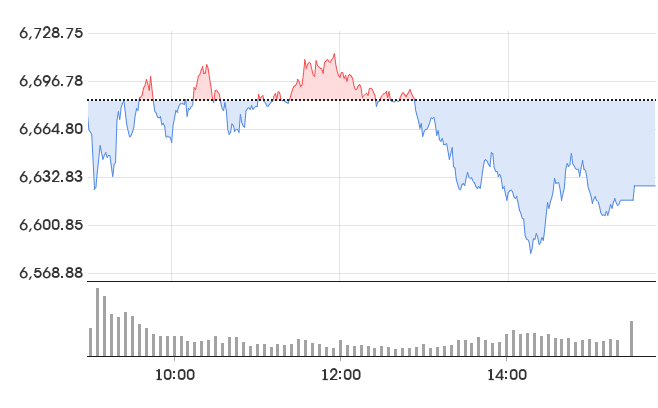
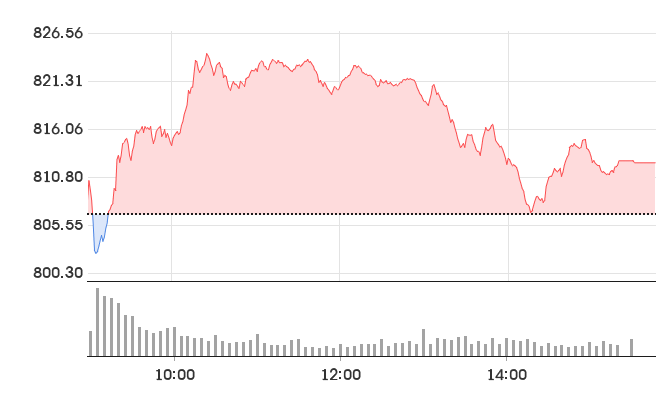
The KOSPI closed at 6,627.26 on September 15, 2026—down 57.11 points, or -0.85%, extending losses to a fourth consecutive trading day. The KOSDAQ, by contrast, rose 0.70% to 812.41, snapping three days of declines. By index, the session looked weak. Yet nearly a dozen stocks hit daily price limits on the upside. The gap between headline weakness and individual strength warrants examination.
KOSPI daily chart (Naver Finance)
Why KOSPI Couldn't Find Its Footing
The index opened lower at 6,659.25. Mid-morning, it recovered to 6,715.46 and briefly turned positive. By afternoon, momentum evaporated. KOSPI fell to 6,582.20. Late-session buying pared losses before another decline, closing at 6,627.26. Intraday swing from high to low exceeded 133 points—a 2% plus range—indicating choppy sentiment.
The backdrop lay overnight in U.S. markets. AI investment deceleration talk spread, weighing on U.S. semiconductor shares. The U.S. 10-year Treasury yield briefly topped 5% intraday—the first time since October 2023. Oil surged on news that a critical Saudi pipeline came under attack. West Texas Intermediate rose 1.34% to $101.39 a barrel; Brent crude gained 1.02% to $105.68. Rising rates, climbing oil prices, and AI concern converged on one session.
Foreign Investors Sold Large Caps, Bought Growth
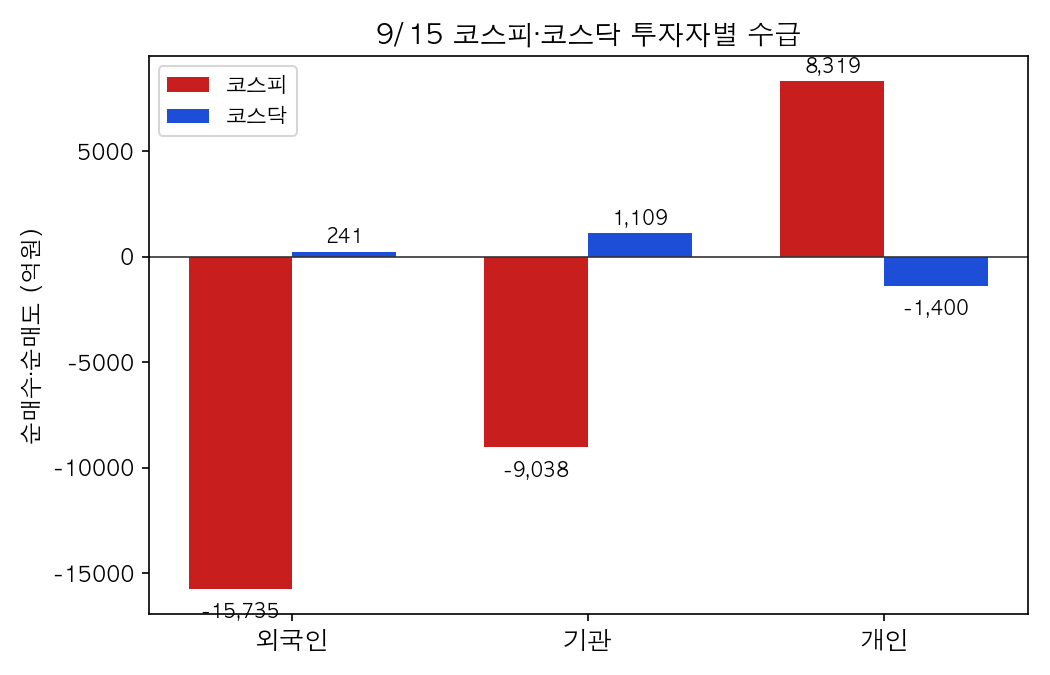
Investor flow data clarified the market split. Foreign investors sold 1.574 trillion won and institutions 903.8 billion won on the KOSPI. Foreign investors have sold for five consecutive trading days. Institutions have sold for three days. Retail investors, alone, bought 831.9 billion won, cushioning KOSPI losses for a fourth day.
The KOSDAQ showed the opposite pattern. Foreign investors bought 24.1 billion won and institutions 110.9 billion won, each turning to buying after four and three days of selling, respectively. Retail investors sold 140 billion won, reversing to selling after three days. On the same day, foreign investors sold large-cap Korean stocks and bought growth stocks. Capital rotated from KOSPI—laden with semiconductors, autos, and financials—toward KOSDAQ themes such as robotics, secondary batteries, and biotech.
Compiled and drawn by author — September 15 KOSPI/KOSDAQ investor net flows, units in 100 million won
KOSDAQ daily chart (Naver Finance)
Robotics Actuators: Why the Sudden Squeeze
The day's winners clustered sharply in one sector. Robot joint actuators—the mechanical components that move robotic limbs—drew disproportionate attention. Samhyun (+29.80%), SPG (+13.34%), Wonkwang Holdings (+14.38%), KNR Systems (+17.75%), Korea PIM (+12.17%), and Halla Cast (+10.98%) all surged. Six names tied to the same theme: expanding global demand for robotic joint actuators. Market interpretation attributed the rally to physical AI and humanoid robot momentum overlapping with actuator supply expectations.
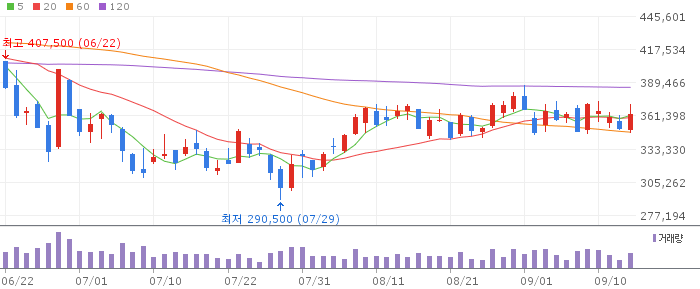
Secondary battery names also strengthened. The U.S. is tightening efforts to reduce its reliance on Chinese battery supply. Korean suppliers stand to capture share. LG Energy Solution (+3.98%), SK Innovation (+3.66%), and Samsung SDI (+2.82%) rose in tandem. SM Vell drew particular notice. The company disclosed co-development of lithium-manganese-rich (LMR) chemistry with Ford, and the largest shareholder's stake exceeded 89%. Speculation about forced delisting from voluntary delisting drove a +18.72% jump.
LG Energy Solution daily chart (Naver Finance, red = gain / blue = loss)
Broadcaster Hits Daily Limit in Rare Move
Among daily-limit gainers sat an unusual name: YTN, a media company. It rose 29.80% to the daily price ceiling. Disclosure that the Board of Audit and Inspection had found evidence of improper intervention in YTN's share-sale process ignited the move. Media and broadcast stocks broadly benefited. Daily price limits typically mark earnings beats, drug approvals, or technology breakthroughs—not share-sale governance findings. Today was an exception.
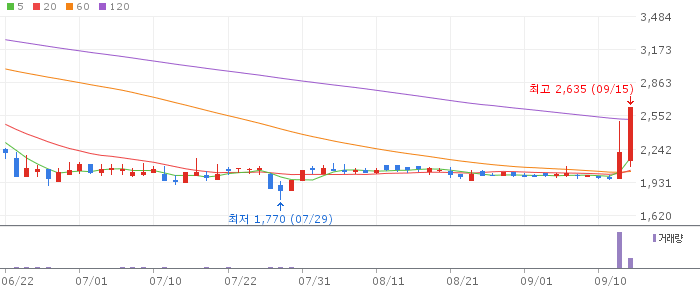
YTN daily chart (Naver Finance, red = gain / blue = loss)
Sectors That Stumbled
Not all sectors rallied. Shipbuilding slid on mounting concerns over labor strikes by the Korean shipbuilders' union, and Hanwha Aerospace (-6.51%), HD Hyundai Heavy Industries (-5.32%), and Hanwha Ocean (-4.07%) ranked among the largest-cap losers. Property & casualty insurers fell after H1 auto-insurance underwriting swung to loss for the first time in six years. Airlines retreated on jet fuel pressures from climbing oil. Transport equipment and parts (-3.35%), insurance (-3.08%), retail (-2.75%), and finance (-2.18%) posted the largest sectoral declines.
| Item | KOSPI | KOSDAQ |
|---|---|---|
| Close | 6,627.26 | 812.41 |
| Change | -0.85% | +0.70% |
| Foreign investors | -1,574 billion won | +24.1 billion won |
| Institutions | -903.8 billion won | +110.9 billion won |
| Retail investors | +831.9 billion won | -140 billion won |
Won Weakness and Yield Moves Tracked in Parallel
Markets beyond equities signaled the same pressure. The won/dollar rate jumped 13.2 won to 1,359.4 as of 3:30 p.m., versus the prior evening's close. The three-year government bond yield climbed 6.6 basis points to 4.091%; the 10-year rose 6.4 basis points to 4.600%. U.S. Treasury yields at 5% flowed directly through to Korean rates and the exchange rate. Behind KOSPI's four-day decline lies macroeconomic pressure—not isolated stock strength.
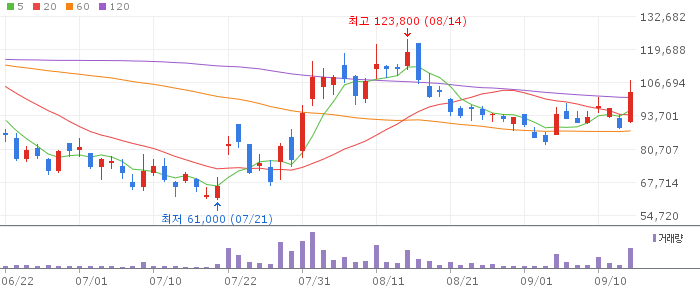
SPG daily chart (Naver Finance, red = gain / blue = loss) — representative robotics actuator theme name
What to Watch
In isolation, today's session showed headline weakness beneath which individual themes like robotics and secondary batteries held strength. Whether that rotation persists hinges on two factors: whether the U.S. 10-year yield remains above 5%, and whether AI investment moderation translates into actual earnings headwinds. The immediate signposts are U.S. Treasury yields and semiconductor guidance. For KOSPI's direction, the critical variable remains whether foreign investors extend or reverse their five-day selling streak.
For context on the 3%-plus selloff last session, see this post. The recent oscillation between 7,000 and current levels is detailed here.
This article is provided for information purposes and does not constitute buy or sell advice. All investment decisions and outcomes rest with the individual investor.
#KOSPI #KOSPIindex #KOSDAQ #KOSDAQindex #MarketClose #KoreaMarket #ForeignInvestors #InstitutionalSelling #RobotStocks #JointActuators #HumanoidRobots #SecondaryBatteries #LGEnergySolution #SamsungSDI #SKInnovation #SPG #YTN #U.S.TreasuryYield #Oil #WTI #KoreanWon #GovernmentBonds #AIModeration #SemiconductorStocks #Shipbuilding #Insurance #Airlines #DailyLimit #SurgeStocks #Investing #MarketOutlook
댓글
댓글 쓰기