KOSPI closed at 6,717.97 on September 16, up 90.71 points or 1.37%. The gain stands out given overnight developments: U.S. 10-year Treasury yields topped 5% and oil prices surged to their highest in roughly four months—typically headwinds for equity markets. Yet by day's end, semiconductors had carried the broader index higher.
The rally marked the first advance in five sessions, propelled by semiconductor-sector momentum linked to two separate developments around SK Hynix.
Index and flows
KOSPI opened at 6,611.24, dipped to 6,598.87 early in the session, recovered to near 6,680 before retreating again, then pushed higher in the afternoon to close at session highs. Institutional investors led the rebound, purchasing a net KRW 1.2 trillion—their first net-buying day in four sessions. Foreign investors remained sellers, offloading a net KRW 1.68 trillion and extending their selling streak to six consecutive days. Retail investors net-sold KRW 1.19 trillion, resuming selling after a one-day pause. Other corporate entities, by contrast, net-bought KRW 1.66 trillion—underscoring a fragmented picture with institutional and corporate support narrowly offsetting foreign outflows.
KOSDAQ gained 0.44% to 815.98, marking its second consecutive advance. Retail investors net-bought KRW 13 billion and institutional investors KRW 17 billion; foreign investors net-sold KRW 28.5 billion.
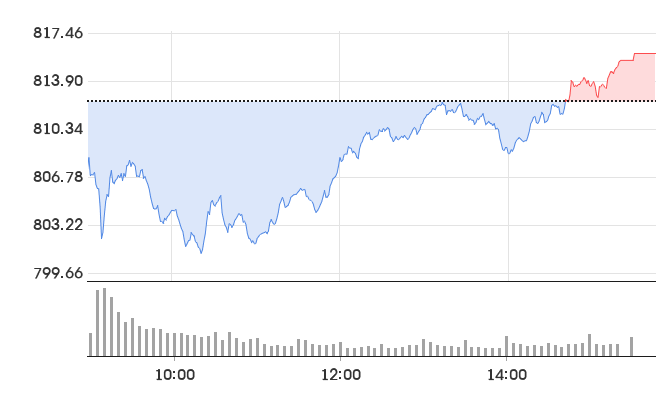
KOSDAQ daily chart (Naver Finance)
| Category | KOSPI | KOSDAQ |
|---|---|---|
| Close | 6,717.97 (+1.37%) | 815.98 (+0.44%) |
| Foreign investors | −KRW 1.68T | −KRW 28.5B |
| Institutional investors | +KRW 1.21T | +KRW 17B |
| Retail investors | −KRW 1.19T | +KRW 13B |
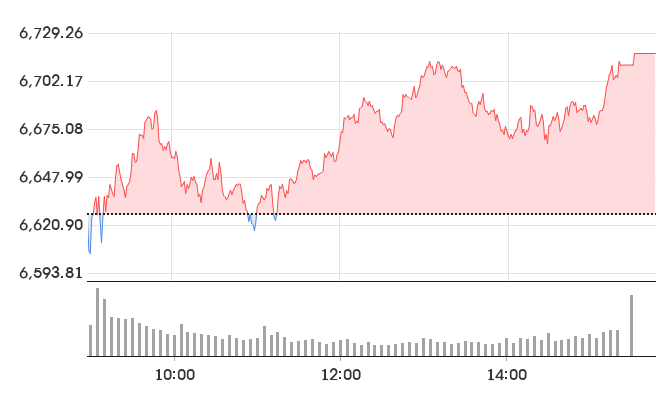
KOSPI daily chart (Naver Finance)
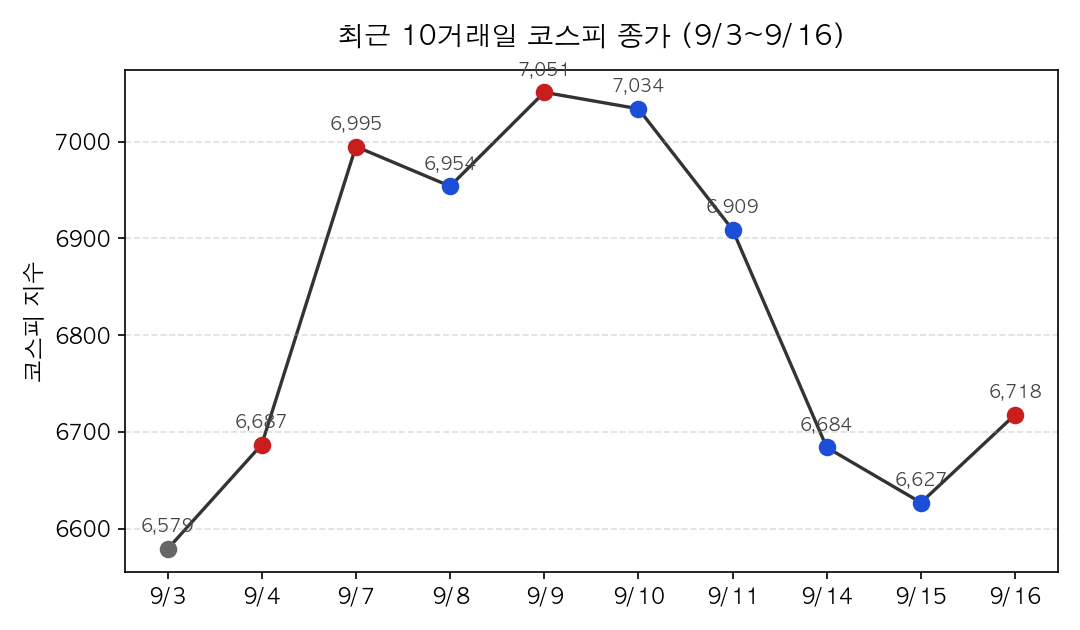
KOSPI closing prices, past 10 sessions (compiled)
The ten-day chart illustrates the rebound's significance: after breaching 7,000 in early September, the index had slid to 6,627 by September 15 before recovering 90 points in a single session.
Semiconductor sector in focus
Two developments drove semiconductor strength. The first came via Reuters: SK Hynix is in talks with Intel to jointly produce memory chips within the United States for the first time, with reports suggesting SK Hynix may lease manufacturing space at Intel's Ohio facility.
The second centers on labor relations. SK Hynix announced that union members approved a revised wage agreement in a member ballot. The central issue involved profit-sharing payouts, a distribution tied to strong earnings. Under the new terms, the cash payout ratio rises to 50% from 40%, while the stock portion falls to 50% from 60%—a shift toward immediate cash over equity participation.
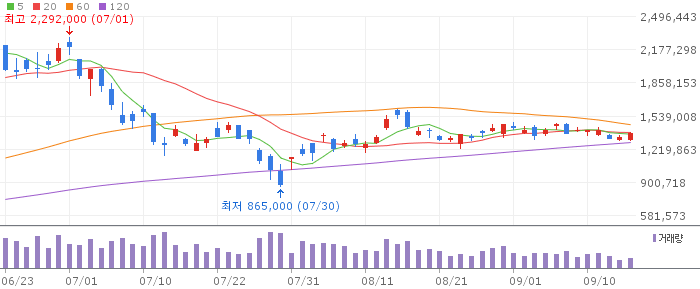
SK Hynix shares rose 4.08% on the combined news. Samsung Electronics gained 2.01%, Samsung Electro-Mechanics 4.86%, and Hanmi Semiconductor 1.57%. The Electrical & Electronics sector as a whole advanced 2.81%, the largest gain among all sectors. Power-infrastructure stocks also benefited from expectations surrounding ultra-high-voltage transformer demand: Hyosung Heavy Industries climbed 4.35% and LS Electric 2.41%.
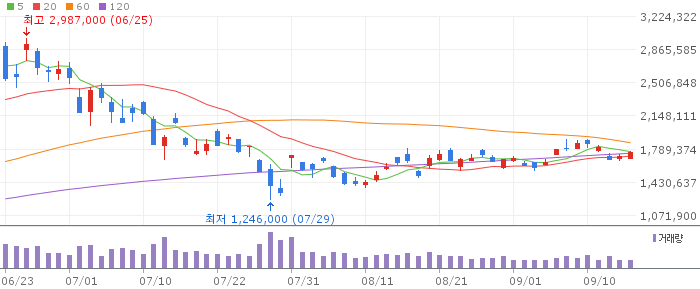
SK Hynix, 3-month daily chart (Naver Finance; red=up, blue=down)
Samsung Electro-Mechanics, 3-month daily chart (Naver Finance; red=up, blue=down)
Sectors that retreated
Overnight, the U.S. Senate voted down the "Clarity Act" on digital assets. Cryptocurrency and stablecoin-linked stocks on KOSDAQ tumbled: Dozen fell 18.31%, Cuckoo Finance 16.47%, Hecto Financial 16.32%, Danal 10.20%, and Uri Technology Investment 7.66%. For stocks that typically move single digits daily, double-digit declines stand out.
Construction and shipbuilding underperformed as well. Parliamentary briefing on U.S. investment commitments was postponed, and concerns emerged that a pending Korea-U.S. investment memorandum of understanding could face delays. Major stocks in these sectors retreated: HD Hyundai Heavy Industries fell 2.87%, Doosan Enerbility 2.78%. Soaring international oil prices and rising fuel surcharges also pressured aviation and low-cost carrier themes.
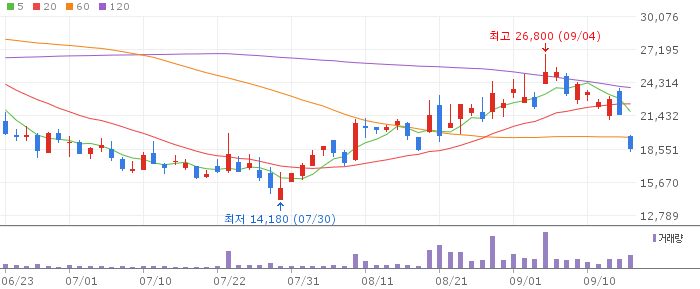
Hecto Financial, 3-month daily chart (Naver Finance; red=up, blue=down)
Today's pivotal issues
1) The Federal Reserve's policy meeting opened overnight with a two-day schedule. According to CME FedWatch, the probability of a 25 basis-point rate increase stands at 92.3%. Market focus is shifting from whether to hike to how much; the probability of a cumulative 75 basis-point increase through December has risen to 30.6%.
2) Supply disruptions from Saudi Arabia and Libya pushed international oil prices to four-month highs. The U.S. 10-year Treasury yield briefly reached 5.041%, the highest level since July 2007. This combination—rising rates and rising energy prices—is unusual enough to command attention.
3) KB Securities published research suggesting that semiconductor sentiment has grown overweighted toward "AI development pace moderation" narratives at the expense of fundamental earnings. The firm argues that delays in individual AI model launches should not automatically signal a slowdown in infrastructure investment cycles. Meanwhile, hyperscalers' 2027 AI capex outlook has been revised upward to $1.1-1.3 trillion from the prior $1.1 trillion.
Twelve-year context
A review of twelve years of price history shows that when Treasury yields and oil prices both spike, KOSPI gains are not rare—but they typically occur on days when a single sector carries the broader index. When that sector pauses, the index often follows. Today's electrical & electronics concentration was marked. Whether this follows a similar pattern warrants monitoring; no certain conclusion has emerged yet.
Summary
Foreign investors have sold for six straight sessions, yet the index advanced. Today belonged to semiconductors. The Fed's statement arrives early tomorrow. The actual rate decision and projections—the "dot plot"—will be critical. The question is whether semiconductors can absorb that shock as well.
Yesterday's four-day decline—which saw only robot-sector stocks hitting daily limits—was covered in yesterday's column. Last week's action, when foreign investors sold for four straight sessions yet KOSPI held steady, was detailed in an early September post.
Investment decisions and their outcomes remain the reader's responsibility.
댓글
댓글 쓰기