On September 22, 2026 (U.S. time), the New York market showed a split personality. The Dow fell 185 points, while the Nasdaq posted all-time highs for a second consecutive day. Same market, different stories across the indices.
The reason is straightforward. Two forces drove last night's market: semiconductors and interest rates. Semiconductors pushed the Nasdaq higher; rates weighed on the Dow.
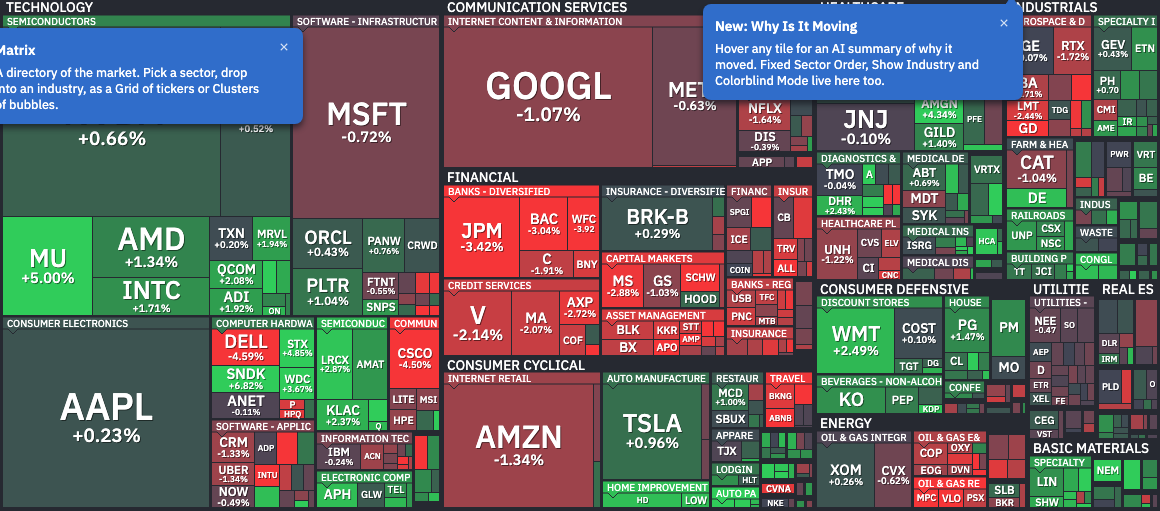
U.S. market map (S&P 500 heatmap) last night · Green=gains/Red=losses (finviz convention)
The three major indices, by the numbers
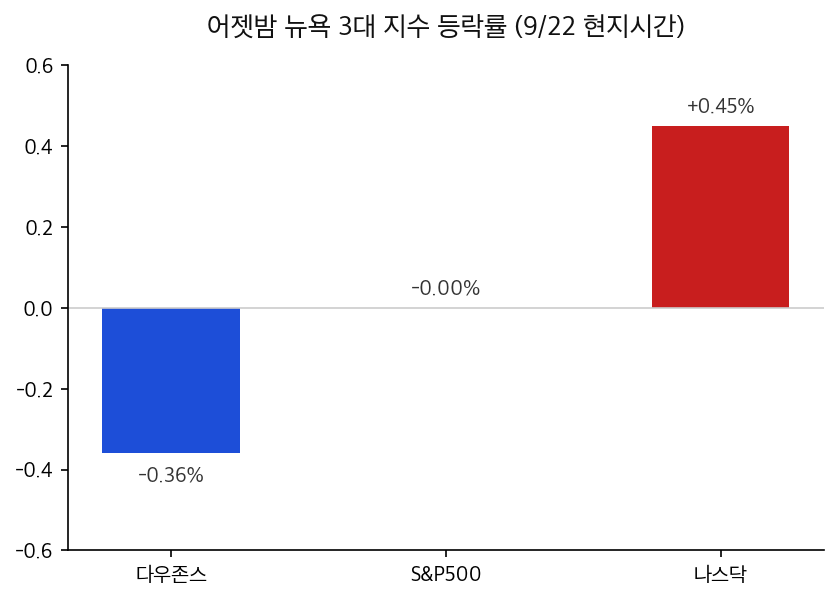
Last night's New York market movers (9/22 U.S. time, self-compiled)
The Dow Jones Industrial Average closed down 185.14 points (-0.36%) at 51,863.70. The S&P 500 fell 0.06 points (-0.00%) to 7,764.64—essentially flat. The Nasdaq Composite rose 122.19 points (+0.45%) to 27,244.30, posting an all-time closing high for the second day running.
The Russell 2000, the small-cap benchmark, gained 0.56%. Large-cap blue chips (the Dow) lagged, but tech stocks and small-caps held steady.
The Philadelphia Semiconductor Index in a six-day rally
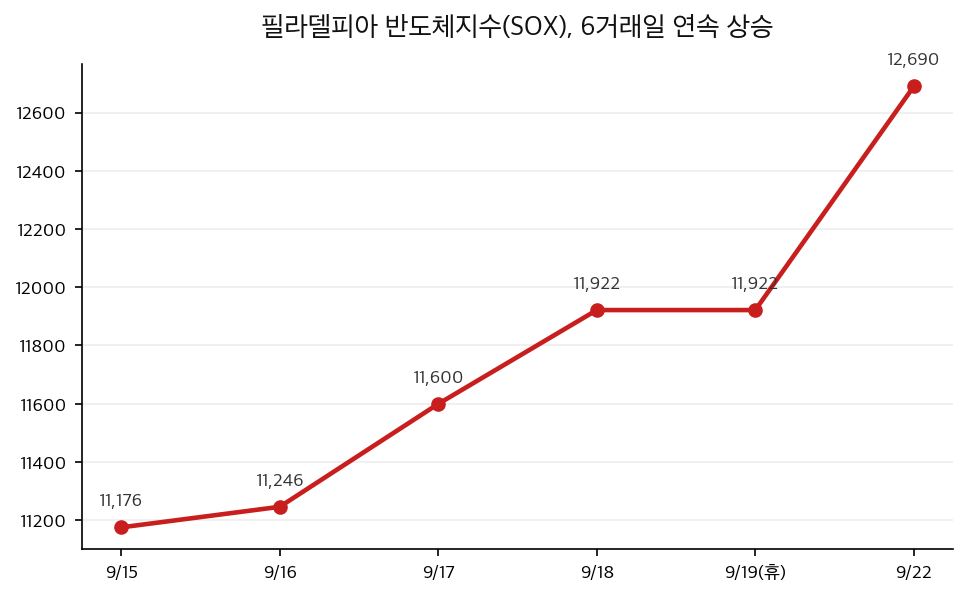
Philadelphia Semiconductor Index (SOX) over the past six trading days (self-compiled)
The Philadelphia Semiconductor Index (SOX) closed up 2.06% at 12,689.8 last night, marking six consecutive days of gains. On September 15, it stood at 11,175. In less than ten days, the index has climbed roughly 13%.
But here's what's interesting: the semiconductor leader last night was not Nvidia.
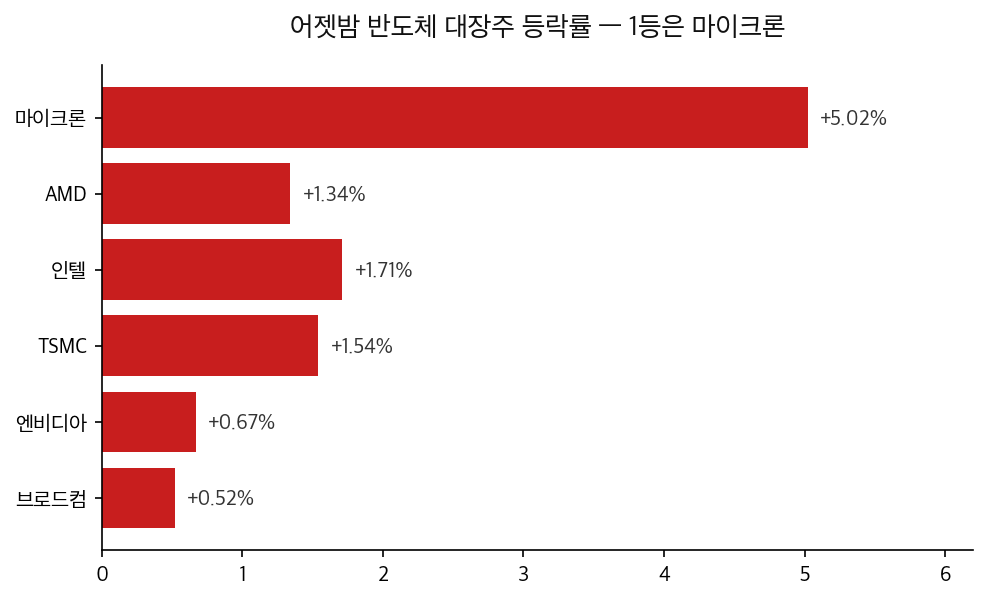
Semiconductor individual stocks last night (9/22 U.S. time, self-compiled)
Micron Technology rose 5.02%. Nvidia gained only 0.67%. AMD (+1.34%), Intel (+1.71%), TSMC ADR (+1.54%), and Broadcom (+0.52%) all rose, but none matched Micron's advance.
NAND flash maker SanDisk surged more than 7% in a single day—its best performance since July. The move reflects orders for large-scale AI infrastructure storage. Meta's AI assistant 'Muse' has held the #1 spot in free apps on Apple's App Store for two consecutive days. Together, these developments continue to fuel expectations around AI infrastructure demand.
Interest rates pressing back toward 5%
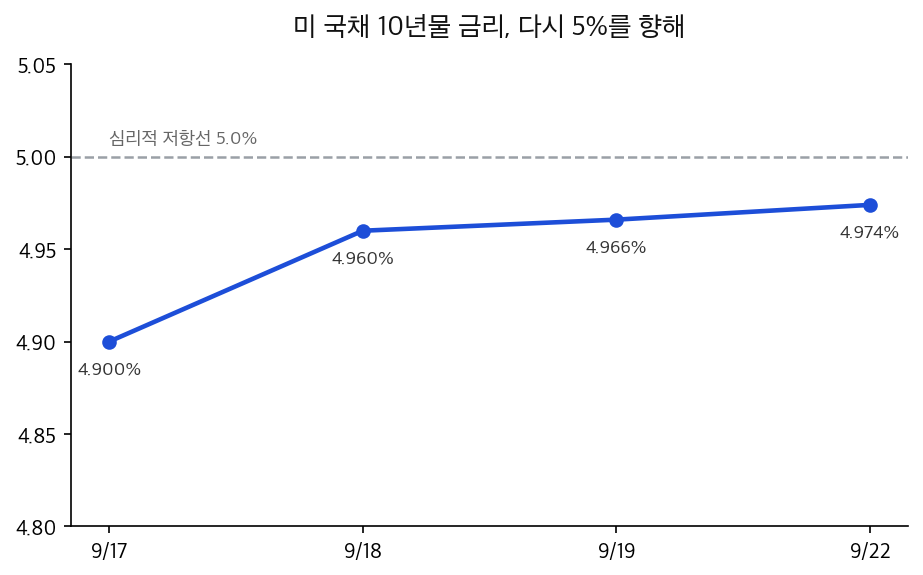
U.S. 10-year Treasury yield recent moves (self-compiled)
The U.S. 10-year Treasury yield rose to 4.974%, approaching the psychological resistance level of 5%. Analysts attribute the move to rising government debt, elevated oil prices, and persistent inflation. Traditional large-cap stocks in the Dow proved more sensitive to rising rates, explaining their underperformance.
Crude oil prices moved the opposite direction. Brent crude declined roughly 1% to around $99 per barrel. WTI dropped to the mid-$95 range. The declines reflect signs that the U.S. and Iran may restart diplomatic talks during this week's UN General Assembly. Reports indicate that Iran has proposed reopening the Strait of Hormuz within seven days if U.S. military pressure eases. Concerns about Middle East supply disruptions have noticeably eased.
How Asian markets closed
Japan's markets are closed for the holiday. China's Shanghai Composite closed up 0.06% to 3,952.13—essentially flat. Trading was cautious ahead of a scheduled U.S.-China summit on September 24. Hong Kong's Hang Seng Index gained 1.18%. Taiwan's TAIEX rose 0.17% to 47,800.17, extending its fifth consecutive day of gains. The advance reflects strength in semiconductor-related stocks—a pattern similar to Korea's market.
What to watch in today's Korean market
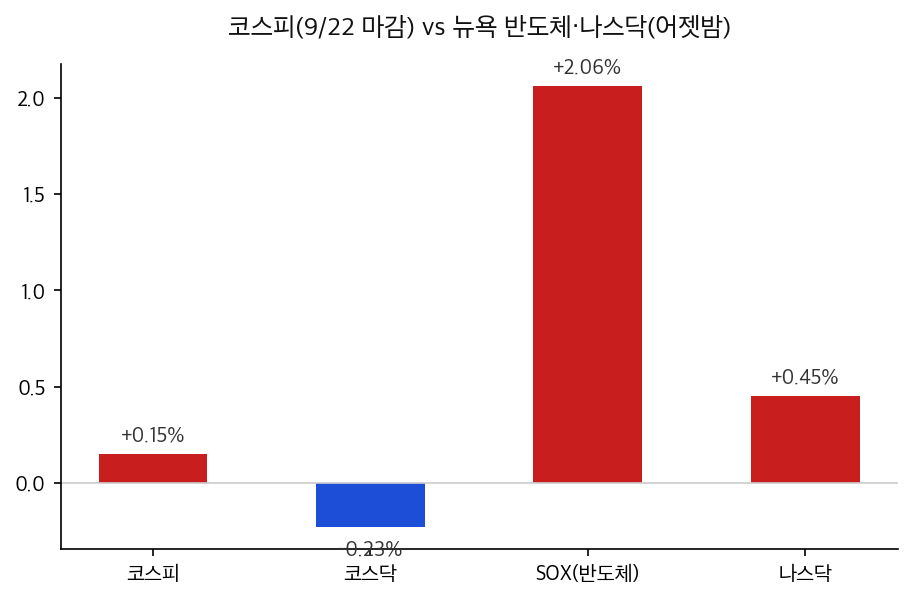
KOSPI (9/22 close) vs. overnight Nasdaq and U.S. semiconductor strength comparison (self-compiled)
Yesterday, September 22, the KOSPI closed up 10.19 points (+0.15%) at 7,017.91, holding above the 7,000 level. Though the semiconductor sector surged, SK Hynix notably declined. The KOSDAQ, after six trading days, turned negative, falling 0.23%.
There are three main points to watch in today's Korean market open:
| What to Watch | Last Night's Backdrop |
|---|---|
| Whether semiconductor strength extends to Samsung Electronics and SK Hynix | SOX up six consecutive days, Micron surging 5%-plus |
| Whether rising rates weigh on Korean stocks | U.S. 10-year yield at 4.974%, approaching 5% again |
| Won movement ahead of Chuseok | Won-dollar at 1,358.2 won on 9/22, down 22.8 won |
Micron deserves particular attention. Its business model is most similar to Korea's memory chip makers. It posted the largest gain among U.S. semiconductor stocks last night. Yet SK Hynix stood alone in declining amid the semiconductor rally the day before. Whether that U.S. tailwind carries into today will depend on how the opening unfolds.
Falling oil prices are relief for inflation concerns. Rising Treasury yields pressing back toward 5% are a headwind. These two forces are pulling in opposite directions. How the KOSPI responds to each will be key. With the U.S.-China summit just two days away, investor flows in related beneficiary and hurt sectors will also merit attention.
The takeaway
Last night in New York, semiconductors rallied while rising rates weighed on the broader market. The Nasdaq posted a fresh all-time high, but the Dow fell. The question for today's KOSPI is which of these divergent signals will dominate.
Investment decisions and their outcomes remain the responsibility of investors.
#코스피 #코스피지수 #나스닥 #다우존스 #뉴욕증시 #미국증시 #반도체 #필라델피아반도체지수 #SOX #마이크론 #엔비디아 #AMD #인텔 #TSMC #샌디스크 #국채금리 #원달러환율 #국제유가 #WTI #브렌트유 #미중정상회담 #코스닥 #SK하이닉스 #삼성전자 #증시전망 #오늘의증시 #장전시황 #뉴욕마감 #관전포인트 #투자정보 #증시브리핑
댓글
댓글 쓰기