[Korea Market Close] KOSPI at 7,017 erases morning gains; semiconductor surge leaves SK Hynix trailing
The KOSPI closed at 7,017.91 on September 22, a gain of +0.15%—a modest move by the numbers alone. The intraday picture told a different story. The index reached 7,171 in the morning before sliding to 6,986 in the afternoon, a 185-point or 2.6% swing in a single session.
The disconnect was sharp. Overnight, the Philadelphia semiconductor index jumped 4.29%, with Intel up 12%, AMD 9.95%, and ARM climbing 17%. By historical pattern, a rally this broad in chip stocks would have lifted Korea's semiconductor leaders in tandem. Instead, SK Hynix closed -1.50% while Samsung Electronics gained +0.91%.
Why the morning surge evaporated by close
The KOSPI opened at 7,161.61, 153 points or 2.20% above the prior close. It pushed as high as 7,171.44 in early trade, riding overnight momentum from lower Treasury yields, falling oil prices, and resurgent AI optimism on Wall Street.
Sentiment shifted in the afternoon. The index steadily gave back gains, eventually falling to 6,986.27 and briefly turning negative. The pressure came from profit-taking ahead of the Chuseok holiday, traders unwilling to carry overnight positions and geopolitical risk through a long break. The index briefly recovered to the 7,050 level but closed at 7,017.91, unable to hold its afternoon rebound.
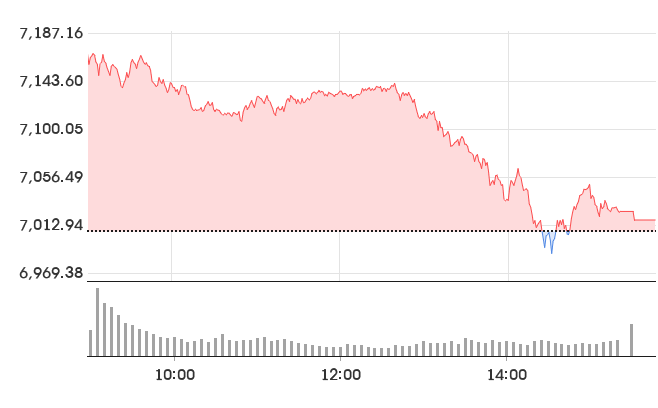
KOSPI daily price action, recent sessions (Naver Finance; red = up, blue = down)
Foreign money stepped in; retail investors stepped out
The investor flows showed opposing directions. Foreign investors bought 63.6 billion won net, extending their buying streak to a third straight day. Futures positions showed a similar pattern, with foreign traders accumulating 1,823 contracts. Retail investors did the opposite, selling 1,581.1 billion won net—also a third consecutive day of selling. Institutional investors flipped to selling after a 5-day pause, moving 126.0 billion worth to the offer side. The most striking figure was other corporations' 1,652.6 billion won net purchase, effectively absorbing the retail inventory that came to market.
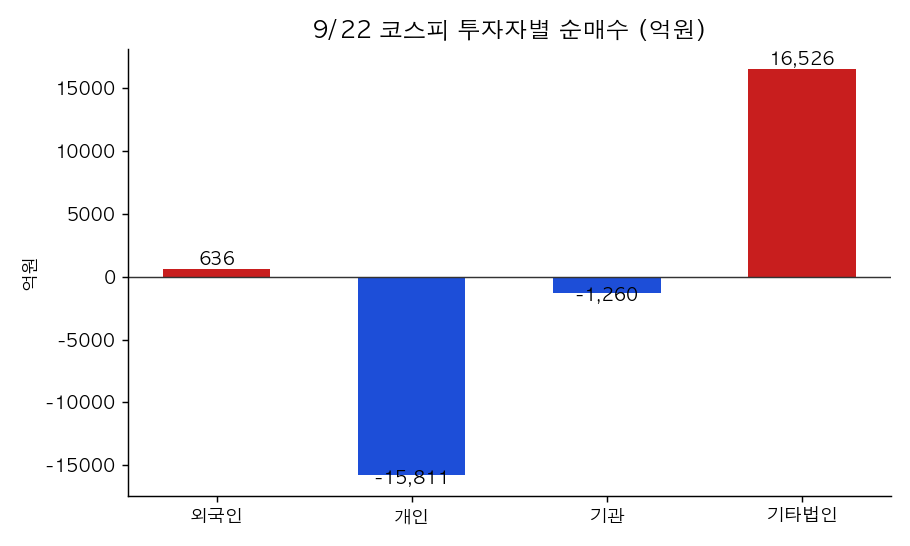
Direct compilation and analysis
The KOSDAQ painted the opposite picture. The index closed at 834.38, down 0.23%, flipping to red after 6 straight days of gains. Foreign investors and institutions both sold—57.6 billion and 95.3 billion won respectively—while retail buyers stepped in with 156.9 billion won in purchases. In the KOSDAQ, retail was the bid when it mattered.
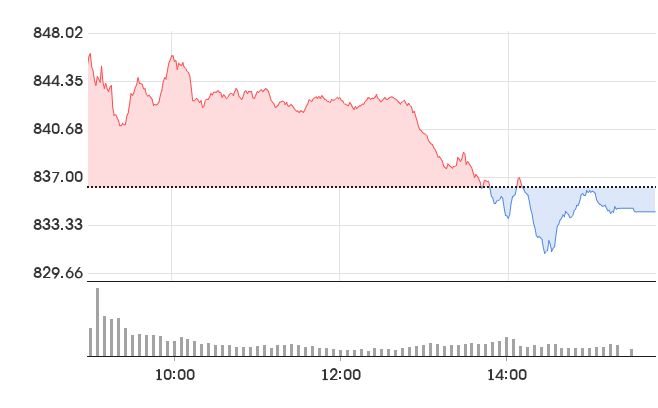
KOSDAQ daily price action, recent sessions (Naver Finance; red = up, blue = down)
Why SK Hynix lagged its semiconductor peers
The day's theme was unambiguous: semiconductors. Meta's overnight surge of 11.43% supplied the spark—its new AI agent Muse had reached the number 1 spot on Apple's free app chart, displacing ChatGPT. The app logged 730,000 downloads in five days. Wells Fargo amplified the move, raising its Meta price target from $640 to $796, a 24% jump.
The momentum flowed through the domestic semiconductor complex. Equipment and component makers surged: KoriaCircuit +25.43%, TLB +16.80%, DaOne Nexview +16.57%, Semtec +13.31%, Daeduk Electronics +10.21%. Samsung Electronics rose 0.91% in the rally.
Yet SK Hynix, the sector's flagship, declined 1.50%. The stock showed early strength but buckled to profit-taking pressure as the day wore on. Here was a rare moment: American chip stocks rallying, Korean equipment and component makers rallying, the core large-cap semiconductor play moving sideways to negative. The divergence suggests supply-chain positioning drove the move—not all semiconductor exposure flows through the same channel.
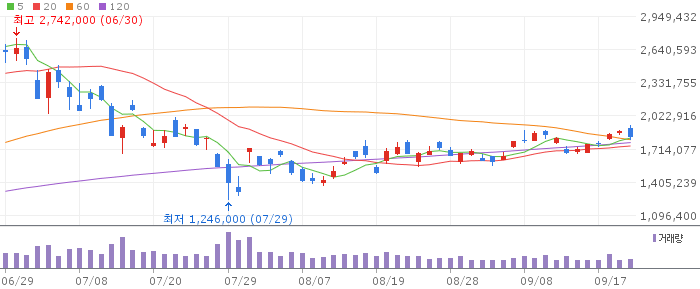
SK Hynix daily price action, recent sessions (Naver Finance; red = up, blue = down)
Among large-cap semiconductor peers, Samsung Electro-Mechanics led with a +3.99% gain, buoyed by MLCC supply tightness and expectations for a full second-half ramp in AI-related revenue. Amotech rose 14.50% on similar catalysts. Within a single semiconductor rally, individual stocks carve distinct paths based on their role in the supply chain.
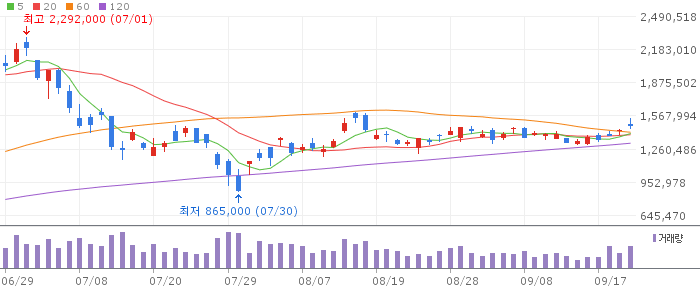
Samsung Electro-Mechanics daily price action, recent sessions (Naver Finance; red = up, blue = down)
Five stocks hit the daily upper limit, each on separate news
Five issues recorded the maximum allowable gain for a single session. Tomato Systems rallied on news of Daewoo E&C completing its web system conversion and receiving final regulatory sign-off from a U.S. investment insurer. Dongkuk Life Sciences jumped after its subsidiary Inventer reported that its Phase 3 trial for contrast agent INV-002 hit its primary efficacy target. Nota rose on word that its technology tripled robotic arm performance in Qualcomm's NPU testing.
| Company | Change | Catalyst |
|---|---|---|
| Tomato Systems | +30.00% | Daewoo E&C system conversion complete; U.S. insurer approval |
| Dongkuk Life Sciences | +29.98% | Contrast agent Phase 3 primary efficacy achieved |
| Nota | +29.97% | Qualcomm NPU robotic arm performance improvement |
| Celid | +29.95% | Third-party share issuance approved |
| WSI | +29.94% | Subsidiary European patent registration across 19 countries |
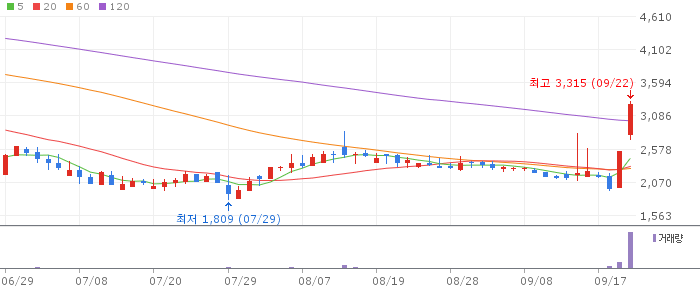
Tomato Systems daily price action, recent sessions (Naver Finance; red = up, blue = down)
Oil falls, then bounces, as geopolitics remain unsettled
Crude oil moves also shaped sentiment. WTI fell over 4% and Brent over 3% overnight on expectations that U.S. and Iranian leadership might meet during the UN General Assembly—scheduled for September 22-23. Trump is set to address the assembly on the 22nd, Pezeshkian on the 23rd. The possibility of a summit between them sent traders to the short side of oil. Aviation and budget-airline stocks benefited from lower fuel expectations; refining and LPG themes sold off in response.
But during Asian trading hours, renewed Middle East risk hauled oil back up by over 1%. A single night's sharp fall followed by a next-day bounce of similar magnitude signals that the market lacks conviction—geopolitical risk pricing remains fluid.
The dollar-won rate fell 16.3 won to 1,358.2 during Asian hours, a notable single-session move. Korean government bond yields split direction: the 3-year curve dropped 1.6 basis points to 4.040%, while the 10-year rose 0.4 basis points to 4.461%. The divergence suggests the bond market is pricing both near-term rate cuts and lingering long-duration inflation concerns.
Seoul eyes nuclear and liquefied natural gas plays in the U.S.
The Ministry of Industry reported to parliament three proposed U.S. investment projects. Project 1: a gas-fired combined-cycle power plant in Texas. Projects 2 and 3: construction of eight nuclear power plants in the United States and development of an Alaska LNG facility. Unlike Project 1, the nuclear and LNG initiatives remain in negotiation and have not yet been formally approved. Related stocks—Doosan Enerbility, HD Hyundai, and Hyundai Construction—moved higher on the news.
What to watch
Two developments merit close tracking. First: whether a U.S.-Iran summit actually materializes during the UN General Assembly on September 22-23. Oil price direction hinges on that outcome. Second: Meta's developer event, Meta Connect, scheduled for September 23. CEO Mark Zuckerberg is expected to unveil new AI and wearable initiatives. The semiconductor momentum that ignited today's gains will either extend or fade depending on what he shows and how the market interprets it. Related context can be found in earlier KOSPI market close summaries and post-Fed rate decision analysis.
This article is a market summary provided for informational purposes and does not constitute investment recommendation or endorsement of any security. Investment decisions and their outcomes remain your responsibility.
#KOSPI #KOSDAQ #Korean stocks #Samsung Electronics #SK Hynix #semiconductor stocks #Philadelphia semiconductor index #foreign investors #retail investors #institutional investors #investor flows #oil prices #WTI #Brent crude #UN General Assembly #U.S.-Iran relations #dollar-won rate #Korean government bonds #Meta #Muse #ChatGPT #Tomato Systems #semiconductor equipment #nuclear power #liquefied natural gas
댓글
댓글 쓰기