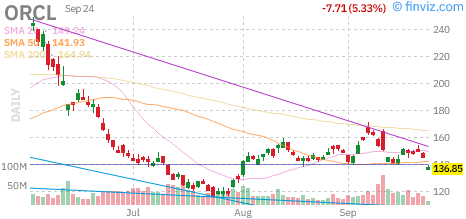
Oracle shares fell 4–5% on September 24, trading near $140 after closing at $149 the previous session. That represents a sharp three-week decline from early-September levels around $170.
The puzzle: the company's earnings were solid. Oracle reported first-quarter revenue of $19.3 billion on September 10, up 30% year-over-year. Cloud revenue surged 62%, with infrastructure (OCI) revenue jumping 121%. Remaining performance obligations (RPO) climbed to $664 billion—numbers that paint a picture of stellar growth.

So Why the Decline?
Two factors triggered today's selloff. First, layoff news. Multiple divisions are undergoing double-digit percentage workforce reductions. The company has shed over 21,000 employees this year. Growing revenue while cutting staff signals to markets that earnings aren't keeping pace with sales—that cash isn't sticking to the bottom line.
Second, credit concerns. Debt issued for the Project Jupiter data center in New Mexico is now trading in distressed territory after S&P downgraded Oracle to just above junk status. Project Jupiter itself faces permitting delays and environmental litigation; last September, hundreds of New Mexico residents turned out at a county meeting to voice opposition to the project.

The numbers tell a starker story. While Oracle pours $90–95 billion annually into AI data centers, free cash flow has swung to -$23.7 billion, and total debt has climbed past $125 billion. Revenue acceleration and cash burn are moving in tandem.
What Oracle Actually Is
Oracle built its franchise on enterprise database software. Today it operates across three divisions: Oracle Cloud Infrastructure (OCI)—renting servers and storage against AWS and Azure; the legacy database business; and enterprise applications like ERP and HR systems (SaaS).
Recent attention has centered on Project Stargate, a partnership with OpenAI where Oracle provides data center real estate and infrastructure while OpenAI runs its models on top. The bulk of that $664 billion RPO is believed to stem from large AI infrastructure contracts of this type.

The Numbers, Distilled
| Metric | Q1 Results | Year-over-Year |
|---|---|---|
| Total Revenue | $19.3 billion | +30% |
| Cloud Revenue (IaaS+SaaS) | $11.6 billion | +62% |
| OCI (Infrastructure) | — | +121% |
| Remaining Performance Obligations (RPO) | $664 billion | +$209 billion |
The company guided for full-year revenue above $90 billion. Cloud revenue growth guidance for the next quarter is 64–70%. On growth metrics alone, the trajectory remains steep.
Valuation and Wall Street Views
Current P/E trades in the 22–26x range. Barclays raised its price target to $252 on September 11. Consensus targets span $230–260. The widening gap between current price and average targets likely reflects that recent credit and headcount developments haven't yet percolated into analyst models, rather than suggesting Oracle is undervalued. Two competing signals deserve parallel reading: the optimistic long-term framework and the immediate operational and credit friction. A higher price target doesn't erase today's decline.
What to Watch
· Debt burden — $125B+ total debt, -$23.7B free cash flow. As long as data center spending continues, cash will keep draining.
· Further credit downgrade risk — Currently one notch above junk status. One more step down means losing investment-grade standing.
· Project Jupiter delays — If permitting and litigation drag on, data center deployment timelines could slip.
· Competitive pressure — Datacom and Rimini Street bundled offerings in Australia and New Zealand are undercutting Oracle's high-margin support services.
· Macro headwinds — Rising US Treasury yields and rate-hike concerns are weighing on technology valuations broadly.
The Bottom Line
Oracle is currently telling two stories. Revenue and bookings are hitting all-time highs, while debt and cash burn are simultaneously at all-time highs. The simplest summary: "The growth is genuine, but the market is recalculating the cost of achieving it."
The next critical check-in is December's second-quarter earnings, where cloud revenue growth will either sustain the 64–70% guidance and where credit raters may reassess Project Jupiter financing.
This isn't a single-number story. Which curve breaks first—revenue or debt—will matter more than either in isolation.
Oracle trades on U.S. exchanges. This analysis is factual assessment, not investment advice. Investment decisions and outcomes are your responsibility.
#Oracle #ORCL #OraclStock #USStocks #Nasdaq #CloudInfrastructure #OCI #AIInfrastructure #DataCenters #USMarkets #StockInFocus #Earnings #CreditRating #Restructuring #BigTech #CloudComputing #AI #NasdaqIndex #TechStocks #InternationalInvesting
댓글
댓글 쓰기