Friday, September 18, 2026. Overnight (U.S. time, September 17), the three major U.S. indices rose in tandem. Just one day prior, the market had fallen for four straight sessions following the Federal Reserve's rate increase. Then the momentum reversed. The Nasdaq surged 1.69%—semiconductors and Big Tech led the rally. What to watch today: how much of this rebound the Korean market absorbs.
For those who missed the overnight session, here are the numbers, why markets moved, and what it means for Korean equities today.
U.S. indices reverse after one day
September 17 (U.S. time): All three major indices closed higher in unison. The Dow Jones Industrial Average gained 316.14 points, or 0.61%, to 51,778.04. The S&P 500 rose 85.95 points, or 1.14%, to 7,637.76. The Nasdaq Composite surged 439.87 points, or 1.69%, to 26,418.29.
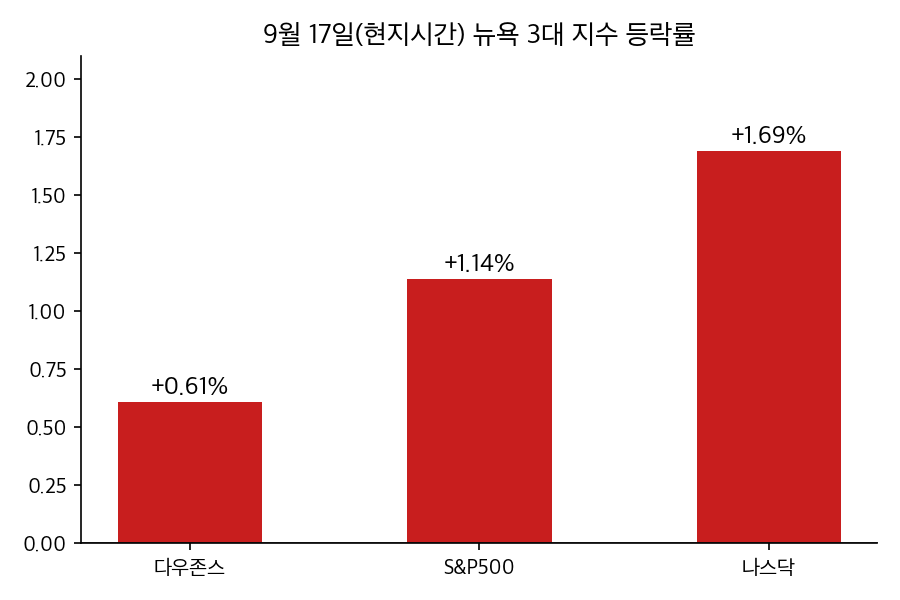
September 17: U.S. three major indices daily change
Just one day earlier, on September 16, the picture inverted. The Federal Reserve raised its benchmark rate to 3.75–4.00%, the first increase in 3 years and 2 months. The dot plot signaled additional hikes possible later this year. The fallout: the Dow tumbled 631 points, or 1.21%, in a single session. Today's rebound erased that entire loss.
The 10-year Treasury yield retreated 7 basis points to 4.93%. The month-long pressure from yields above 5% eased noticeably. Crude oil prices fell in tandem: WTI closed at $101.91 per barrel, down 0.51%, and Brent at $104.82, down 0.95%. Both headwinds moved in the same direction. Two major sources of market pressure released simultaneously.
Why the Philadelphia Semiconductor Index jumped—Intel's case
Semiconductors and Big Tech powered the advance. The Philadelphia Semiconductor Index (SOX) jumped over 3% intraday—a notable move. Intel led gainers with a 7.67% surge, followed by Nvidia (+2.54%), Qualcomm (+2.09%), Amazon (+2.13%), and Microsoft (+1.52%). All closed higher.
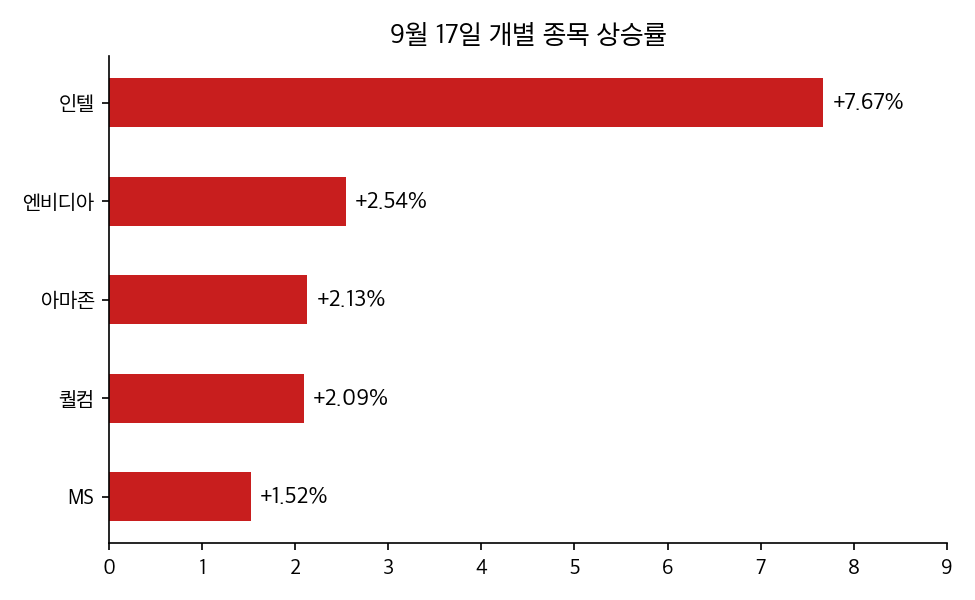
September 17: Individual stock performance
Intel's outsized gain had a catalyst. According to Reuters, SK Hynix is in discussions with Intel about joint memory-chip production in the United States. One scenario under review: SK Hynix leasing part of Intel's Ohio manufacturing facility to produce memory chips. Another proposal in discussions: a joint venture involving cloud companies. However, SK Hynix told Reuters it is "reviewing various options but has made no final decisions." No contract has been finalized. This remains exploratory. It bears noting.
The market appears to read the news as a signal of semiconductor supply-chain realignment. For Intel, a company facing headwinds, it represents a potential strategic opening. The alignment with U.S. policy support for domestic chip manufacturing adds weight. If talks advance, the implications reach directly to South Korean semiconductor firms' standing in the U.S. market—a significant dynamic to track. Today's Korean session will be worth monitoring for SK Hynix developments.
Interest rates and currency movement overnight
Bond markets reflected the reprieve. The 10-year yield, as noted, retreated to 4.93%. Short-duration rates, which had spiked on the Fed's hawkish message the prior day, partially reversed.
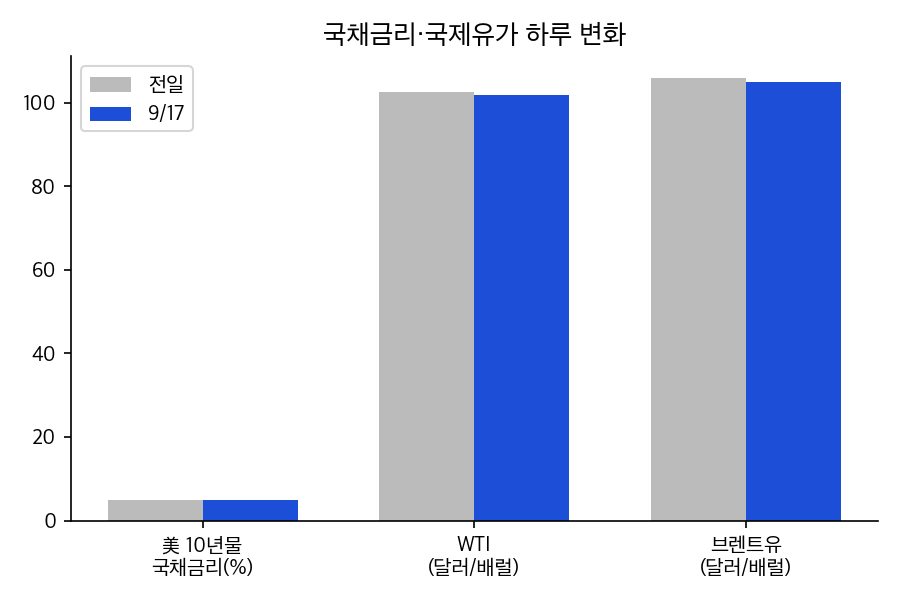
Treasury yields and crude oil: September 17 vs. prior day
Currency markets told a different story. The Fed's rate increase and hawkish tone sustained dollar strength. The yen weakened to as low as 156.42 per dollar. Significantly, the Bank of Japan announces its monetary policy decision on September 18. The central bank issues guidance amid yen weakness. Markets are watching for signals on the stance from Governor Ueda. The Korean won also faces pressure from this dollar rally. Today's won-to-dollar movement warrants attention.
Asian markets showed mixed direction overnight
September 17: Asian equities diverged. Japan's Nikkei 225 rose 0.33% to 64,136.25, with the FOMC outcome seen as reducing uncertainty. However, profit-taking appeared in AI and semiconductor names such as Advantest and Tokyo Electron, which capped broader gains.
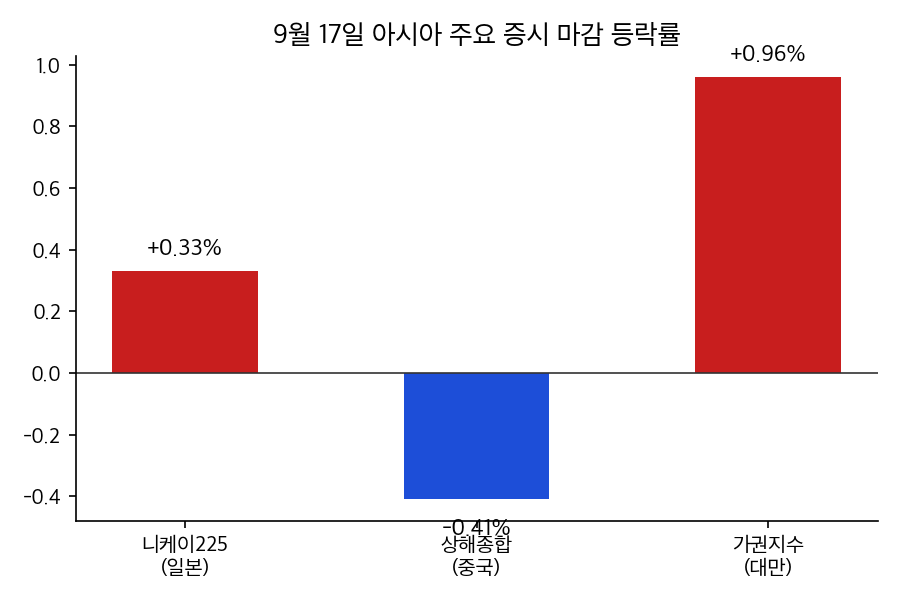
September 17: Major Asia-Pacific market performance
China's Shanghai Composite fell 0.41% to 3,875.60, pressured by the Fed rate increase and the Hong Kong Monetary Authority's parallel tightening. Support from liquidity injections by the People's Bank of China and rhetoric from President Xi Jinping on advanced manufacturing limited the decline. Taiwan's Taiex, by contrast, gained 0.96% to 46,288.00, buoyed by a 1.89% rise in TSMC. Semiconductor strength in Taiwan aligned with overnight semiconductor momentum in U.S. markets. The question for today: whether Korean semiconductor names follow suit.
For context: Korea's KOSPI on September 17 closed at 6,715.41, down 0.04%, amid foreign investor net selling. The KOSDAQ, supported by institutional investor net buying, advanced 0.76% to 822.18. This marks three straight sessions of gains.
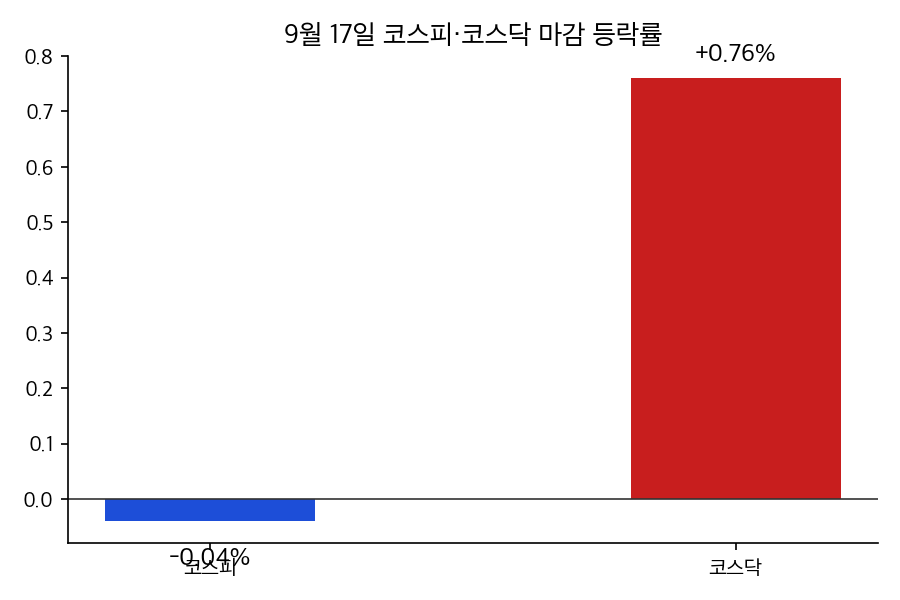
September 17: KOSPI and KOSDAQ daily change
How much of the U.S. rebound the KOSPI absorbs remains an open question.
What to watch on the KOSPI today
| Checkpoint | What to track |
|---|---|
| Semiconductor momentum carry-through | Whether SK Hynix and Samsung Electronics reflect overnight SOX 3%+ surge and Intel's 7%+ gain |
| BOJ decision | Bank of Japan's September 18 monetary policy announcement and Governor Ueda's tone |
| Won-to-dollar rate | Whether yen weakness at 156 per dollar transmits to won weakness as dollar strength persists |
| Foreign investor flows reversal | Whether foreign investors shift from net selling (September 17) to net buying following U.S. market advance |
Conclusions would be premature. The core drivers of last night's advance were Treasury yield relief, crude-oil price softening, and semiconductor and Big Tech strength. On the Korean market today, watch first for semiconductor sector response and rate-sensitive names. The SK Hynix-Intel cooperation discussion, though preliminary, merits tracking for further developments.
U.S. market heat map
Below is a color-coded visualization of overnight U.S. market performance by sector and name. Darker green indicates stronger gains; darker red indicates larger declines.
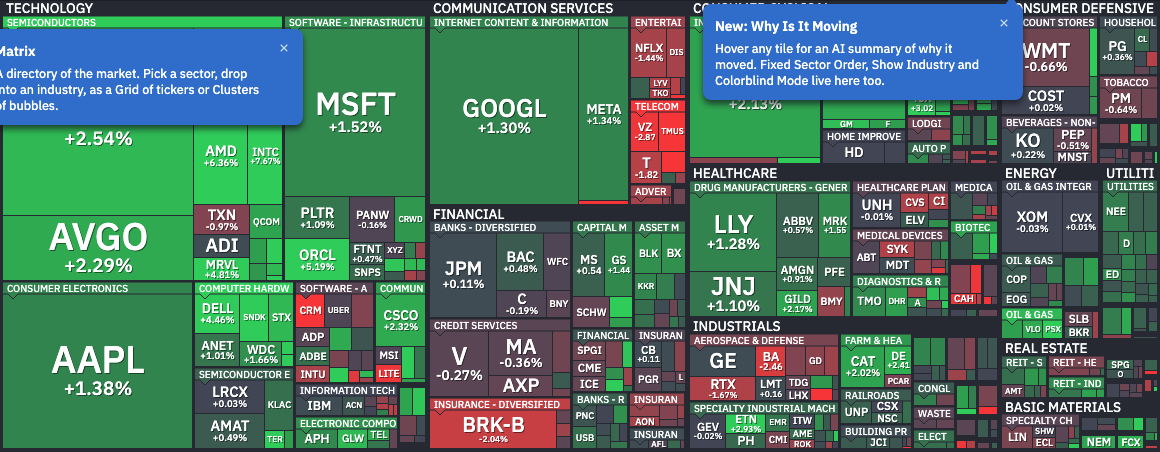
Overnight U.S. market heat map (S&P 500 treemap) · Green = gains / Red = declines
Bottom line
Overnight, Treasury yields and crude-oil prices both eased simultaneously, triggering a rebound after four straight days of declines. The Nasdaq's 1.69% gain was the strongest performance, fueled by semiconductor and Big Tech strength led by Intel (+7.67%) and Nvidia (+2.54%). The SK Hynix-Intel U.S. memory production discussion added momentum to that trend. For the Korean market today, watch the semiconductor and rate-sensitive sectors, plus the BOJ decision and won-to-dollar movement—a full day ahead.
This article is for informational purposes and does not recommend any particular stock or trading action. Investment decisions and outcomes remain the reader's responsibility.
#USMarket #KOSPI #Nasdaq #SP500 #DowJones #PhiladelphiaSemiconductor #SOX #Nvidia #Intel #SKHynix #Samsung #CrudeOil #WTI #Treasuryyield #WonDollarRate #YenWeakness #BOJ #BankOfJapan #KOSDAQ #AsiaPacific #Nikkei225 #ShanghaiComposite #TaiwanTaiex #TSMC #Qualcomm #Amazon #Microsoft #MarketClose #MarketWatch #Signals
댓글
댓글 쓰기