[U.S. Market Brief] Big Three rebound after four-day slide, but Nvidia stays flat—the semiconductor divergence
All three major U.S. indexes rose Friday, September 11 (U.S. time), snapping a four-day losing streak. The Dow Jones gained 508.71 points (+0.98%) to close at 52,657; the S&P 500 added 65.15 points (+0.86%) to 7,656; and the Nasdaq advanced 251.31 points (+0.96%) to 26,333.
Oil prices retreated after days of upward pressure. August's Consumer Price Index rose 0.4% month-over-month and 3.4% year-over-year. Core CPI climbed 0.3% m/m, beating the market consensus of +0.2%, though the year-over-year rate improved to 2.4%. The data sent conflicting signals—inflation readings that looked warm on the monthly side but cooler on the annual one—and the market leaned toward the softer interpretation.
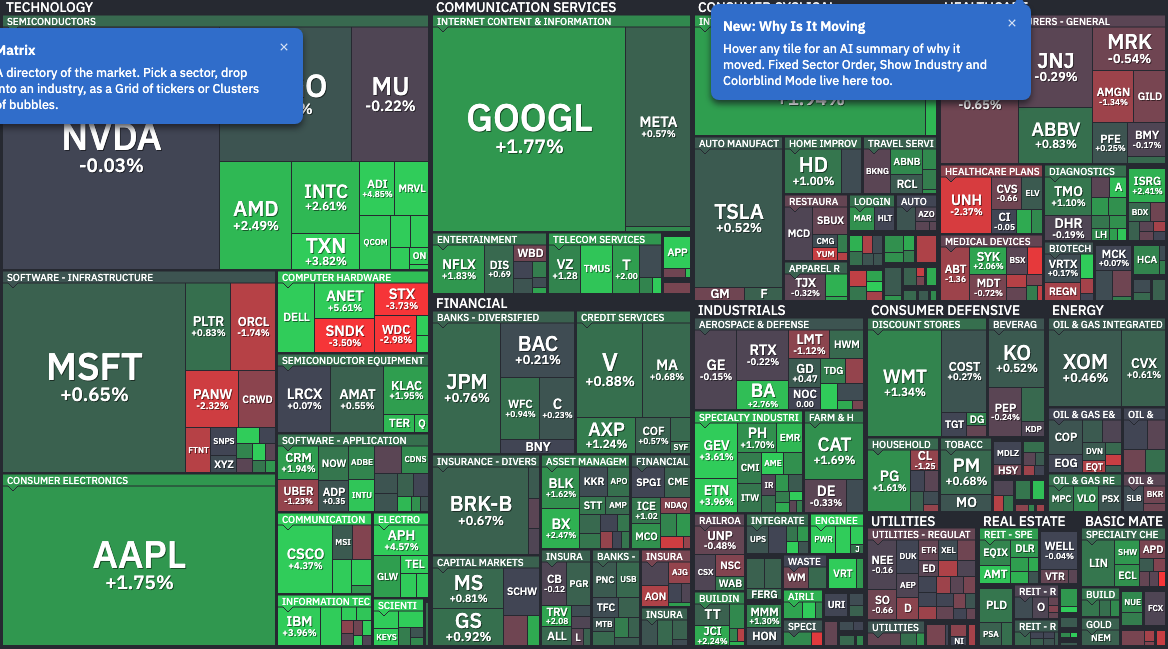
U.S. market heatmap (S&P 500) as of Friday night · Green = gainers, Red = losers (finviz view)
Why the Big Three bounced after four consecutive losses
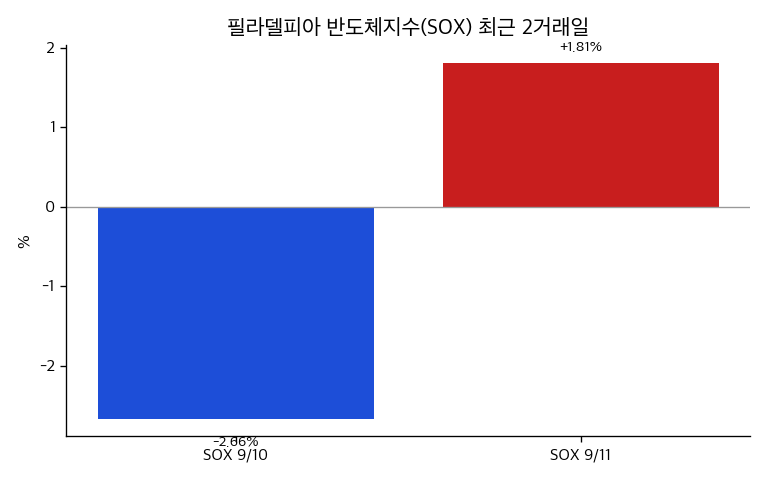
The day before told a different story. On September 10, U.S. and Iranian forces attacked shipping vessels, and reports that Yemen's Houthi-aligned forces had seized the port city of Mokha triggered a geopolitical rally in crude. International oil spiked more than 6% in a single session. Simultaneously, August's Producer Price Index came in at 5.4% year-over-year, topping the 5.3% expectation, and all three major indexes sold off sharply.
By September 11, the tone shifted. Reports emerged that Gulf states and Iran were pursuing a temporary agreement to manage tanker transit through the Strait of Hormuz. Oil prices reversed course. October WTI crude fell 2.4% to $100.05 per barrel, while Brent slipped 2.8% to $104.61. After briefly topping $108 mid-week, crude had retreated sharply in just a few hours.
Yet the backdrop remained tense. The 10-year Treasury yield hovered near 5%, and fed-funds futures showed an 85-90% probability of a rate hike at the September 15-16 FOMC meeting. Inflation concerns and tightening expectations, in other words, had not gone away.
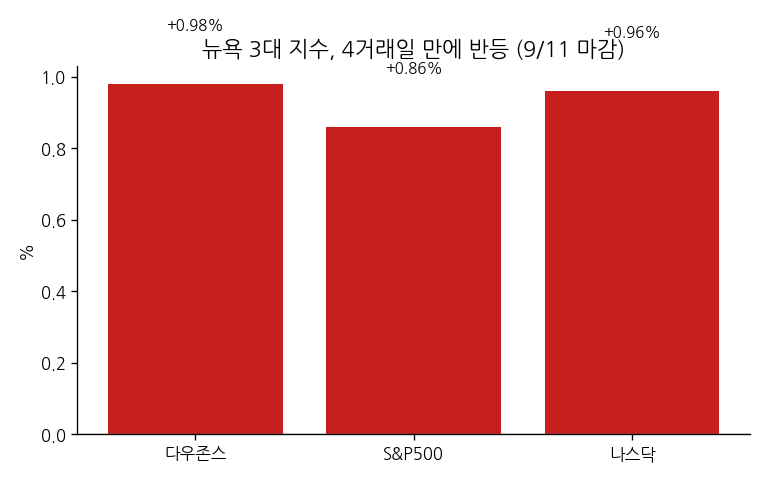
U.S. Big Three performance (close, 9/11) · compiled from market data
Philadelphia Semiconductor Index—up, but with cracks showing
The Philadelphia Semiconductor Index (SOX) rose 0.87%, a modest recovery from Thursday's 2.66% plunge when bond yields and crude spiked. The rebound recovered only about half of the prior day's losses.
The real story lay in stock-by-stock divergence. AMD gained 1.01% and Intel added 0.19%—modest moves. By contrast, SK Hynix ADR surged 4.70%, signaling strength in memory chips. Micron followed suit, up 0.87%. Yet Nvidia, the index's dominant holding and the engine of the AI rally, fell 0.02%—essentially flat. The broad index climbed while the technology it was supposed to reflect took a breather.
Semiconductor stock performance (close, 9/11) · compiled from market data
Whether memory chip strength signals a lasting shift or a one-day bounce will become clear as the week progresses and earnings and investor-flow data arrive.
What yields, currency, and oil mean for Korean equities
The 10-year Treasury yield climbed to 4.944% on September 10 and held near 4.94% on the 11th—levels not seen in nearly two decades. If rates stay elevated, growth and semiconductor stocks, which carry lofty valuations, face persistent headwinds.
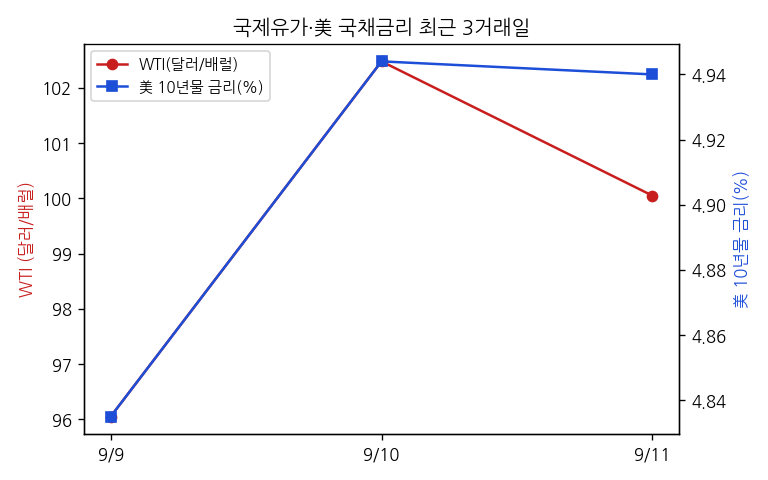
Oil and U.S. 10-year yield, last three trading sessions · compiled from market data
Oil also changed direction. After spiking to $102.48 per barrel on September 10, crude settled at $100.05 on the 11th. At $100, oil remains elevated—high enough to keep pressure on refining and petrochemical costs, with spillover effects on Korean import prices and inflation.
The dollar-won rate weakened 4 won (-0.30%) to 1,345.9 won as of 3:30 p.m. on September 11, as Korean exporters moved to sell dollars. The won saw modest strength on the day.
Asian markets Friday—ripple effects from Wall Street's turmoil
Asian markets on September 11 felt the full weight of the prior day's U.S. selloff. The Nikkei 225 fell 1.93%, pressured by surging bond yields, inflation fears, and heavy technology selling. Early in the session the index had dropped more than 3%, before paring losses in afternoon trade. Shanghai's composite fell 1.18%, and Taiwan's weighted index declined 1.61%.
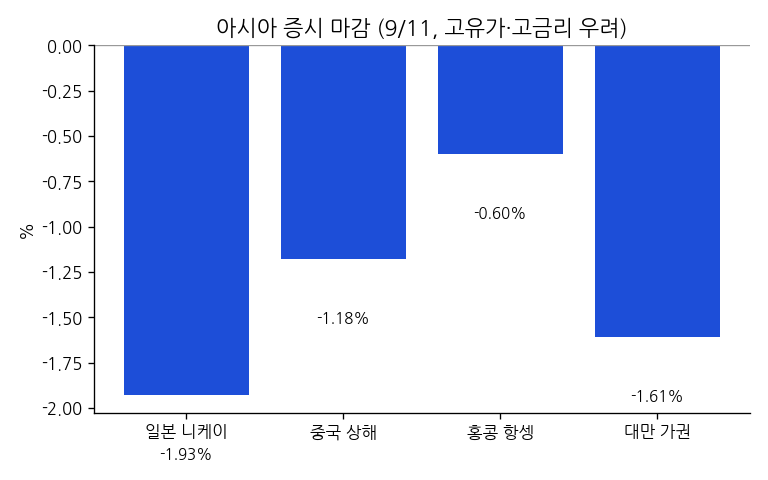
Asia market closes (9/11) · compiled from market data
Taiwan's decline masked relative strength in TSMC, which fell only 1.63%—a smaller loss than the benchmark. Japan's semiconductor names bore the worst of the selling: Kyocera tumbled 6.99% and Advantest dropped 6.49%, underscoring the depth of risk-off sentiment in the sector.
Index summary
| Index | Close | Change |
|---|---|---|
| Dow Jones (9/11) | 52,657 | +0.98% |
| S&P 500 (9/11) | 7,656 | +0.86% |
| Nasdaq (9/11) | 26,333 | +0.96% |
| Philadelphia Semiconductor (9/11) | — | +0.87% |
| KOSPI (9/10) | 7,033.92 | -0.25% |
| KOSDAQ (9/10) | 836.92 | +0.79% |
What to watch: Korean markets Monday
The U.S. rebound and ebbing oil can be read as constructive for Korean equities. Yet with SK Hynix ADR up 4.70% while Nvidia flatlined, watch whether Korean semiconductor stocks align more closely with memory strength or AI-chip weakness.
The Hormuz transit agreement is still under negotiation—not yet signed. If talks collapse, crude will likely spike again. If they succeed, refining and aviation costs could ease. For now, the outcome remains unsettled.
The direction of the 10-year Treasury yield—whether it climbs further or breaks lower on the softer CPI print—will be another key driver for growth and semiconductor valuations this week. Watching whether foreign and institutional investor flows in Korea track the U.S. rebound or hedge against higher rates will clarify positioning.
On a brighter note: Korean semiconductor exports hit a new record in early September, growing 270.1% year-over-year. Setting aside Wall Street's short-term volatility, underlying demand for chips remains robust.
Bottom line
The final session of last week saw the Big Three recover after four straight losses. Oil and bond yields both eased, lifting the broad indexes. Yet Nvidia, the trade's nominal leader, went nowhere—while SK Hynix ADR and memory chips surged. Whether memory's outperformance holds, whether the Hormuz agreement closes, and which way the 10-year yield breaks will shape the opening days of the week.
Investment decisions and their outcomes rest with you.
#USMarkets #DowJones #SP500 #Nasdaq #SemiconductorStocks #Nvidia #SKHynix #MicronTechnology #PhiladelphiaSemiconductor #OilPrices #TreasuryYields #KoreanMarkets #KOSPI #KOSDAQ #AsiaPacificMarkets #NikkeiIndex #DollarWon
댓글
댓글 쓰기