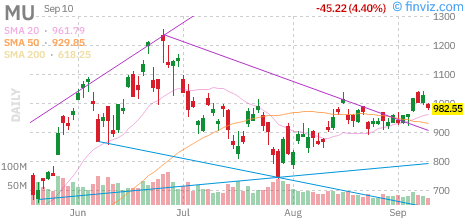
Thursday, September 10, US Eastern time. Micron Technology (MU) is trading at $981.85, down 4.47% from the prior close. The Nasdaq is still in regular hours; final closing prices will come after the market close. No new earnings or company disclosures triggered the move. Instead, Treasury yields and crude oil prices both jumped sharply, dragging the entire semiconductor and memory-chip sector lower.
The numbers alone look frightening. But Micron has already gained more than 256% since the start of the year. Is today's 4% selloff a signal that the uptrend has reversed, or just a pause in a longer rally? That distinction matters.
What happened today
The trigger was geopolitical. Escalating tensions between Iran and the US near the Strait of Hormuz sent Brent crude surging to $101.21 per barrel, up 3.4%, and WTI to $96.05—the highest closing levels since May. Rising oil prices eventually lift shipping and production costs, flowing through to consumer prices.
Simultaneously, Treasury yields jumped: 10-year yields hit 4.845%, 30-year yields reached 5.295%. The Treasury's announced plan to buy back fewer bonds than the market expected added additional upward pressure on rates. The broad market retreated: the Dow fell 405 points (-0.8%), the Nasdaq dropped 168 points (-0.6%), and the S&P 500 lost 37 points (-0.5%). Micron's 4.47% decline far outpaced those declines, a sign that the selloff was concentrated in the tech and memory-chip space.
Memory and semiconductor stocks fell broadly
In the premarket session and throughout the day, Micron, SanDisk, and Intel all moved lower in tandem, triggering news coverage of the entire sector. This is not a company-specific issue. Rather, it reflects a broad rotation out of technology stocks in response to higher rates and oil prices.
Micron actually experienced volatility just days ago. On September 9, the stock hit $1,041 intraday but closed at $1,000.26, down 1.61%—profit-taking around the psychological $1,000 level. Today's decline extends that pattern. After such a steep year-to-date rally, the stock has entered a phase where even modest headwinds trigger significant selling pressure from traders locking in gains.

But how is the underlying business doing?
Stock-price movements and business fundamentals can diverge significantly. Micron manufactures D-RAM and NAND flash; the market's sharpest focus is currently on HBM (high-bandwidth memory). The company is already mass-producing HBM4 for Nvidia's next-generation Vera Rubin GPU, and its 2026 HBM capacity is fully allocated under multi-year customer contracts. In other words, demand exceeds supply—the company can sell everything it makes.
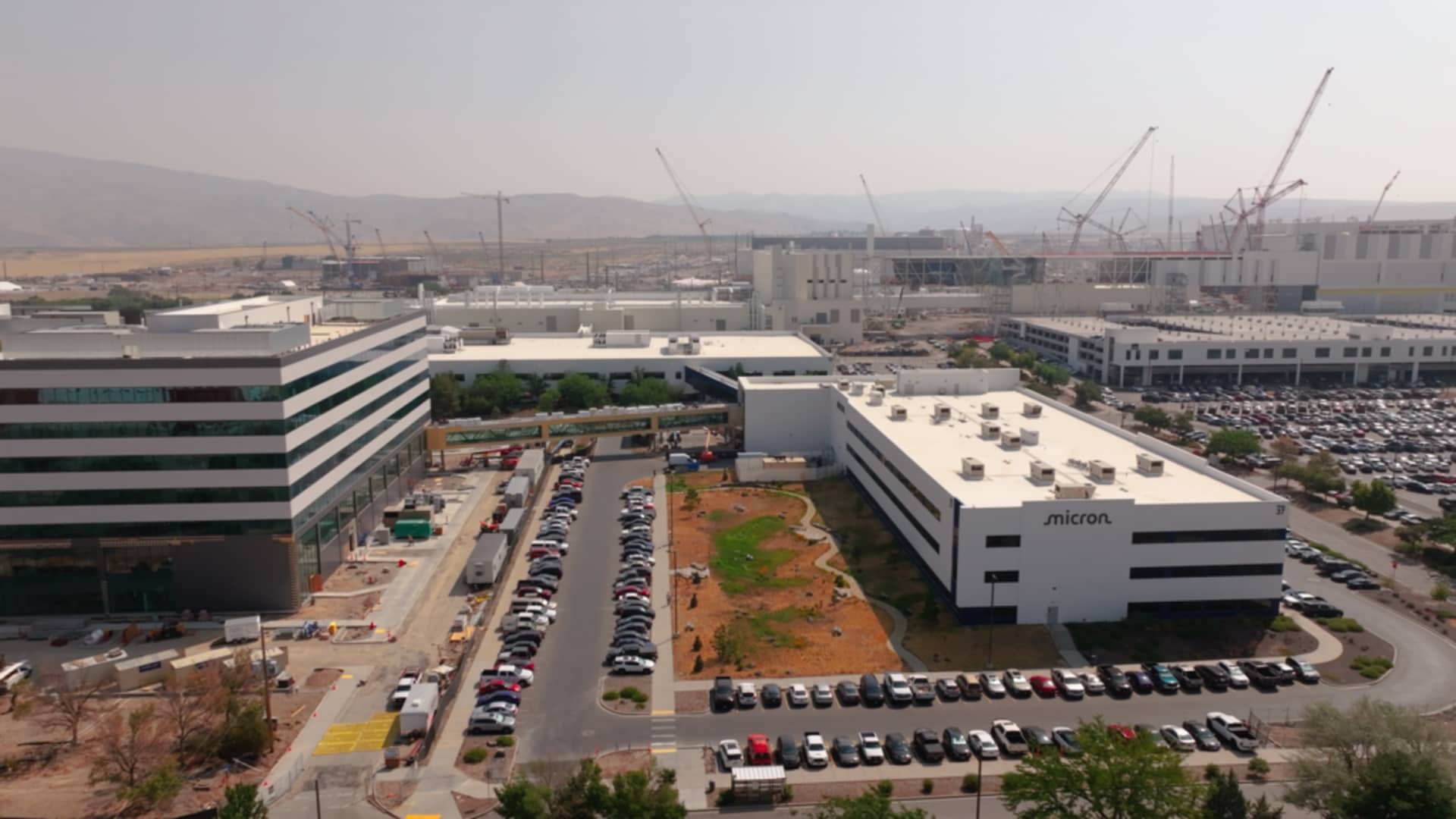
Capital spending is ramping steeply. Micron is constructing a new fab in Boise, Idaho—a $50 billion project that ranks as the largest private investment in Idaho history. The facility is targeted to come online in 2027 and will become the first full-process advanced D-RAM manufacturing plant in the US when completed.
What do Wall Street analysts expect?
According to S&P Global's consensus of 49 analysts tracking the stock, the aggregate rating stands at Strong Buy.
| Metric | Value |
|---|---|
| Average price target | $1,513.11 |
| Highest target | $2,200 |
| Lowest target | $361 |
| Consensus rating | Strong Buy (49 analysts) |
The consensus price target sits well above today's trading level, suggesting that few analysts interpret this selloff as a signal of deteriorating fundamentals. The wide gap between the lowest target ($361) and the mean ($1,513.11) does warrant attention—analysts hold sharply different views on valuation. Nevertheless, the stock continues to trade above its recent moving averages, and the long-term uptrend has not visibly broken.
Key risks to monitor
Valuation risk ranks first: when a stock has multiplied in value since the start of the year, even moderate macro shocks can trigger sharp reversals. Memory-chip pricing is cyclical by nature, and while Micron benefits when prices rise, the company has no direct control over those cycles. Perhaps most significantly, the current rally rests heavily on a single narrative: surging demand from AI servers. If that demand materializes more slowly than expected, the stock price could move lower before earnings reports catch up.

Where Micron stands now
Today's selloff reflects market-wide headwinds—rising rates, oil prices, geopolitical risk—rather than a Micron-specific problem. The HBM products the company sells remain severely undersupplied; demand vastly exceeds current production. Analyst price targets cluster above current levels. Yet after such a powerful year-to-date advance, Micron has entered a phase of elevated sensitivity to macro headlines, with profit-taking pressure just below key round numbers.
The next crucial data point arrives September 30, when Micron reports fourth-quarter fiscal 2026 earnings. The HBM revenue mix and forward guidance for the next quarter will matter most. They will help answer whether today's sharp decline was a normal pullback within an ongoing uptrend or the opening move of a new, more skeptical phase for semiconductor stocks.
Micron is US-listed. This article is factual analysis, not investment advice. Investment decisions and outcomes rest with you.
#Micron #MU #semiconductor #memory #DRAM #NAND #HBM #Nvidia #AI #Nasdaq #Treasuries #oil #US stocks #stock news
댓글
댓글 쓰기