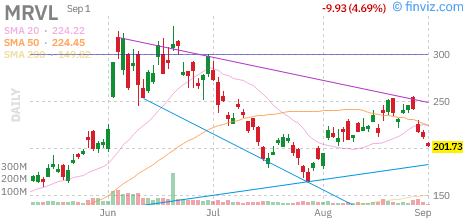
Marvell (MRVL) was trading near $201 in midday U.S. trading on September 1st, down 4.6% from the prior close of $211.57. On the surface, the decline suggests bad news. Yet this was the company that reported record revenue just a week earlier.
Record earnings paired with a fourth day of selling. That contradiction requires explaining.
Marvell: What It Does
Marvell designs semiconductors for servers and networking equipment. It initially built its reputation on storage and networking chips, but in recent years has transformed into a custom chip supplier for big tech's AI data centers. When companies like Amazon and Microsoft design their own semiconductors to reduce reliance on Nvidia GPUs, Marvell serves as their design and production partner.
That business mix made Marvell one of the stocks that tripled in the past year—a sign of how lofty expectations had climbed. Understanding this context is essential to why today's decline looks counterintuitive.
Is This Selloff Unique to Marvell?
Start with a key question: Is this decline isolated to Marvell or does it reflect broader sector pressure?
The answer leans toward the latter. The 10-year Treasury yield jumped to 4.8% today—up 0.6 percentage points in a single session. Rising rates hit growth stocks hardest, since they rely on discounting future earnings. Intel fell 3%, AMD and Nvidia each declined 2%, and Broadcom dropped 1%. The Philadelphia Semiconductor Index (SOXX) fell 2%. In short, the entire semiconductor sector came under pressure today.
So Why Were Earnings So Strong?
Marvell reported Q2 revenue (on a fiscal-year basis) of $2.739 billion on August 27, up 37% year-over-year. Data center revenue rose 46% to $2.17 billion, accounting for 79% of total revenue. The company also raised its full-year outlook.
By any measure, the results were clean. Yet the stock fell over 8% that day—erasing roughly $17.4 billion in market capitalization in a single session.
Why Sell on Good News? The Google Contract Catch
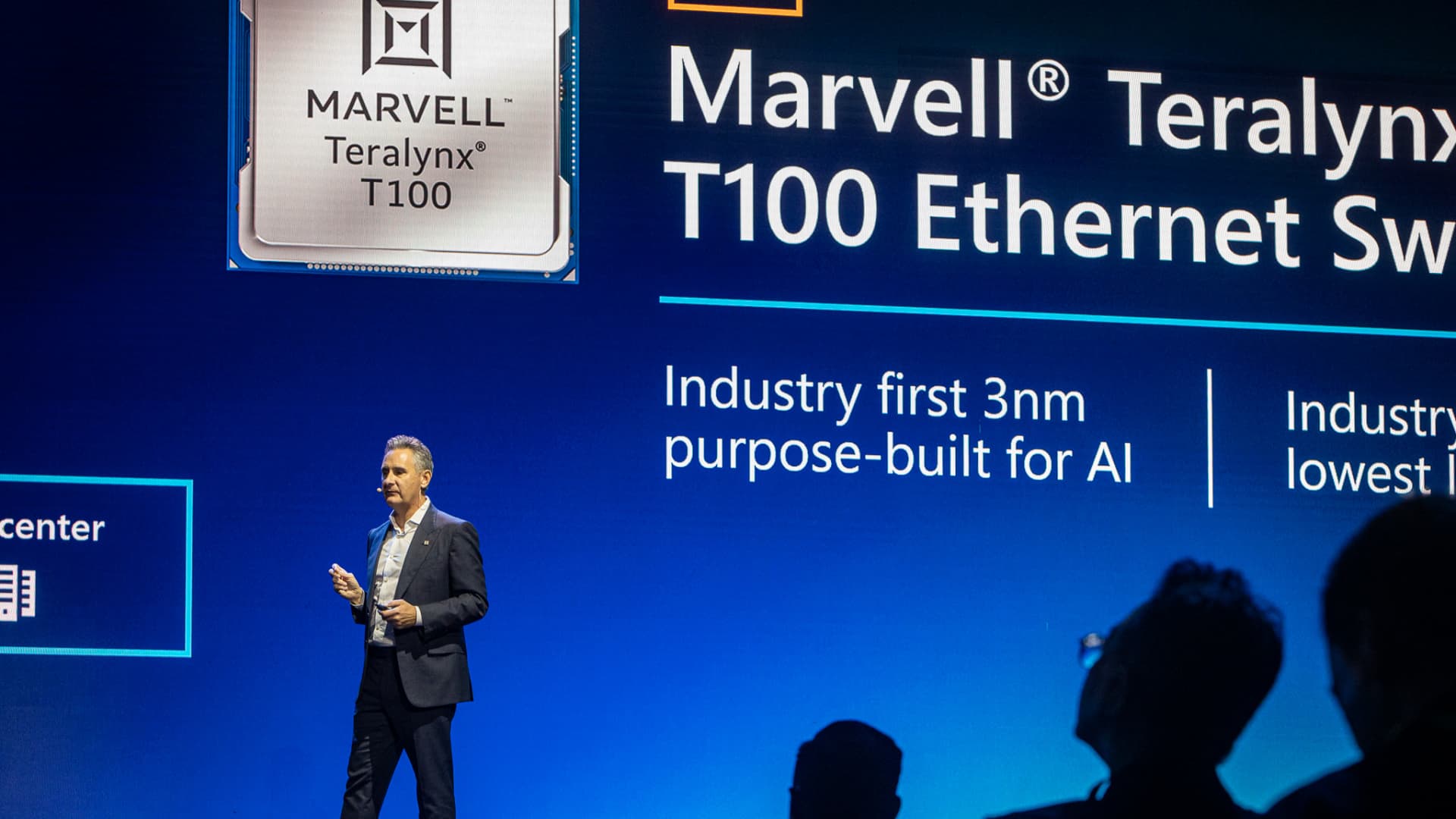
The question animating the earnings call was Marvell's custom AI chip agreement with Google—a deal worth up to $120 billion through fiscal 2033. The issue is timing. CEO Matt Murphy disclosed that while part of the contract is already reflected in FY2027-2028 guidance, the bulk of revenue recognition doesn't begin until fiscal 2029.
The market read this as a disappointment. Morgan Stanley analysts noted that "expectations around the Google contract had run too far ahead." The paradox of landing a major deal yet seeing stock weakness reflects a simpler reality: the market had already priced in an earlier revenue timeline. When guidance shifts to show earnings arriving later than previously assumed, even significant wins get sold.
Not One Day But Four—What Else Happened?
The timeline: August 27, earnings release. Next day, an 8% drop. August 31, B. Riley Financial cut its price target from $345 to $315, triggering another 2.3% decline. Today, September 1, the stock fell again as interest rate pressure weighed on semiconductors sector-wide.
Over four trading days, the stock slid from around $245 to $201—roughly an 18% loss. This isn't a single event but a cascade of separate catalysts: earnings-driven expectation resets, analyst target reductions, and sector-wide interest rate headwinds.
Valuation: Is Marvell Too Expensive?
Marvell's 12-month forward P/E stands at roughly 58x, versus around 32x for Broadcom, its closest peer. Even accounting for Marvell's growth premium, the stock has traded at a substantial valuation discount. That said, valuation alone doesn't explain the decline. Valuation acts less as a cause and more as an amplifier—magnifying the impact of already-negative catalysts like the Google contract timing shift and rising rates.
Analyst sentiment remains constructive overall. The median price target sits around $275, implying upside exceeding 13% from pre-decline levels. That said, consensus targets reflect average expectations, not a guarantee of reaching those prices.
Real risks remain. Marvell's custom chip business depends on a handful of customers—Google, Amazon, Microsoft, and a few others. Revenue concentration means that volume swings at any major customer create outsized earnings volatility. On days like today, when rates spike, the stock moves with the sector regardless of Marvell's operational fundamentals. That macro dynamic lies outside the company's control.
| Item | Figure |
|---|---|
| Current price (9/1 intraday) | ~$201.87 |
| Day-over-day change | -4.6% |
| Q2 revenue (YoY) | $2.739 billion (+37%) |
| Data center revenue as % of total | 79% |
| Google contract value | Up to $120 billion through FY2033 |
| Analyst price target (median) | ~$275 |
So Where Does Marvell Stand?
To sum it up: The underlying business hasn't deteriorated. Data center revenue continues growing at double-digit percentage rates, and the Google contract remains in place—only the revenue timing has shifted. The current decline reflects a reset of inflated expectations meeting actual timelines, compounded by sector-wide interest rate pressure.
Watch the analyst day scheduled for early October. If the company quantifies its FY2029 Google revenue contribution, the current uncertainty discount could compress. If guidance remains vague, the adjustment may extend longer.
A stock that tripled in a year losing ground over four days hardly signals a broken business. However, rebuilding those elevated expectations will likely require time.
Marvell trades on U.S. exchanges. This article is factual analysis, not an investment recommendation. Investment decisions and outcomes rest with individual investors.
#Marvell #USStocks #MRVL #MarvellStock #Semiconductors #AIchips #DataCenters #Google #CustomSemiconductors #Earnings #Rates #Treasuries #Nasdaq #SemiconductorIndex #Broadcom #AnalystTargets #StockInFocus #USMarkets #Selloff #Equities
댓글
댓글 쓰기