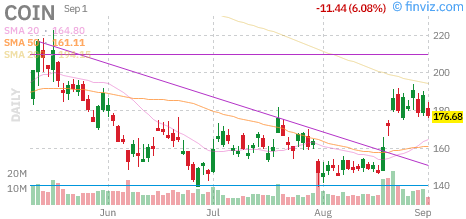
Coinbase fell 6.04% during U.S. trading on September 1, sliding to $176.76. That reversed a gain of more than 5% from the day before—a complete reversal in 24 hours.
Coinbase itself isn't the culprit. The trigger lies thousands of miles away, on the other side of the world.
What sparked the decline
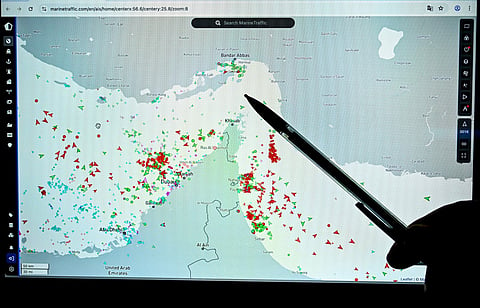
On Sunday, U.S. forces struck Iranian rocket launchers near the Hormuz Strait. The following day, the UAE said it intercepted Iranian drones over its territorial waters. As geopolitical risk spiked, Treasury yields climbed: the 2-year rose from 4.34% to 4.35%, and the 10-year jumped from 4.73% to 4.76%. While those moves look modest on paper, a synchronized shift of this magnitude signals the market is repricing the odds of a Fed rate increase in September.
When war risk and rate-hike anxiety collide, investors dump risk assets first. Crypto gets dumped before nearly anything else.
Why Coinbase fell harder than the broader market
The Nasdaq got rattled by war headlines on Monday. Coinbase got hammered. The reason: the company is heavily exposed to crypto trading fees. When Bitcoin moves sharply, trading volume collapses. When volume drops, revenue drops. This selloff isn't about Coinbase's fundamentals—it's market-wide risk-off behavior.
| Metric | Value | Notes |
|---|---|---|
| Current price | $176.76 | Down 6.04% today |
| Goldman Sachs target | $196 (prior $173) | Raised Aug 25 |
| Q2 market share | 10.3% | All-time high |

The company's actual earnings picture
To be fair, Coinbase had underlying problems before geopolitics took center stage. Q2 revenue came in at $1.2 billion, missing the $1.35 billion consensus estimate. The company posted a net loss of $359 million, or $1.36 per share.
One number changes the narrative entirely. Coinbase captured 10.3% market share in crypto trading—a record high. This gain came while industry-wide trading volumes contracted 25%. Subscription and services revenue now accounts for 48% of total revenue, up from minimal contributions in prior years. The company is diversifying away from trading fees alone.
Why analysts raised their price target
Goldman Sachs lifted its price target to $196 from $173 on August 25. The rationale: rising activity in brokerage services, prediction markets, and crypto trading, combined with a gradually opening regulatory environment. Analysts see a business getting stronger, not weaker.

At $176.76, the stock sits well below both the prior and new price targets. That's telling: analysts don't see a broken business. Today's drop looks more like one day's panic than a fundamental reassessment. That said, price targets are not buy signals, and the Street can revise them downward at any time.
Where this stands
Coinbase is caught between two different stories. One is acute: a day of geopolitical jitters and Fed-rate anxiety. The other is slower and less dramatic: steady gains in market share and subscription diversification. Both are real. Which one steers the stock remains an open question.
Two developments matter most. First, whether military tensions around Hormuz actually ease. Second, whether Bitcoin holds the high-$70,000 area. If both stabilize, today's 6.04% decline is likely just short-term noise. If tension escalates, that equation shifts.
The fact that a crypto exchange swings this hard on Middle East headlines alone underscores a hard truth: this company remains deeply wired to crypto sentiment.
Coinbase is a U.S.-listed security. This is factual analysis, not investment advice. All investment decisions and outcomes are your responsibility.
#Coinbase #COIN #crypto #bitcoin #Hormuz #geopolitical #Fed #rates #GoldmanSachs #TreasuryYields #September2024 #Nasdaq #trading #cryptoexchange #marketshare
댓글
댓글 쓰기