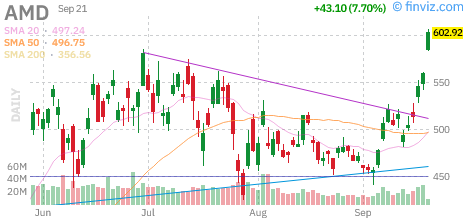
AMD shares are rallying sharply in New York trading on September 21. As of early Eastern time, the stock trades around $604, up 7.89% from the previous close of $559.82. This price level surpasses the prior 52-week high of $584.73 set on June 30. It marks an all-time high. The move stands out even among semiconductor stocks.
The numbers alone could suggest just another up day, but the broader trend over the past week tells a different story.
Why today's move
Two main catalysts. First, Piper Sandler analyst David O'Connor reiterated a $600 price target and outperform rating following the company's recent conference call. His case rests on on-schedule CPU and GPU launch timelines and sustained strong demand relative to supply. Second, AMD announced a roughly 10% price increase for some Q4 AI accelerators and GPUs, citing higher production costs. Price increases typically occur when demand is strong, not when supply is abundant.
Current consensus among 55 Wall Street analysts: 39 buy ratings, 5 outperform, 11 hold. The consensus price target is $617—above today's level. A higher target doesn't guarantee further gains; it reflects analyst optimism.
This week has been volatile
AMD sold off sharply early last week when AI industry leaders signaled a potential slowdown in model development. Semiconductor stocks broadly declined in response. But the stock recouped those losses within a week, finishing last week up 8% while the Philadelphia Semiconductor Index gained only 0.8%—a relative outperformance of more than 4-to-1. And today, another sharp move higher.
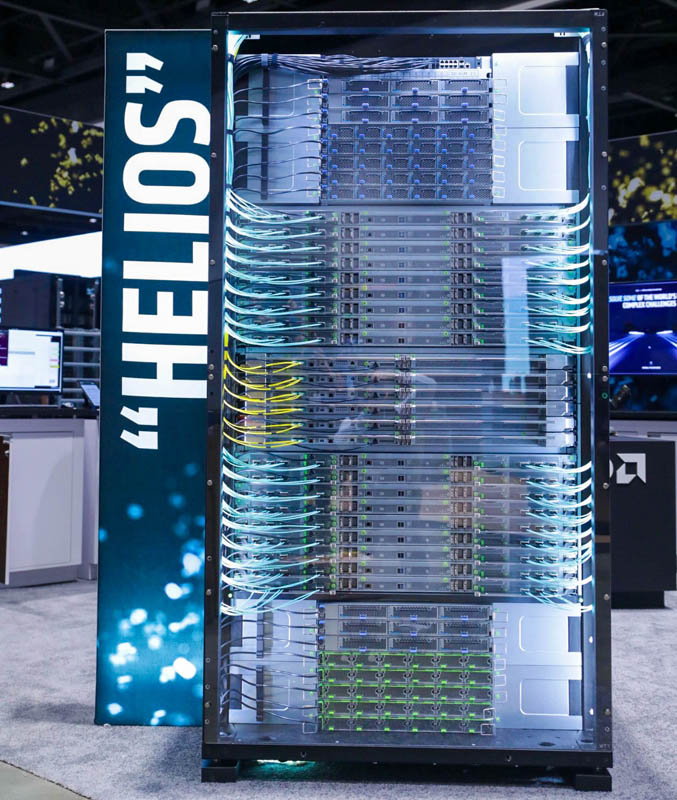
In July, AMD hosted "Advancing AI 2026," where CEO Lisa Su unveiled the MI450 series accelerators and Helios rack systems. The event featured a significant Anthropic supply agreement for up to 2 gigawatts of GPU capacity, with up to $5 billion in investment, alongside Oracle's announcement of a 50,000-GPU supercluster. Today's rally reflects not new announcements but a reassessment of the backlog-driven business foundation laid in July as it is validated in earnings.
Is the company actually profitable?
Q2 2026 data center revenue reached $6.72 billion, up 107% year-over-year. Data center now represents more than half of total revenue. Company-wide Q2 revenue was $11.54 billion, up 50%.
| Item | Q2 2026 | Year-over-Year |
|---|---|---|
| Total Revenue | $11.54B | +50% |
| Data Center Revenue | $6.72B | +107% |
| Q3 Revenue Guidance | ~$13B | +41% (expected) |
The numbers look solid. The concern is valuation. AMD trades at a P/E of over 200x, compared to Nvidia's roughly 45x. Nvidia's gross margin is 75%; AMD's is 56%. The company commands a higher valuation despite lower profitability margins—a reflection of how much forward growth is priced in.
Remaining risks
· Risk of pullback after sharp rally—since gains are driven by growth expectations rather than low valuation, earnings misses could trigger sharper declines.
· HBM supply constraints—even as AMD seeks to increase GPU production, high-bandwidth memory supply could become a bottleneck.
· Export control variables—heightened U.S. government restrictions on advanced semiconductor exports to China could impact revenue.
· Software ecosystem gap—while Nvidia's CUDA ecosystem is mature, AMD's ROCm is seen as having a thinner developer base.
The bottom line
The earnings and order backlog are real and demonstrable. Analysts are broadly constructive. But all these positive developments already appear substantially priced into the stock. Today marks a new all-time high. The more pressing question than "How much higher?" is "What revenue growth is needed to justify today's valuation?"
The next confirmation point is Q3 earnings. The company's $13 billion revenue guidance and whether data center can sustain 100%-plus growth rates are critical variables. Missing those targets could prompt a quick reversal of today's gains. Hitting them would vindicate the current valuation debate.
U.S. listed company. This analysis is factual, not an investment recommendation. Investment decisions and outcomes are your responsibility.
#AMD #AMDstock #USstocks #USmarkets #semiconductors #AIchips #Nvidia #LisaSu #datacenters #Helios #MI450 #PiperSandler #priceTarget #Nasdaq #StockInFocus #gainers #USstockinvesting #semiconductorindustry #AIaccelerators #Anthropic
댓글
댓글 쓰기