[Life Finance] When Does Korea's Basic Pension Start? It Differs From the National Pension in Age, Amount—and Eligibility
You've probably heard a claim like this: "If you're receiving the National Pension, you can't also get the Basic Pension." That's incorrect. They're two entirely separate programs. According to Ministry of Health and Welfare data as of September 29, 2026, the two programs diverge on nearly every dimension—starting age, benefit amount, and eligibility rules. The National Pension and the Basic Pension are governed by different rules. And the vast majority of recipients actually collect both simultaneously.
The real problem is treating these two programs as one. That confusion causes people to miss deadlines or abandon claims based on rumors—"I heard the National Pension reduces your Basic Pension." Today we'll lay out precisely what makes you eligible for the Basic Pension, how it actually differs from the National Pension, and what you'll receive according to official figures.
Age Requirements Differ First — National Pension by Birth Cohort, Basic Pension Always at 65
This is the most commonly misunderstood feature. The decisive factor is your birth year. The National Pension's Old-Age tier has been phasing in a later start age since 2013: it increases by one year per five-year cohort. If you're in your early 60s now, your exact eligibility age depends on your birth year.
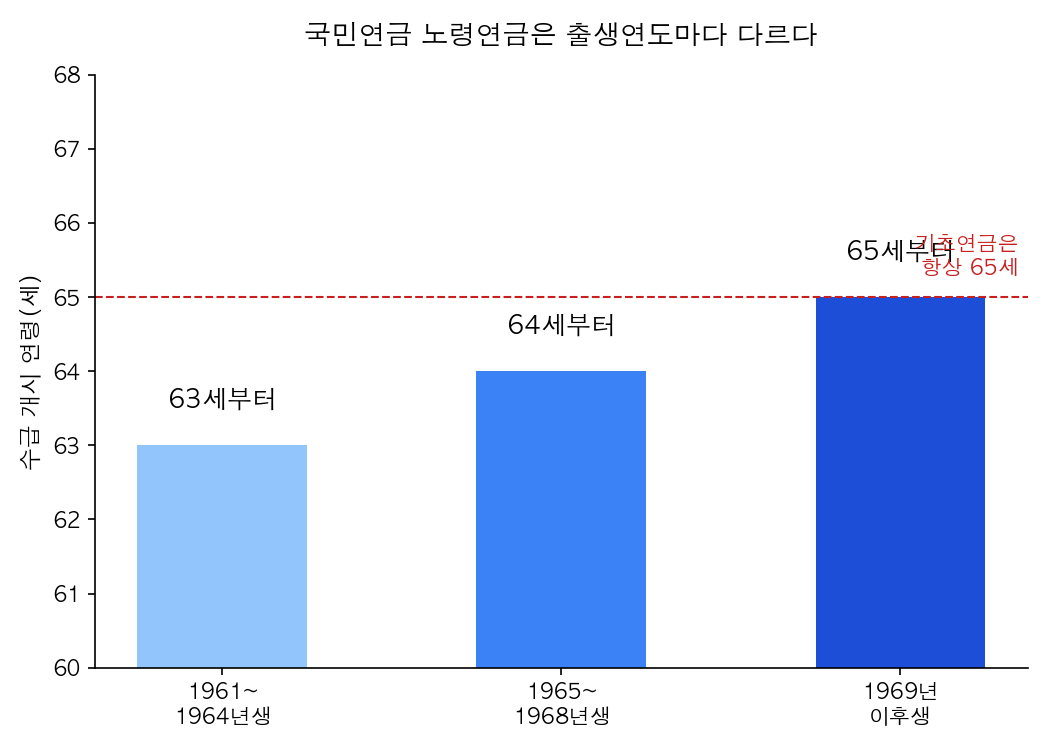
Compiled from Ministry of Health and Welfare data.
| Birth Year | National Pension Start Age | Basic Pension Start Age |
|---|---|---|
| 1961–1964 | 63 | 65 |
| 1965–1968 | 64 | 65 |
| 1969 onward | 65 | 65 |
For anyone born 1969 or later, both ages align at 65. Those born 1961–1968 face staggered start dates. You'll claim the National Pension first, then file separately for the Basic Pension years down the road. This time lag creates the confusion. Many people assume the Basic Pension will arrive automatically once they start collecting the National Pension. It won't. You must submit a separate application beginning one month before you turn 65—at your local public service center, through the government welfare website, or at a National Pension Service office.
Eligibility Criteria — "Lower-Income 70 Percent": Here's What It Actually Means
The Basic Pension flows to anyone aged 65+ whose recognized income stays at or below the selection criteria amount. Recognized income equals your monthly earnings plus an income-equivalent valuation of your assets. On earned income, there's a KRW 1.16 million monthly deduction before your remaining amount is factored in. In other words, only a portion of your gross wages count toward the threshold. Your actual qualifying income is typically lower than your paycheck shows.
The 2026 selection criteria threshold is KRW 2.47 million per month for a single household and KRW 3.952 million for a couple. If you fall below those ceilings, you're eligible to apply. Uncertain whether you qualify? Don't preemptively give up. Use the free recognized income calculator on the government welfare website first. It's the most reliable way to know. If you own assets but carry debt, liabilities reduce your asset value before the calculation. Many people who think they won't qualify actually do.
Benefit Amount — KRW 349,700 Monthly for a Single Recipient
The 2026 standard monthly benefit is KRW 349,700. Single households receive the full amount. However, if both spouses are eligible, each sees a 20% reduction: KRW 279,760 per person, for a combined KRW 559,520 monthly. When most people first learn about spousal reduction, they react with disbelief: "Why do we lose money for being married?"
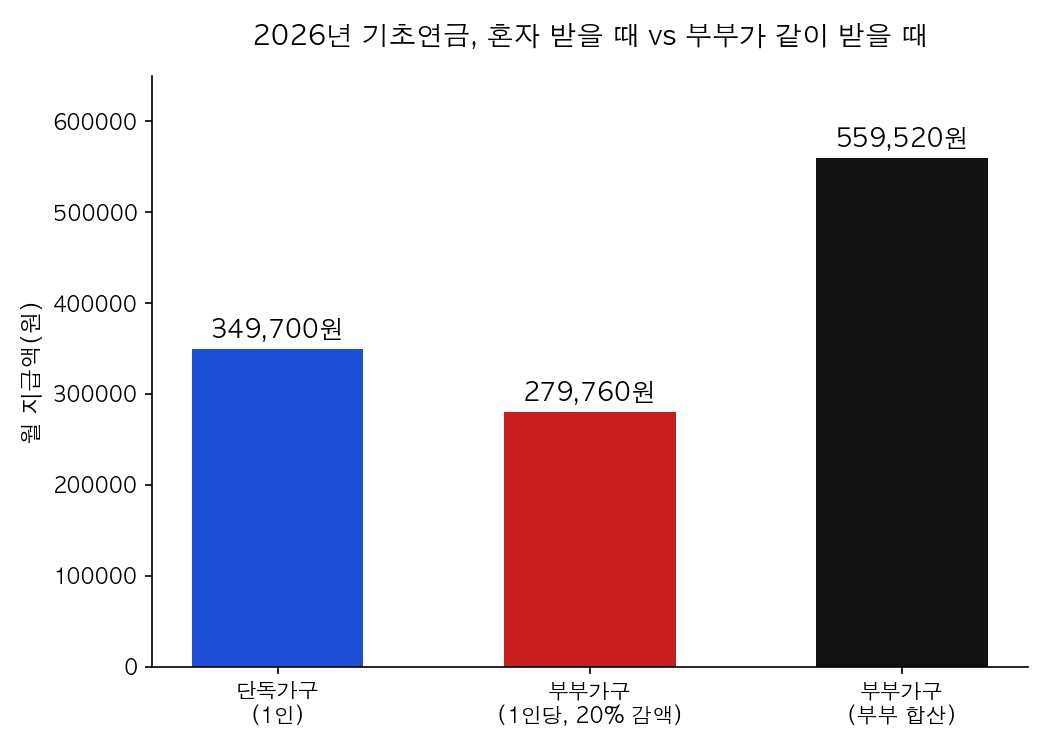
Compiled from Ministry of Health and Welfare data.
The spousal reduction rests on the principle that two people sharing a household have combined expenses lower than two separate single households. It's an equity measure designed to keep benefits proportional to living costs. From the recipients' standpoint—"We each still have individual living expenses"—the logic may feel unfair. Nonetheless, it's a regulatory feature you cannot change. Before you apply, calculate your combined household monthly benefit using the reduced rate. It softens the surprise.
Does a High National Pension Reduce Your Basic Pension?
This is the second most common misconception. The short answer: "Only in part." Simply receiving the National Pension doesn't automatically reduce your Basic Pension. Linkage reduction kicks in only if your National Pension benefit exceeds 150% of the standard Basic Pension amount. For 2026, that threshold is KRW 524,550 per month. Cross that line, and your Basic Pension shrinks partially.
Consider the flip side: if you collect around KRW 500,000 monthly from the National Pension, your Basic Pension pays in full. Only those who contributed consistently over decades—drawing above KRW 1 million monthly—encounter partial reduction. Paying into the system honestly isn't a penalty. Adjustments apply only to the upper tier of recipients.
Sum it up in three buckets: most people with a moderate National Pension still collect the full Basic Pension. A small minority with very high National Pensions sees modest reduction. Those without a National Pension face no reduction at all. In all three cases, applying is worthwhile. Pre-deciding you'll be rejected—that's the real mistake.
You can apply starting one month before your 65th birthday. Apply at your local public service center, a National Pension Service branch office, or through the government welfare website. Online applications are available. Annual updates to amounts and criteria mean you should verify the latest numbers immediately before submitting your application.
You'll need an ID and a bank account copy—that's it. If you're married, both spouses must apply separately. If only one of you applies, the other spouse's benefit doesn't materialize. If your spouse hasn't turned 65 yet, the eligible spouse files first. Once the other spouse reaches 65, they file independently. Both eligible—file both applications at whatever intervals work. Eventually, both claims will activate.
This article is for informational purposes only and does not constitute application advice. Program rules, amounts, and thresholds change annually. Verify the current eligibility standards with the National Pension Service (1355) or the Ministry of Health and Welfare hotline (129) before applying.
#basicpension #basicpensioneligibility #basicpensionage #nationalpension #oldagepension #basicpensionstandard #basicpensioncriteria #basicpensionamount #oldagepensiondifference #nationalpensionbasicppensiondifference #basicpensionbirthyear #65yearsoldbasicpension #basicpensionselectioncriteria #basicpensionbenefitamount #nationalpensioneligibility #oldagepensioneligibility #basicpensionapplication #basicpensionspousalreduction #nationalpensionlinkagereduction #recognizedincome #governmentwelfare #nationalpensionservice #ministryofhealthandwelfare #retirementplanning #retirementincome #pensionsystem #lifefinance #retirementincome #seniorbenefits #basicpensionmodelcalculator
댓글
댓글 쓰기