[Personal Finance] Working Chuseok: Your Pay Hinges on Company Size, Not Hours—and Firms Under 5 Employees Owe You Nothing Extra
Work the same hours on the same holiday, and the payout might double—or stay flat. The difference comes down to one thing: how many people your employer has on payroll. At workplaces with fewer than five employees, Chuseok is not a legally mandated paid holiday. Work that day and you get nothing extra—just your regular hourly rate.
Many people working the holidays overlook exactly this point. Let's start with holiday bonuses themselves, based on guidance from the Ministry of Employment and Labor and the Labor Standards Act.
Holiday Bonuses Aren't Legally Required
Plenty of people assume holiday bonuses are automatic. They're not. Korea's Labor Standards Act doesn't have a provision for bonuses at all. They're not legally mandated.
So when can you claim one? Only if it's written into your employment terms—house rules, a collective agreement, or your individual contract. There's a workaround: if your employer has a consistent practice of paying the same bonus in the same way every year, you may have grounds to claim it. How does the Ministry of Employment and Labor judge this? The same way: bonuses are determined by company policy and precedent, not by law.
What if you got one last year but not this year? Before you complain, check your employment terms. If it's written there, it's unpaid wages—a legal claim. If it's not documented and there's no established practice, your argument weakens.
Work Through the Holiday and You Get a Three-Part Payout
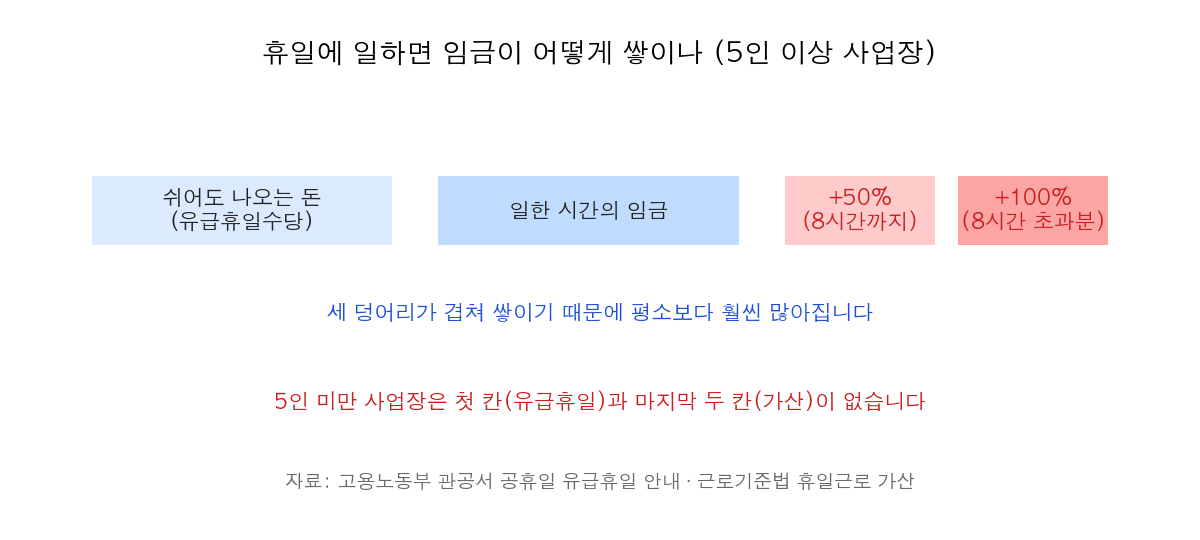
This is separate from bonuses. Holiday work surcharges are legally mandated. Since 2022, employers with five or more workers must provide paid time off on national holidays like Chuseok and substitute holidays. The rule originally applied only to firms with 300 or more employees, then was gradually lowered. Now it covers anyone with five or more.
A paid holiday means you're paid even if you don't work. But if you do work, you get extra pay. You're paid for the hours worked, plus a surcharge: 50% extra for the first eight hours, 100% extra for any hour beyond that.
Data compiled from Ministry of Employment and Labor guidelines
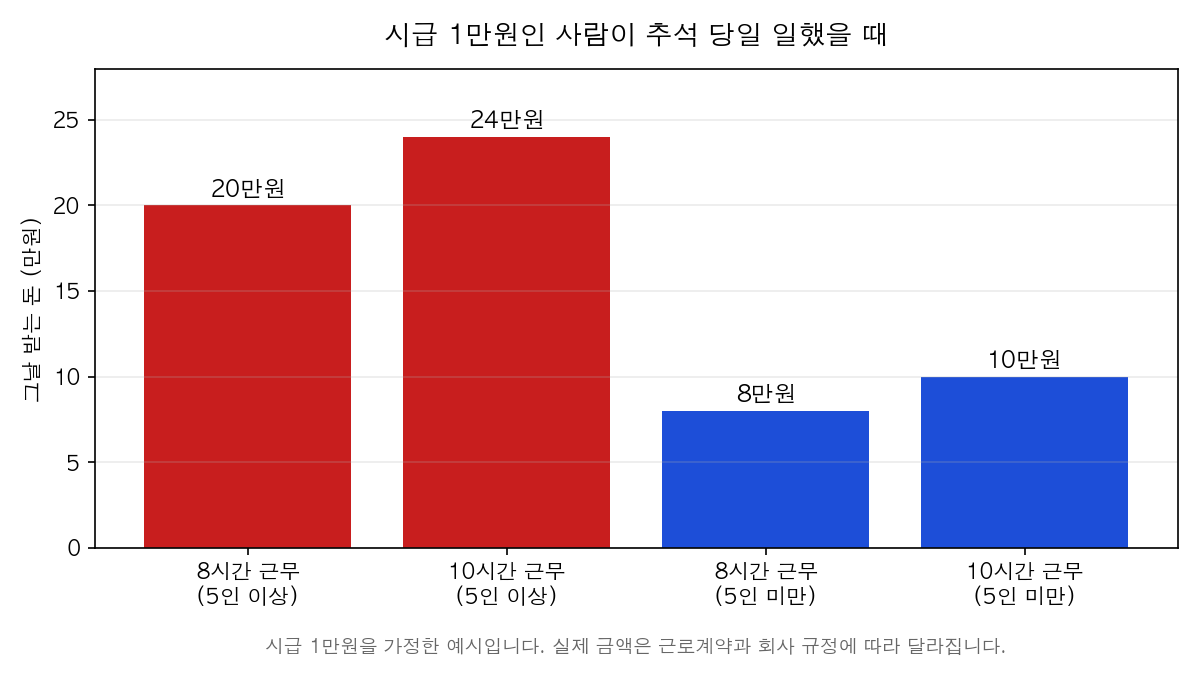
Numbers make the difference clear. Take someone earning 10,000 KRW per hour, working eight hours on Chuseok:
Data compiled from Ministry of Employment and Labor guidelines
Pay for not working: 80,000 KRW. Pay for working: 80,000 KRW. Surcharge: 40,000 KRW. Total: 200,000 KRW. Work 10 hours? The extra two hours get 100% surcharge. That brings it to 240,000 KRW—two and a half times a normal day's pay.
But None of This Applies If You Work for a Small Business
This is the part most people miss. Employers with fewer than five workers have no legal obligation to provide paid national holidays. Holiday surcharges don't apply either.
So work the same eight hours: at a firm with five or more employees, you get 200,000 KRW. At a smaller operation, you get 80,000 KRW—your regular rate, no surcharge. That's the blue bar in the chart above.
If you work a holiday at a neighborhood shop or small office, know this going in: the law doesn't require extra pay. The exception: if your employer has its own policy, check your contract first.
Note: the five-person threshold counts permanent employees only, not the owner. Part-time and temporary workers count toward that total. If you're near the line, get clarification—don't guess.
Your Employer Can Substitute a Different Day
There's one more option. If operations must continue on a holiday, the employer can work out a swap. With a written agreement signed by the employer and a worker representative, they can designate a substitute day as the paid holiday.
With this arrangement, Chuseok becomes a regular workday—no surcharge. You take your paid day off on the agreed-upon date instead. If you worked Chuseok and the pay looked the same as any other day, this swap is probably what happened.
But there are conditions
The agreement must be in writing, signed between your employer and a worker representative. The substitute day must be specified in advance. Verbal promises like 'I'll let you off later' don't count. If there's no written swap and you got no surcharge, you might have grounds to claim one. Clarify when and how you'll take your compensating day off, and get it documented.
Three Things to Verify
First: your company headcount. Five is the threshold—that's where holiday pay can double or stay flat. Count all permanent and part-time workers, not the owner.
Second: is a bonus written into your employment terms? If yes, it's owed income. If no, it's discretionary. That distinction decides whether you can legally claim it.
Third: was there a written holiday-swap agreement? If your boss only said "take the day off later" and you got no surcharge, it's worth asking when and how you'll make up the paid day. Get it in writing.
Plenty of people work through the holidays. It's worth checking your pay stub—usually issued with your next paycheck—to make sure you got what you were owed.
Sources: Korea's Ministry of Employment and Labor guidance on national and substitute paid holidays, guidance on bonuses, Labor Standards Act provisions on holiday surcharges (law.go.kr). All figures in this article assume an hourly wage of 10,000 KRW; actual amounts depend on your employment contract and employer policy. For individual situations, contact your local labor office or call 1350 (toll-free).
This article provides information only and does not constitute advice to take any particular action.
댓글
댓글 쓰기