Monday, September 7, 2026. Over the weekend, U.S. stock indices appeared subdued on the surface. But look inside the numbers and a different story emerges entirely.
Friday, September 4, all three major U.S. indices closed lower. The Dow Jones Industrial Average fell 271.86 points, or 0.51%, to 53,414.25. The S&P 500 declined 29.11 points, or 0.38%, to 7,718.60. The Nasdaq Composite dropped 77.07 points, or 0.29%, to 26,506.99. Each index posted a modest loss.
One data point drove the move: employment came in too strong.
Why U.S. markets fell—good news priced as bad
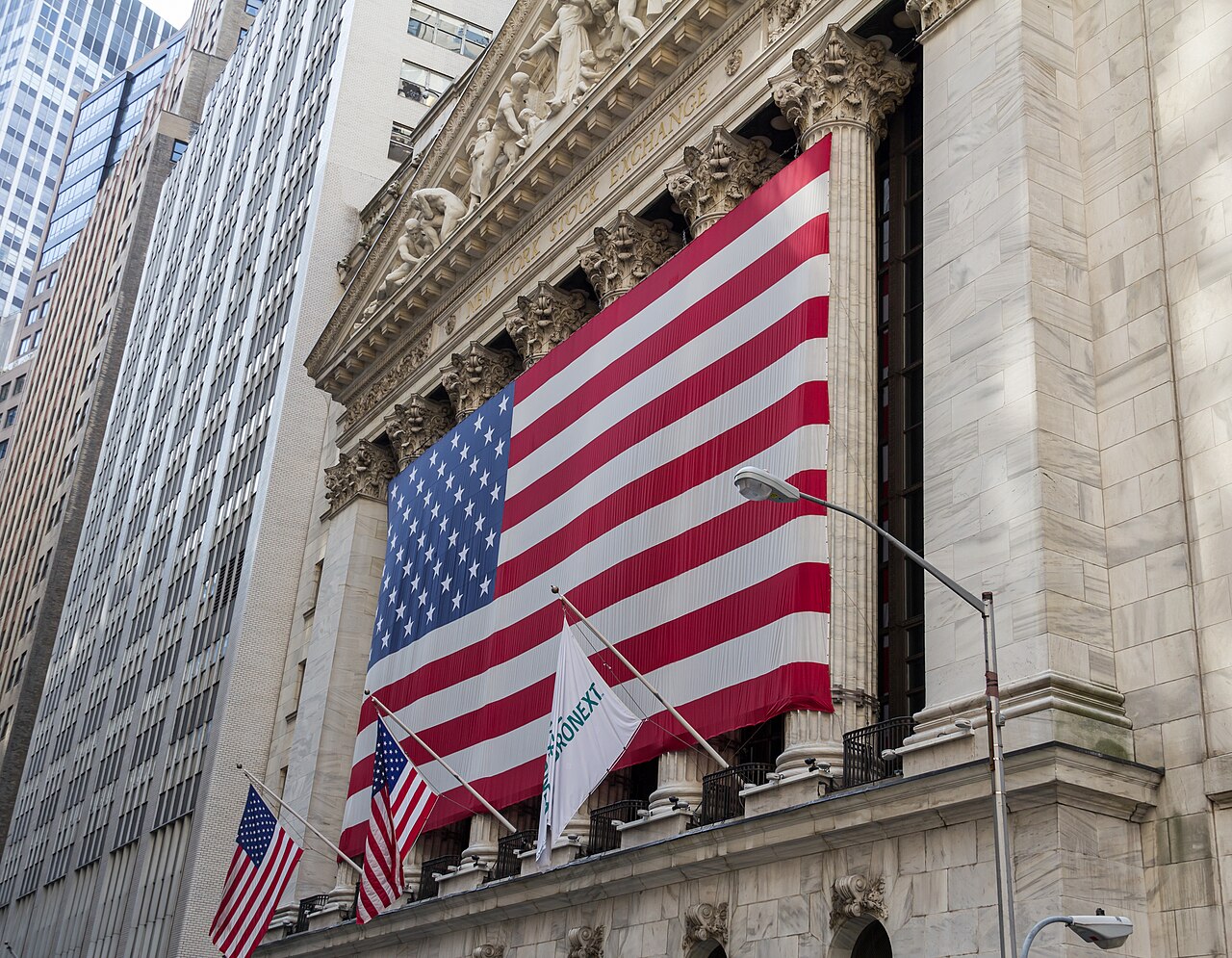
Wall Street. Friday saw the three major indices close lower, driven by stronger-than-expected employment data.
The Labor Department reported 162,000 non-farm jobs added in August. Markets had expected roughly 50,000. The actual figure exceeded consensus by more than threefold. Unemployment held steady at 4.1%.
A single employment report shouldn't move markets this sharply, but the mechanism is pure interest-rate arithmetic. Stronger job growth leaves the Fed room to pause, hold, or raise rates. The 10-year Treasury yield climbed to 4.79%. Higher bond yields pressure stock valuations, especially for growth stocks dependent on discounted future earnings. Bond traders repriced instantly; equity traders followed suit.
A day when good news was read as bad.
But semiconductors moved the opposite direction—SOX +3.38%
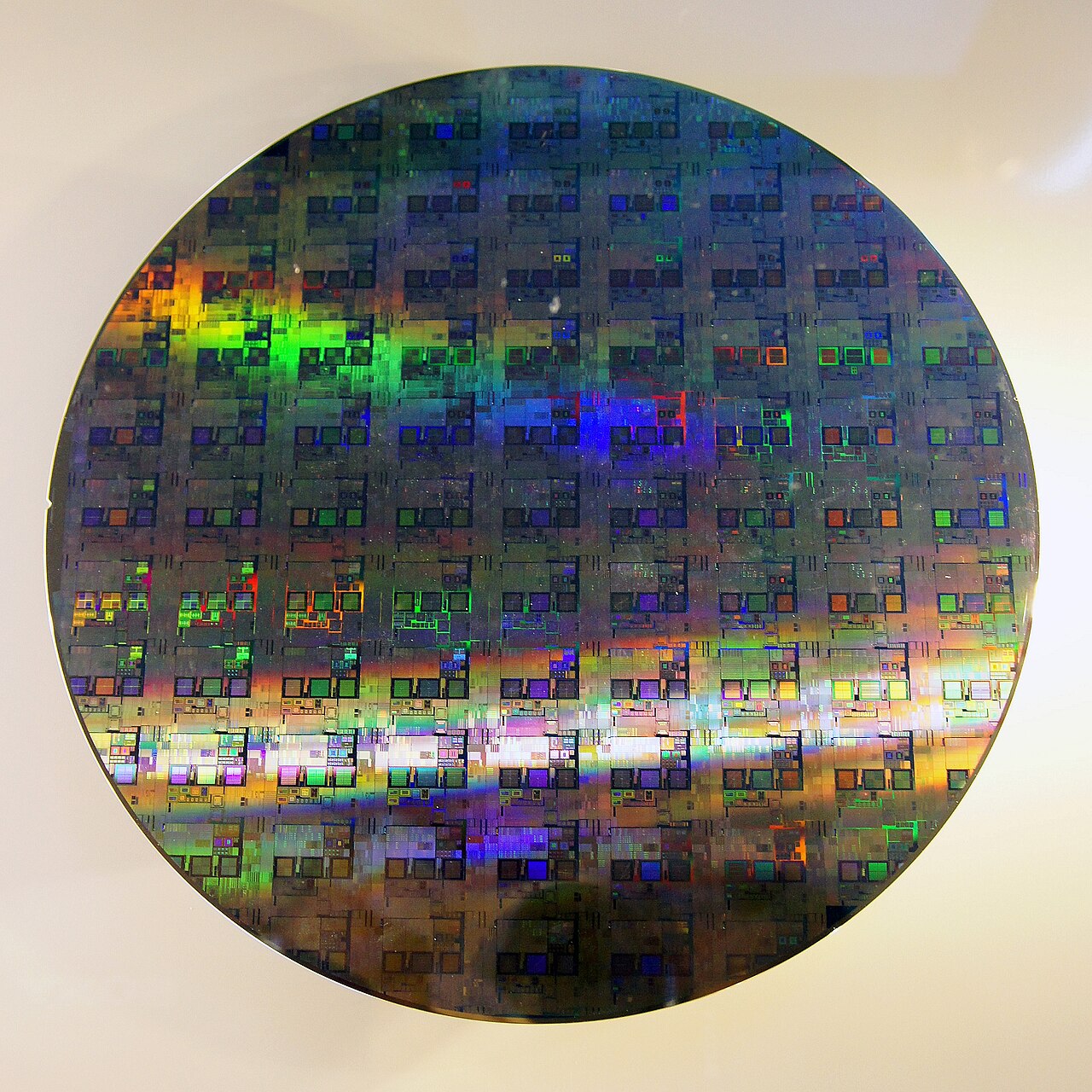
Semiconductor wafers. On a day when broad indices retreated, one sector stood alone.
That's where Friday's real story lies. The Philadelphia Semiconductor Index (SOX) surged 3.38% to close at 11,735.26 on the same day the three major indices fell. A single sector gained 3% while the market retreated.
Individual stocks showed clear direction. Intel rose 4%. AMD gained 3%, closing at $471.05. NVIDIA added 2%, ending at $232.37. One sector managed to sidestep the rate headwind.
Earnings explain the divergence. NVIDIA's latest quarter showed revenue up 106% year-over-year. AMD posted 50% growth. Confirmed demand from AI applications appears to have outweighed interest-rate concerns. For one day, earnings beat rates.
This momentum flows directly into Korean semiconductor and export stocks. SK Hynix and Samsung Electronics typically move in sync with their U.S. sector peers. A 3% SOX rally overnight increases the odds these two names will command trading attention when Korea's market opens.
Interest rates, currency, oil—all moving in concert
The Federal Reserve Building. Stronger employment reset rate expectations for the second half of 2026.
The 10-year Treasury yield at 4.79% reflects what we outlined earlier. The 2-year yield has climbed to its highest level since January 2025. When short-term yields rise sharply, markets are signaling concrete odds that the Fed will act at its next meeting.
In Korea's foreign exchange market, the USD/KRW rate closed Friday at 1,350.4 won, down 8.9 won from Thursday. The won strengthened against the dollar. A stronger won narrows export price competitiveness marginally but improves the attractiveness of Korean assets to foreign capital.
Crude oil moved in the opposite direction. Brent crude traded at $96.90 a barrel Friday, down $2.48 from the prior session. Lower energy costs ease inflation pressure and partially offset the rate-hike headwind.
Prior session in Asia—Korea alone finished higher

Oil prices remain a key gauge of inflation expectations.
Asia's major indices showed sharp divergence on Friday. KOSPI rose 107.73 points, or 1.64%, to 6,687.21, reclaiming the 6,600 level. KOSDAQ surged 2.95% to 813.50. Trading volume was led by SK Hynix in top position and Samsung Electronics second. Foreign investors and institutional buyers showed simultaneous net buying across semiconductor and IT large-cap names.
Japan's Nikkei 225 gained 806.44 points, or 1.26%, to 65,020.94. Korean and Japanese momentum aligned around semiconductor and tech positioning.
Greater China underperformed. The Shanghai Composite fell 0.3% to 3,930.12. The Shenzhen Component declined 0.79% to 13,516.97. The ChiNext Index lost 0.78% to 3,286.55. The CSI 300 dropped 2.10% to 1,577.36. Taiwan's TAIEX fell 307.06 points, or 0.67%, to 45,857.66. Regional reports attributed the weakness to profit-taking in technology stocks after an initial rebound on Wall Street strength, leaving Chinese indices down for a second straight session.
Same semiconductor supply chain, divergent trades: Korea and Japan accumulated; Greater China distributed.
Overnight U.S. market structure—S&P 500 heatmap
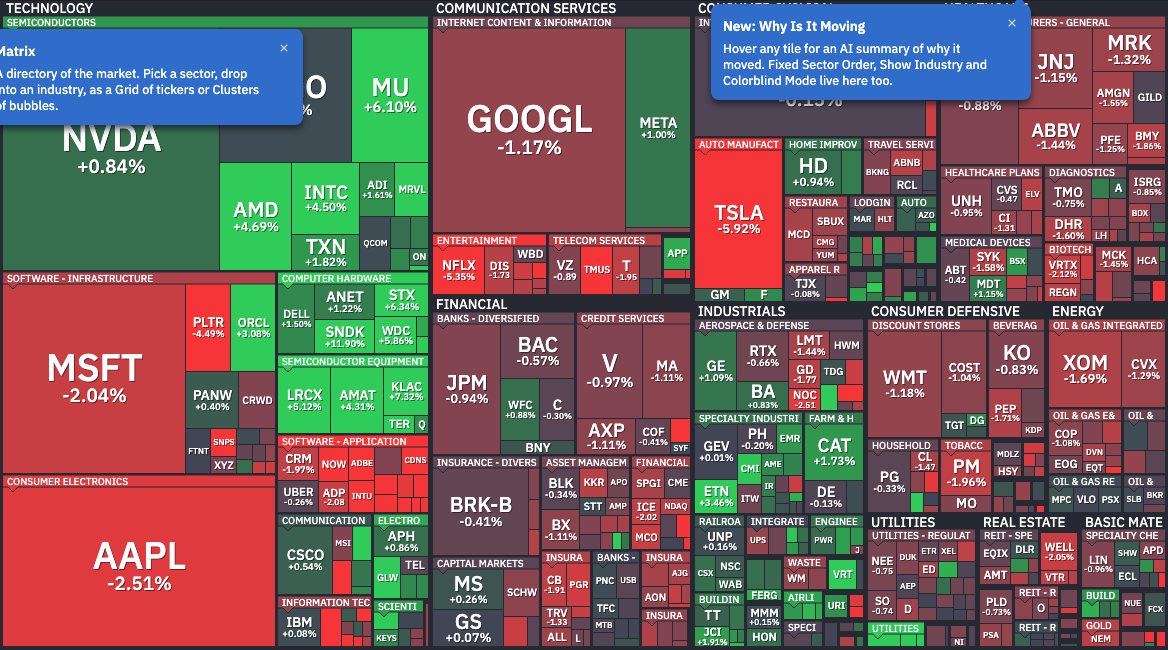
U.S. market structure, September 5 (S&P 500 heatmap) · Green = gainers / Red = losers (finviz color convention)
The heatmap crystallizes the day in one image. The overall market shows a faint red tint, but the semiconductor and technology zones stand out in bright green. Earnings confirmed in one corner; unproven elsewhere.
What to watch in Korea's market today

Yeouido. Korea's market opens today facing two competing forces overnight: semiconductor momentum and rate headwinds.
Korea's market opens today under two opposing pressures. One is semiconductor momentum from a SOX gain of 3.38%. The other is the U.S. 10-year Treasury yield at 4.79%. How these two forces balance will set the session's tone.
Key items to track:
| Watch Point | Overnight Data | Today's Signal |
|---|---|---|
| Semiconductor momentum | SOX +3.38%, Intel +4%, AMD +3%, NVIDIA +2% | Whether SK Hynix and Samsung Electronics sustain top-5 volume |
| Rate headwind | U.S. 10-year yield at 4.79% | Whether foreign investor net buying persists beyond one day |
| Exchange rate | USD/KRW at 1,350.4 won, down 8.9 won | Whether the won holds near 1,350 |
| Oil | Brent crude at $96.90/barrel | Whether inflation concerns resurface |
KOSPI has already climbed to 6,687. Upside room may be narrower than Friday's gain. Whether semiconductor large-caps hold volume leadership and whether foreign net buying extends to a second day will signal whether Friday's rally has follow-through.
The FOMC meeting is scheduled for September 15-16. The next data point to watch: August consumer prices, due mid-month.
Summary

Exchange rates were another layer to last night's market structure.
At first glance, last night's U.S. markets looked quiet. But underneath, a single employment print reset rate expectations, and confirmed earnings in semiconductors let that sector escape the fallout. One day when broad indices and one sector moved in opposite directions.
Korea's market today absorbs both currents at once. The real question is not the individual headlines, but which force—semiconductor strength or rate headwinds—proves more durable.
Investment decisions and outcomes remain your own responsibility.
#USMarkets #KOSPI #DowJones #SandP500 #NasdaqComposite #PhiladelphiaSemiconductorIndex #SOX #SemiconductorStocks #NVIDIA #AMD #Intel #SKHynix #SamsungElectronics #USDKRWExchangeRate #TreasuryYield #USEmployment #Nikkei225 #ChinaStocks #Taiwan #MarketBrief #EquityMarkets #TechStocks #FOMC #BrentOil #AsianMarkets
댓글
댓글 쓰기