[Korea Market Close] KOSPI Closes at 6,838; Intraday Rally of +94 Points Erased as Long-Dated U.S. Yields Surge
KOSPI ended today at 6,838.04, down 32.77 points, or -0.48%, from the prior session. On the surface, it looks like a routine pullback.
But the intraday picture was entirely different. Shortly after the open, the index rallied to 6,965.64—a gain of 94.83 points, or +1.38% from yesterday's close. In less than half a trading day, that 127-point swing vanished. The market pivoted twice in one session.
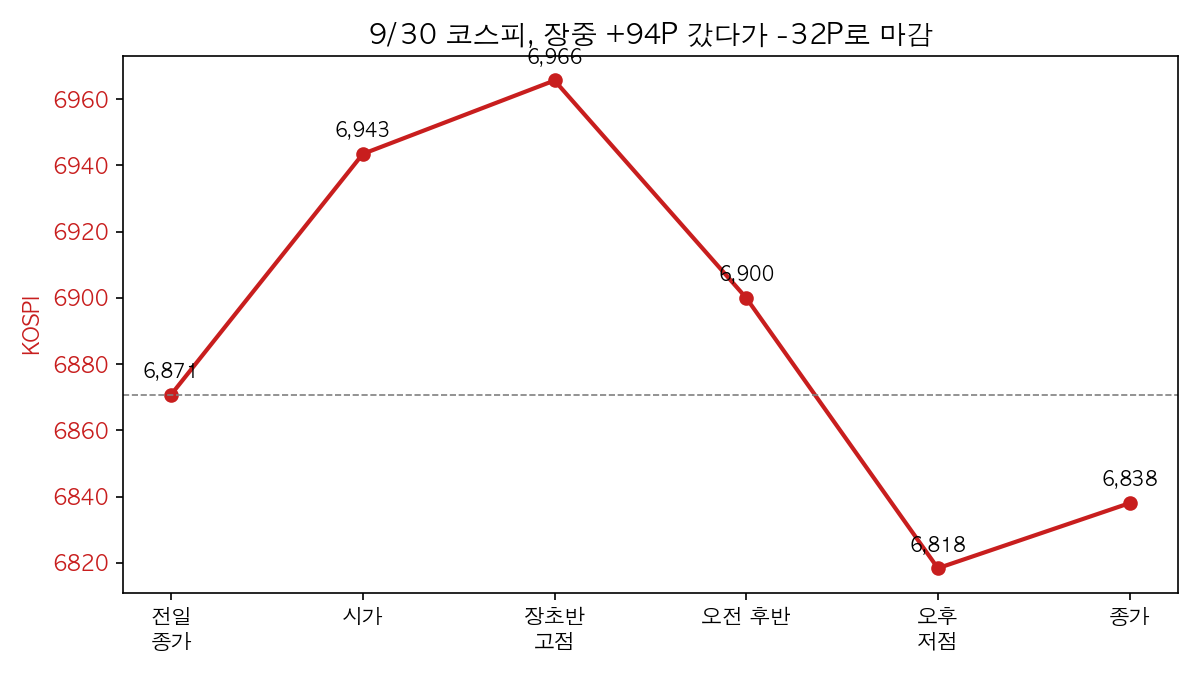
KOSPI intraday path, Sept. 30. Source: aggregated from Infostock market data
The culprit wasn't in Seoul
Domestic news can't explain the reversal. The real pressure came from across the Pacific. Overnight, U.S. 30-year Treasury yields climbed to 5.621%, the highest level since June 2002—nearly 24 years ago. The 10-year yield also reached 5.294%, the highest since June 2007. The cause is straightforward: U.S. government spending isn't declining, and companies building AI infrastructure continue heavy borrowing. More bonds are being issued than purchased, so prices fall and yields rise.
Analysts at Barclays are already discussing the possibility of 30-year yields reaching 6%. That pressure flowed directly into Korean equities. The early strength eroded throughout the afternoon.
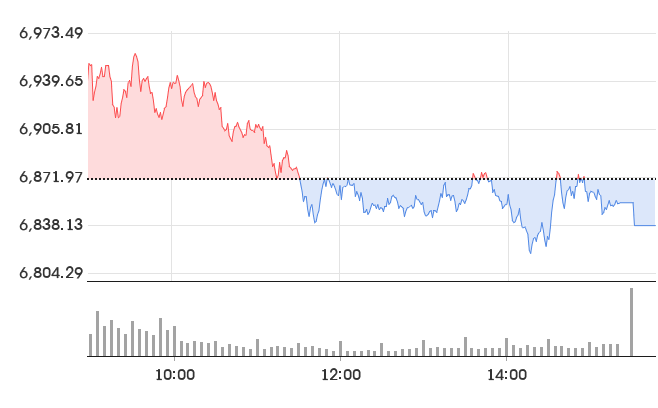
KOSPI three-month daily chart (Naver Finance; red = gains, blue = losses)
Investor flows: foreigners sell for a fourth straight day, institutions flip
The investor flows explain why the market couldn't hold its ground. Foreign investors sold net KRW 2.057 trillion, marking their fourth consecutive day of net selling. Institutional investors net sold KRW 775.2 billion, reversing yesterday's net purchases. Retail investors stepped in with KRW 1.178 trillion in net buys, but couldn't fully absorb the two-handed selling pressure.
KOSDAQ moved in the opposite direction. It closed at 855.91, up +0.72%, extending its winning streak to four sessions. Retail investors have now bought for seven straight days, and institutions returned to buying for a second consecutive day. While large-cap KOSPI was pinned down by rate pressure, smaller-cap KOSDAQ was buoyed by individual semiconductor and battery names. A tale of two indices.
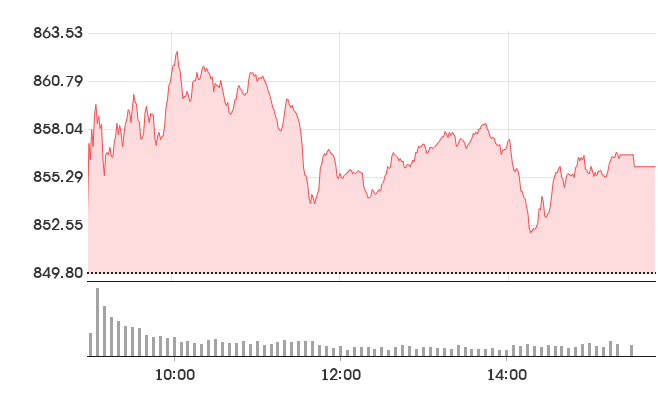
KOSDAQ three-month daily chart (Naver Finance; red = gains, blue = losses)
Today's daily limits: all traced back to one man's words
Dongil Stainless Steel (+29.99%), KBI Dongyang Steel Tube (+29.97%), Keumkang Steel (+22.69%), Hi-Steel (+18.97%). Different sectors, same driver. Reuters reported that President Trump could announce as soon as today a commitment by South Korea to invest $54 billion in Alaska LNG development.
The context behind that number is revealing. Alaska is a competitive midterm election state in November. While Trump won decisively there in the 2024 presidential race, the current race for Senate seats is now described as tight between the Republican incumbent and the Democratic challenger. The timing suggests this may be a campaign card, not a trade-policy move. Reports indicate Trump has also scheduled a campaign rally in Alaska for October.
Battery-sector names also rallied—EcoPro (+2.28%), EcoPro BM (+2.83%), Solbrain (+5.56%)—but again, the driver was domestic. The calculus: if Democrats sweep both chambers in the midterms, the "blue wave" scenario could revive policy premium for solar, batteries, and energy storage that has been under pressure. Similarly, solar stocks like Hanwha Solutions (+4.31%) and OCI (+1.48%) rose on the same logic.
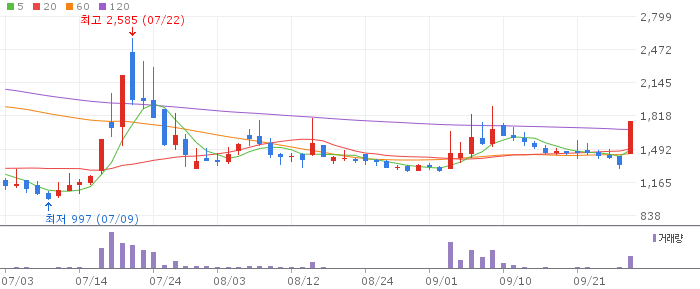
Dongil Stainless Steel three-month daily chart (Naver Finance; red = gains, blue = losses)
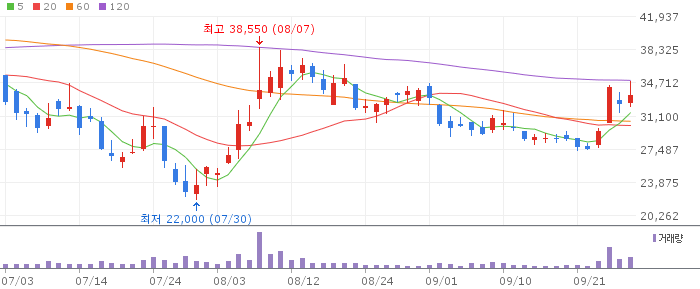
Hanwha Solutions three-month daily chart (Naver Finance; red = gains, blue = losses)
Financial stocks bore the brunt of rising rates
By sector, Insurance (-3.27%) and Financials (-1.40%) fell the most. Key names: Shinhan Financial (-3.98%), Hana Financial Group (-3.92%), Samsung Life (-2.93%), Samsung Fire & Marine (-3.06%), all sliding 3-4%.
A common misconception: higher rates should benefit banks by widening net interest margins. Today's action proved otherwise. When long-term rates spike this rapidly, markets interpret it as a signal of slowing growth alongside persistent inflation and fiscal burden. This combination compounds the mark-to-market losses that insurers and banks carry on their bond portfolios. Samsung Electronics (-1.47%), the semiconductor bellwether, briefly rallied on the strength of the Philadelphia Semiconductor Index at the open, only to give back all gains by close. Foreign investors' four-day selling streak continued unabated.
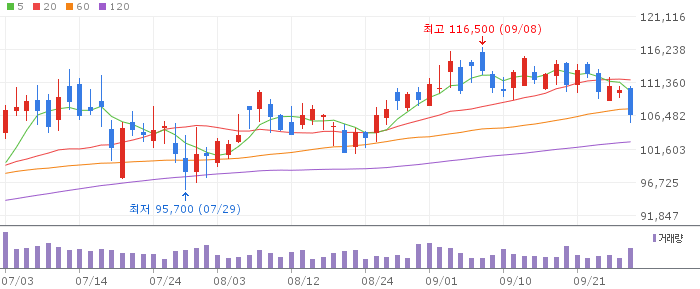
Shinhan Financial three-month daily chart (Naver Finance; red = gains, blue = losses)
Not all the news was grim
Overnight U.S. economic data came in softer than expected, offering some relief. John Williams, president of the Federal Reserve Bank of New York, said there is "no need to move expeditiously with further rate increases" given actions already taken in September. By the close of trading on Wall Street, the odds of a rate hike at the October FOMC meeting had collapsed from 70% to 49%.
Yet long-dated Treasury yields kept climbing. That's the crux of today's action. Policy rates—controlled by the central bank—and long-term yields—set by markets pricing inflation and fiscal risk—can diverge sharply. Even if the Fed slows its pace, long-term headwinds don't ease. Today, the market demonstrated exactly that disconnect.
| Metric | Level | Context |
|---|---|---|
| KOSPI | 6,838.04 (-0.48%) | Third consecutive daily decline; intraday range +1.38% to -0.48% |
| KOSDAQ | 855.91 (+0.72%) | Fourth consecutive daily gain |
| Foreign investors (KOSPI) | -KRW 2.057 trillion | Fourth consecutive day of net selling |
| U.S. 10-year yield | 5.294% intraday | Highest since June 2007 |
| U.S. 30-year yield | 5.621% intraday | Highest since June 2002 (~24 years) |
Two numbers to watch tomorrow
First: the U.S. Personal Consumption Expenditures (PCE) inflation gauge. Since the Fed prioritizes this measure, a hot print could reignite rate-pressure concerns that briefly eased today.
Second: Micron Technology earnings. If the numbers reaffirm strong AI memory demand, semiconductor stocks could regain footing. If not, expect another session of early gains reversed by day's end. Like the way Samsung Electronics and HLB moved in opposite directions when the 5% yield level broke two days ago, this coming week is being shaped by these two figures more than by broad index dynamics.
This article is provided for informational purposes only and does not constitute investment advice. Investment decisions and their outcomes rest with the reader.
#KOSPI #KOSDAQ #Korea-bonds #US-Treasury-yields #foreign-selling #AI-infrastructure #Alaska-LNG #battery-stocks #solar #semiconductors #Shinhan #Hana-Financial #Samsung-Life #Samsung-Electronics #Micron-earnings #PCE-inflation #Fed-policy #yield-curve #Korea-markets #market-close #trading #stock-market #earnings #FOMC #central-bank
댓글
댓글 쓰기