[Korea Market Close] KOSPI closes at 6,789—Why did Marvell sink in after-hours despite beating earnings?
The KOSPI closed at 6,788.88 on August 28, down 1.79%. It marked the first decline in four trading days.
Semiconductors drove the retreat. But what knocked them down is striking. A day earlier in New York, NVIDIA reported earnings and the stock surged. After the U.S. close, Marvell Technology posted results that moved the opposite way. It beat consensus. Yet the stock tanked in after-hours trading.
"Beat expectations but stock falls." That paradox framed the entire session.
Index opened with a smile, closed in tears
The KOSPI opened at 6,846.54, down 65.83 points from the prior close. It rallied to 6,901.78 in morning trade, nearly erasing its opening loss. At that point the tone turned defensive—losses contained. The afternoon flipped the script. The index fell to 6,780.13 and closed at 6,788.88. A 121-point swing in a single session. A roller coaster.
The KOSDAQ closed at 838.41, up 0.09%, a tepid gain. Retail investors bought; foreign and institutional investors sold. The index rose only by the margin of that balance.
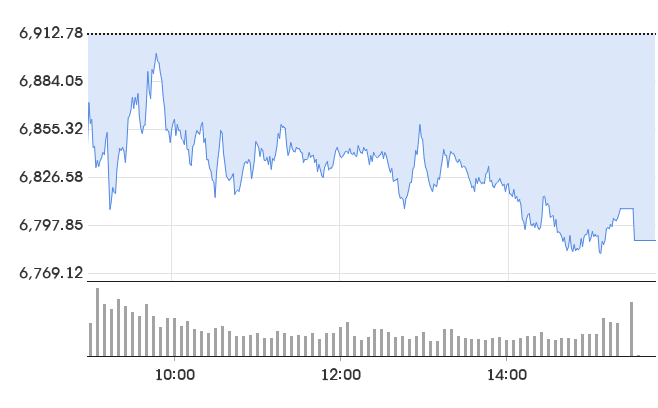
KOSPI daily chart. Morning rebound gave way to afternoon selling pressure.
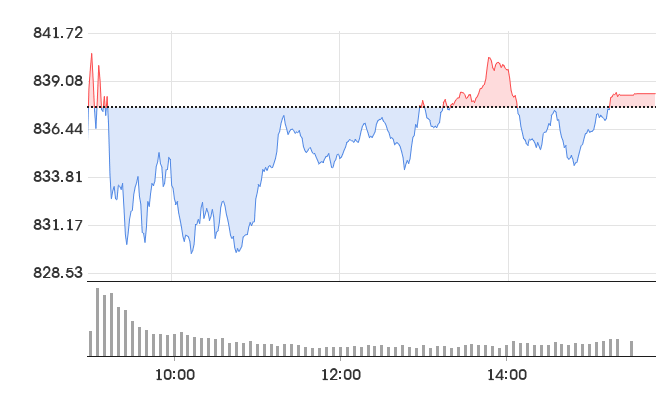
KOSDAQ daily chart. Retail buying offset foreign and institutional selling in a standoff.
Investor Flows—Foreign investors net sold 1.76 trillion won, institutions dumped 284 billion won
Foreign investors reversed course. They turned to net selling, unloading 1.76 trillion won. Institutional investors also swung to net selling for the first time in four trading days, dumping 284 billion won.
Retail investors, by contrast, returned to net buying for the third session in a row, purchasing 424 billion won. One hand selling, one hand buying—the weight was never equal. That imbalance likely explains why the morning rally couldn't hold.
Government bond futures told the same story. Foreign investors net sold 25,525 3-year contracts and 16,148 10-year contracts. The 10-year bond yield jumped from 3.788% to 4.284%. A day of selling both bonds and stocks.
| Category | Foreign Investors | Institutional Investors | Retail Investors |
|---|---|---|---|
| KOSPI net transactions | -1.76 trillion won | -284 billion won | +424 billion won |
| KOSDAQ net transactions | -92.9 billion won | -3.5 billion won | +98 billion won |
Why did Marvell fall despite beating forecasts?—What shook semiconductors
After the New York close, Marvell Technology reported earnings. Surging demand for AI infrastructure pushed results above consensus expectations. On the numbers alone, a strong report.
Yet the stock cratered in after-hours trading. Market expectations had apparently run higher still. Valuation concerns and near-term profitability worries priced in before the beat could register. The paradox: a forecast beat that looks like a miss.
One headline compounded the move. The U.S. government is reportedly under review to broaden semiconductor tariff targets to include laptops, gaming consoles, and data-center servers. Markets read this as a catalyst for profit-taking among Korean semiconductor shares that had recently rallied.
Samsung Electronics fell 3.38%. SK Hynix dropped 4.45%. By sector, electrical and electronics led decliners at -3.19%. Tariffs remain under review, not yet confirmed. The gap between review and announcement will likely set the depth of any correction.
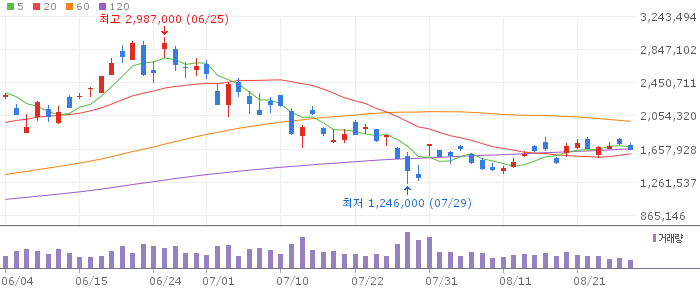
SK Hynix daily chart. Semiconductor tariff-review signals triggered a 4.45% slide.
Samsung Biologics throws its own share-issuance card
The largest-cap loser was Samsung Biologics, down 6.78%.
The cause wasn't external. The company announced a 3 trillion won rights offering with retained shares available to public investors. The stated purpose: facility funding. New shares dilute existing holders. The market priced in that dilution at once.
A healthcare bellwether raises growth capital and gets punished for it on the same day. Irony runs thick. Growth decisions and stock prices rarely move in tandem, whether for investment or business expansion.
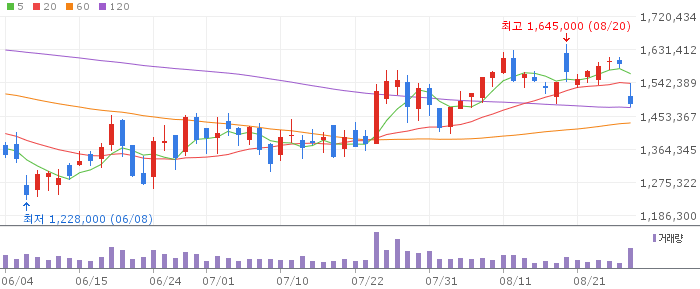
Samsung Biologics daily chart. A 3 trillion won share issuance announcement triggered a 6.78% drop.
On the flip side—oils, chemicals, and COVID names rise
By sector, gains dominated. Chemicals led at +3.83%. Textiles and apparel rose 3.09%; food and tobacco, 2.68%. Capital rotated into defensive names as semiconductors faltered.
Energy also benefited. The move drew support from falling shipping volumes through the Strait of Hormuz and tightening inventory. Brokers attributed the move to expectations of extended refinery strength. WTI crude rose 1.58% to $83.53 per barrel.
The KOSDAQ told a different story. COVID-resurgence signals sent Shinpoong Pharm up 14.14%. Seegene rose 11.76%. Bitcoin briefly reclaimed $80,000, lifting related names. A U.S. cybersecurity firm's surge also boosted Korean security stocks, including Geniuses and Raonix. The KOSDAQ's 0.09% gain masked multiple concurrent themes in motion.
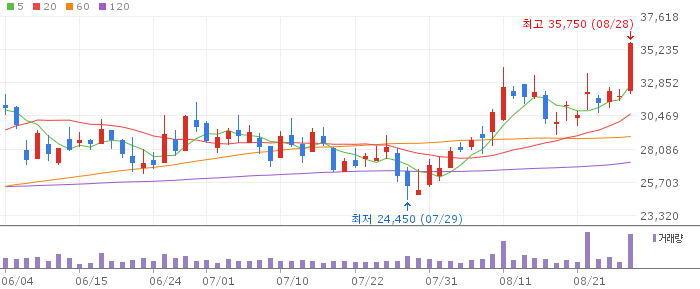
Seegene daily chart. COVID-resurgence signals pushed the stock up 11.76%.
Daily limits—Why did Moadata jump 30% again?
Three stocks hit their daily limits: Moadata, SP Software, and Globeholdings. Moadata's move stands out.
The company disclosed on August 21 a 48.4 billion won loan default. Then, after yesterday's close, it posted an update: the default was resolved. More precisely, the repayment deadline was extended. The crisis didn't disappear; it was deferred. Yet markets greeted this with a daily limit-up rally.
SP Software rose 29.90% on securing Google Workspace partner status. Brokers characterized it as broadening its existing Microsoft 365 and Copilot footprint into Google Gemini.
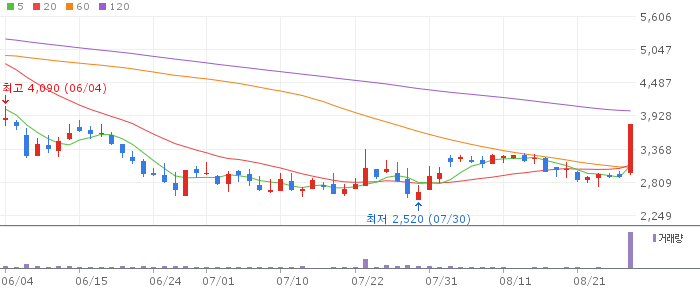
SP Software daily chart. Google Workspace partnership designation triggered a daily limit-up move.
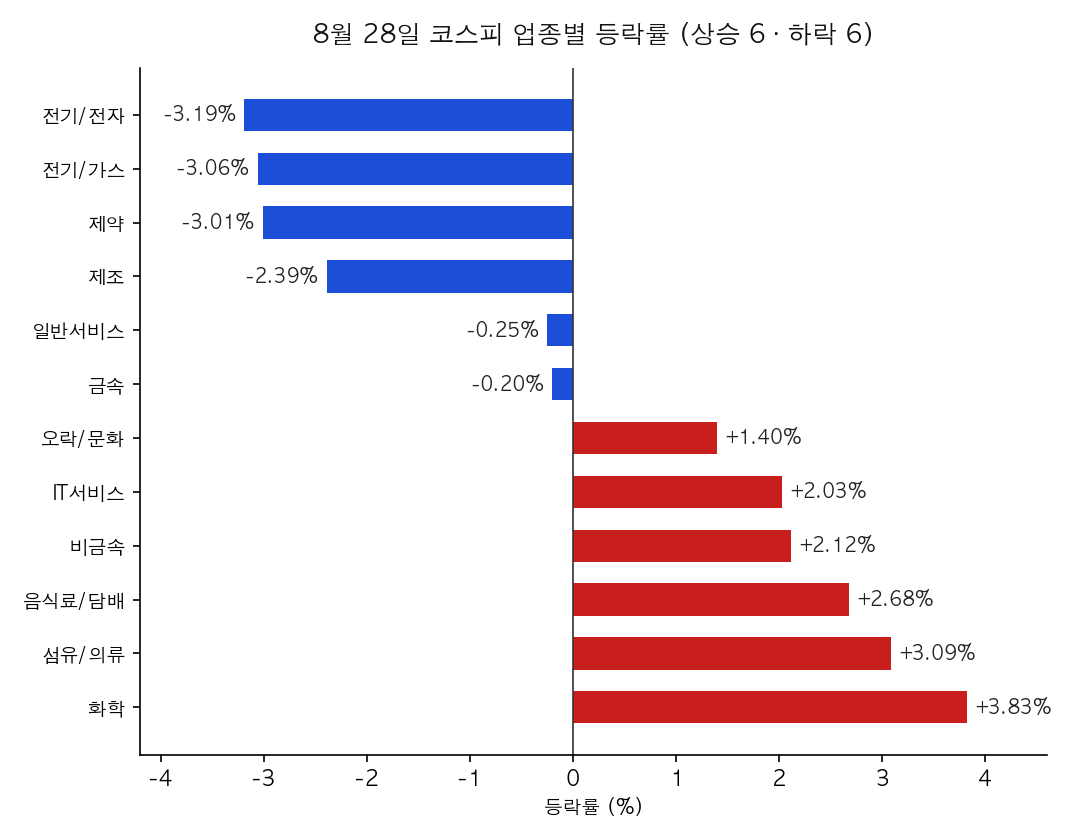
August 28 KOSPI sectoral performance, compiled directly. Chemicals and textiles up; electricals/electronics and pharma down.
Ahead of Jackson Hole, markets already trimmed sails
Fed Chair Kevin Waugh delivers his first speech since taking office this week at Jackson Hole. If he frames long bond yields as sufficient tightening, markets may find relief. If he emphasizes the need for further rate increases, expect renewed turbulence, analysts say.
Overnight signals came early. Cleveland Federal Reserve President Beth Hammack and Kansas City President Jeff Schmid offered hawkish commentary. With inflation still at 3% and above target, further action may be warranted, they suggested. Markets appear to have tightened sails on that signal alone, ahead of Waugh's remarks.
Domestically, the Bank of Korea has raised its policy rate twice in succession. The 3-year government bond yield rose to 3.788%. The 10-year jumped to 4.284%. Yet the won strengthened. The dollar-won exchange rate fell 9.0 won to 1,372.5 won from prior close.
Wrap-up—What to watch
In one sentence: semiconductors didn't collapse on their own. Tariff-review signals and Marvell's elevated forecast assumptions pressed the sector. Chemicals, energy, and COVID-linked names filled the void.
Three items merit focus. Chair Waugh's exact language at Jackson Hole, the outcome of the U.S. semiconductor tariff review, and the issue price and listing timeline for Samsung Biologics' new shares. These three numbers are the pivot points likely to steer the KOSPI over coming sessions.
Earlier coverage of Moadata's status and last week's KOSPI close provides added context to today's moves.
All investment decisions and their outcomes remain the reader's responsibility.
#KOSPIIndex #KOSDAQIndex #KoreaMarketClose #KOSPIClose #SamsungElectronics #SKHynix #SamsungBiologics #ShareIssuance #MarvellTechnology #SemiconductorTariffs #ForeignInvestorsNetSelling #InstitutionalInvestorsNetSelling #RetailInvestorsNetBuying #EnergyStocks #ChemicalStocks #Seegene #ShinpoongPharm #Moadata #SPSoftware #DailyLimitUp #JacksonHole #KevinWaugh #FederalReserveRates #GovernmentBondYields #DollarWonRate #Bitcoin #COVIDRelatedStocks #CybersecurityStocks #StockInFocus #MarketSummary
댓글
댓글 쓰기