It's Monday morning, August 24, 2026. Last Friday (August 21, local time), the three major U.S. indices all moved higher together—a rare sight. The Dow jumped 517.80 points, or +0.98%, closing at 53,277.01. The S&P 500 and Nasdaq both gained 0.43%.
But here's the puzzle: stock prices rose, yet Treasury yields climbed as well. Normally, they move opposite. This piece examines why, and what it could mean for Korean markets.
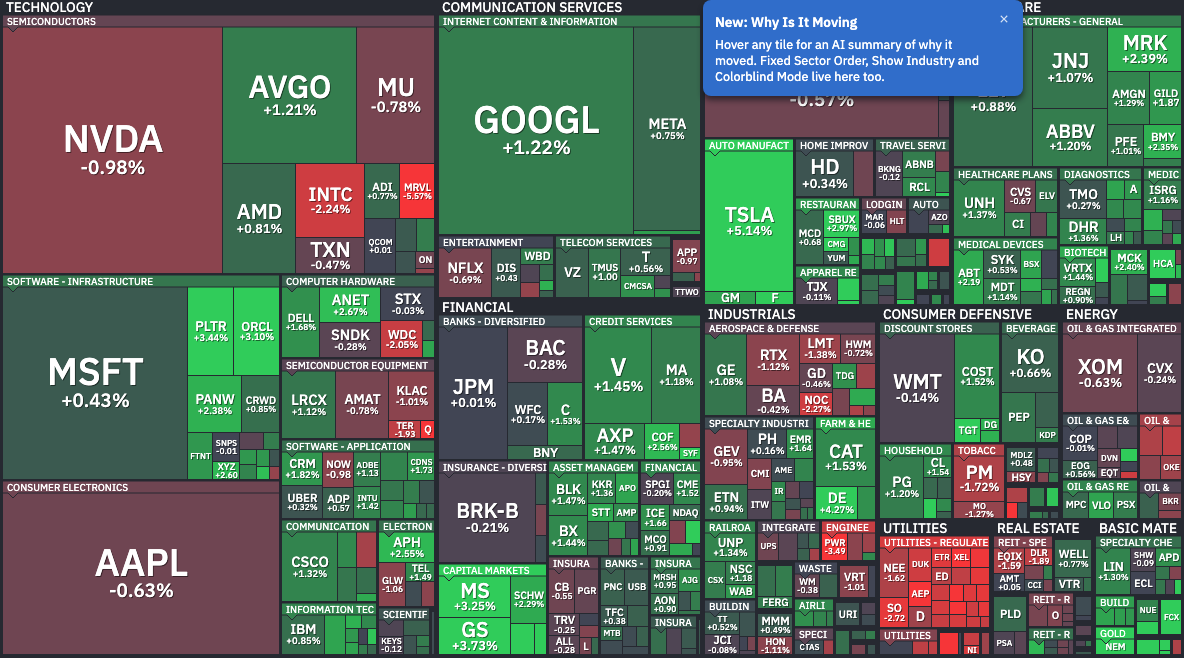
Friday's U.S. market heatmap (S&P 500 constituents). Green shows gainers; red shows losers (Finviz convention).
Why the Three Major Indices Rose Together
Thursday (August 20), the three major indices fell sharply: Dow -1.32%, Nasdaq -1.00%, S&P 500 -0.87%. Treasury yields spiked again. Walmart earnings disappointed, and U.S.-Iran tensions added weight. Friday was the reversal—a day of bargain-hunting buying.
Treasury Secretary Scott Bessent announced plans to double the size of long-term Treasury buybacks, from $2 billion per operation to at least $4 billion. Market sentiment steadied a bit. It doesn't address underlying problems, but it did douse the immediate fire, by most accounts.
On a weekly basis, though, the picture differs. The S&P 500 fell 1.4% and the Dow fell 0.8% for the week. Friday's bounce didn't erase those losses. The Russell 2000, a small-cap index, strengthened as Treasury jitters eased.
Wall Street signage in New York.
Why Treasury Yields Climbed Higher Instead
Here's where it gets interesting. Stock prices rose, yet Treasury yields climbed higher still. The reason is straightforward: the damage from elevated yields throughout the week lingered on.
Bessent's buyback announcement had a one-day effect; most of the market views it as already fading. JPMorgan noted in a report that the move "provided immediate relief to borrowing costs but addresses none of the underlying structural problems." U.S. national debt now exceeds $40 trillion. The core drivers—fiscal deficits and expected inflation—remain unchanged.
In short, the government stepped in with a patch; the market didn't buy it for long. The effect lasted a day. Despite the stock-market bounce, the bond-market anxiety persists—a signal that confidence has not returned.
Philadelphia Semiconductors and Micron Strength
This is likely the part Korean investors care most about. Thursday, the Philadelphia Semiconductor Index (SOX) rose 0.53% even as the major indices fell, buoyed largely by Micron Technology, which surged 3.97%.
Friday it closed at $966.78, off 0.77%—a modest pullback that kept most of Thursday's gains intact. Micron also announced plans to invest $10 billion over the next decade in a next-generation research facility in Boise, Idaho, a sign of confidence in DRAM demand.
The biggest event is still ahead: Nvidia reports second-quarter earnings August 26 local time, or the morning of August 27 Korean time. Semiconductor stocks have been volatile lately. Once Nvidia reports, Korean chip stocks could swing sharply.
Semiconductor wafer.
Treasury Yields, Currency, and Oil Now
| Item | Level (Aug 21 local time) | vs. Previous Day |
|---|---|---|
| U.S. 10-year Treasury yield | mid-to-high 4% | Higher |
| WTI crude oil | $87.83/barrel | +2.33% from previous day |
Treasury yields remain stubbornly high—the week's key concern. Oil gained for a fifth consecutive trading day, holding above $87. The backdrop: expectations that the U.S. will impose broad economic sanctions against Iran. Bessent is expected to unveil specifics today (August 24, U.S. time). Depending on scope, oil and geopolitical risk could swing again.
Higher oil prices can reignite inflation—an uncomfortable mix for the Federal Reserve. The won-dollar rate climbed to around 1,396 won per dollar Friday evening, a sign of won weakness.
Oil extraction facility.
Asian Markets Got a Semiconductor Lift Friday
Asian markets mostly fell Friday in the wake of Thursday's sharp U.S. decline, but semiconductors bucked the trend.
Japan's Nikkei 225 fell 0.30%, yet semiconductor names like Kioxia Holdings (+2.59%), Advantest (+1.53%), and Tokyo Electron (+0.50%) rose. Samsung Electronics and SK Hynix strengthened on expectations for large shareholder payouts, and that momentum carried over to Japanese chip stocks.
Taiwan's Taiex rose 0.65% to close at 45,224.29. TSMC rose 1.47%. MediaTek (+2.43%) and Winbond (+2.55%) advanced as well. Broadcom rose modestly, aided by JPMorgan's analysis that AI revenue will surge 180% year-over-year, related to its partnership with Alphabet. China's Shanghai Composite eked out a +0.04% gain on expectations of government stimulus measures.
What to Watch in Korean Markets Today
Friday, KOSPI closed at 6,912.95, up 60.37 points or +0.88%, lifted by expectations of shareholder returns from Samsung Electronics and SK Hynix. KOSDAQ, by contrast, collapsed. Battery and biotech names, including Ecopro and Ecopro BM, tumbled -4.63%, a sharp drop. Sell-side sidecars—which temporarily halt program-trading orders after a sharp futures-market move—were even triggered. It was a day of stark divergence between KOSPI and KOSDAQ.
Large-cap semiconductors look favorable for now. A rebound in the major U.S. indices, Micron strength, and gains in Taiwan and Japanese chip stocks all lined up. But with Nvidia earnings due August 26, wait-and-see sentiment could creep in before then.
Treasury-rate and currency headwinds remain. U.S. long-term rates haven't budged. The won-dollar rate sits around 1,390 won per dollar. Won weakness isn't bad for exporters, but it's a variable to watch for foreign capital flows.
Later this week comes the Jackson Hole Economic Symposium (August 27-29). Federal Reserve Chair Kevin Warsh will deliver his first keynote since taking office on the 28th. Signals about the Fed's policy direction for September will be key to watch.
KOSDAQ was hit hard. It will be worth monitoring whether selling pressure in battery and biotech stocks eases today.

Federal Reserve Chair Kevin Warsh. He delivers his first keynote at Jackson Hole on August 28.
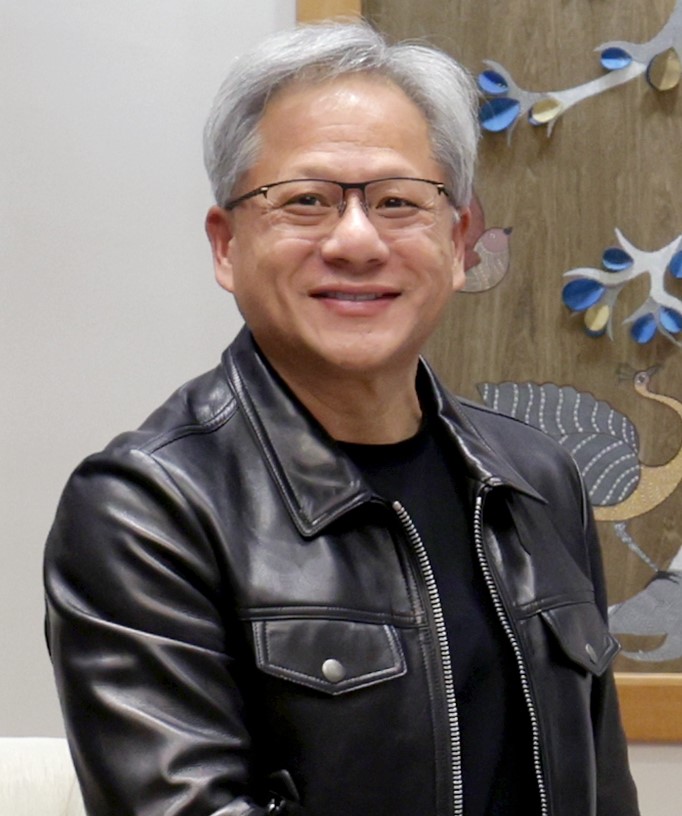
Jen-Hsun Huang, CEO of Nvidia. Nvidia reports second-quarter earnings August 26 local time.
In Short
New York markets managed a one-day bounce last night. But on a weekly basis, it was still a down week. Treasury yields rebounded despite government intervention. On the surface, it looked positive. Underneath, anxiety remains.
Semiconductors, by contrast, were strong across the U.S., Japan, Taiwan, and Korea alike. Will that momentum carry into Korean stocks today, or will traders pause to await Nvidia's results? The opening hour will be key to watch.
This article is for informational purposes. Investment decisions and their outcomes rest with the reader.
#USMarkets #KOSPI #Dow #Nasdaq #S&P500 #TreasuryYields #USBonds #PhiladelphiaSemiconductor #SOX #Micron #NvidiaEarnings #SamsungElectronics #SKHynix #KOSDAQ #Sidecar #TaiwanStockIndex #TSMC #Nikkei225 #Crude #WTI #WonDollar #JacksonHole #KevinWarsh #FederalReserve #IranSanctions #Bessent #TreasuryBuyback #MarketClose #USEquities #MarketOutlook
댓글
댓글 쓰기