On August 25, AMD shares surged roughly 4% intraday on the NASDAQ, trading in the $474-477 range—representing a near-$20 jump in a single session. The catalyst was neither earnings nor a new product announcement. It was an upgrade from a single brokerage.
What happened
Raymond James elevated AMD's rating from Outperform to Strong Buy and raised its price target from $565 to $641. The stock climbed 2.5% in pre-market trading, then accelerated to mid-4% gains by early regular session.
One figure deserves scrutiny. A $641 target implies nearly 40% upside from the previous close. It represents a single analyst's view, but that gap is rare.
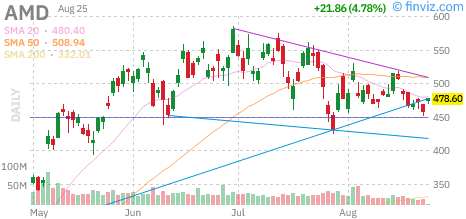
The chart shows AMD compressed since July's peak around $580, sliding to $450 in early August before today's move brought it back to the 20-day moving average at $480. It remains below the 60-day moving average at $509.
Why now?
Analyst Simon Leopold, covering AMD for Raymond James, framed the case around the AI server CPU market, which his research projects will grow at 44% annually to roughly $201 billion by 2030. The thesis centers on AMD's ongoing share gains in that market. But the day also brought news of former House Speaker Nancy Pelosi's Intel and Bloom Energy purchases, which lifted semiconductor stocks broadly. The semiconductor sector moved as a group rather than AMD alone driving the narrative.
AMD within the semiconductor sector
Micron and SanDisk also rebounded after the prior day's semiconductor selloff. The day marked a broad rebound across memory and fabless segments alike. Yet AMD's individual outperformance stood out among large-cap semiconductor stocks, so the upgrade arrived on top of sector-wide recovery rather than in isolation.
Numbers from Q2, three weeks prior
The upgrade rests partly on Q2 results announced August 4. Revenue grew 50% year-over-year to $11.5 billion, with the data center segment alone posting $6.7 billion, up 107% year-over-year. Data center now represents 58% of total revenue.
| Metric | Q2 2026 | Year-over-year |
|---|---|---|
| Total revenue | $11.5 billion | +50% |
| Data center revenue | $6.7 billion | +107% |
| Non-GAAP net income | $2.8 billion | EPS $1.66 |
| Q3 revenue guidance | ~$13 billion | +41% expected |
The earnings themselves are three weeks old. The stock rose 7% on the day of that announcement. Today, a single research report generated similar magnitude price action. The market already knew the earnings were strong. Today's move reflects a shift in how those results are being valued.
The OpenAI and Oracle deals: real benefit or equity dilution?


In October 2025, AMD signed a contract with OpenAI for up to 6 gigawatts of GPU supply, granting OpenAI warrants to purchase as many as 160 million shares at an effective price of $0.01—near-zero. Separately, AMD also signed a chip supply agreement with Oracle for 50,000 units.
Does this truly help the company? Revenue impact is straightforward: locked-in customer volume simplifies production planning. However, handing a major customer 10% of the company at cost basis dilutes existing shareholders, and when customer becomes shareholder, questions arise about whether future purchasing will follow market economics or capital allocation interests.
NVIDIA has pursued similar structures—equity stakes and financing arrangements with key customers are not anomalies in the industry. But these contracts remain in early stages; material revenue contribution has not yet materialized. Actual impact requires watching Q3 results.
Valuation and downside risks

AMD's forward P/E trades in the low 40s. That is not unreasonable for a growth play, but it is hardly inexpensive. High valuation does not explain today's surge, yet it does mean material downside if growth disappoints.
Competitive dynamics matter. NVIDIA remains the dominant force in AI accelerators, and most assessments place it ahead in software ecosystem depth (CUDA). If AMD's MI450 series encounters manufacturing yield or schedule slippage, NVIDIA could widen its lead during that window.
One uncertainty remains plain: AMD has not disclosed when or at what pace OpenAI and Oracle volumes will convert to reported revenue. Q3 results will be the place to track that detail.
Bottom line
Today's AMD move was not driven by new corporate announcements. It reflected a changed view on results already public. The data center revenue doubling is fact. What price the market should pay for that growth is a separate question.
The figure to monitor is Q3: whether data center revenue reaches the $13 billion guidance, particularly whether it achieves the 41% growth rate embedded in that forecast. Valuation premium is first to compress if execution falters.
Multiple brokerages carry Strong Buy ratings on AMD. Yet even after today's 4% move, the stock remains below July's high. The market is not yet fully convinced.
This is a U.S.-listed security. This article is factual analysis, not a recommendation to buy or sell. Investment decisions and their outcomes rest with the investor.
#AMD #AMDStock #USEquities #NASDAQ #SemiconductorStocks #AIChips #RaymondJames #PriceTarget #DataCenter #NVIDIA #Intel #OpenAI #Oracle #MI450 #ServerCPU #USMarkets #StockInFocus #BreakoutStock #StrongBuy #SemiconductorSector
댓글
댓글 쓰기