Good morning, August 12, 2026. Last night (US time, August 11), the Dow, Nasdaq, and S&P 500 all fell for the second straight day. As negotiations to reopen the Strait of Hormuz got snarled again, international oil prices spiked, and ahead of tonight's US July consumer price index (CPI) report, investors played it safe. Yet the Philadelphia Semiconductor Index—which ties directly to domestic semiconductors—rebounded +0.87%, standing alone. While Big Tech stocks bled away, SK Hynix ADR jumped 4.70%. As we head into KOSPI's opening today, I've walked through what this divergence might mean.
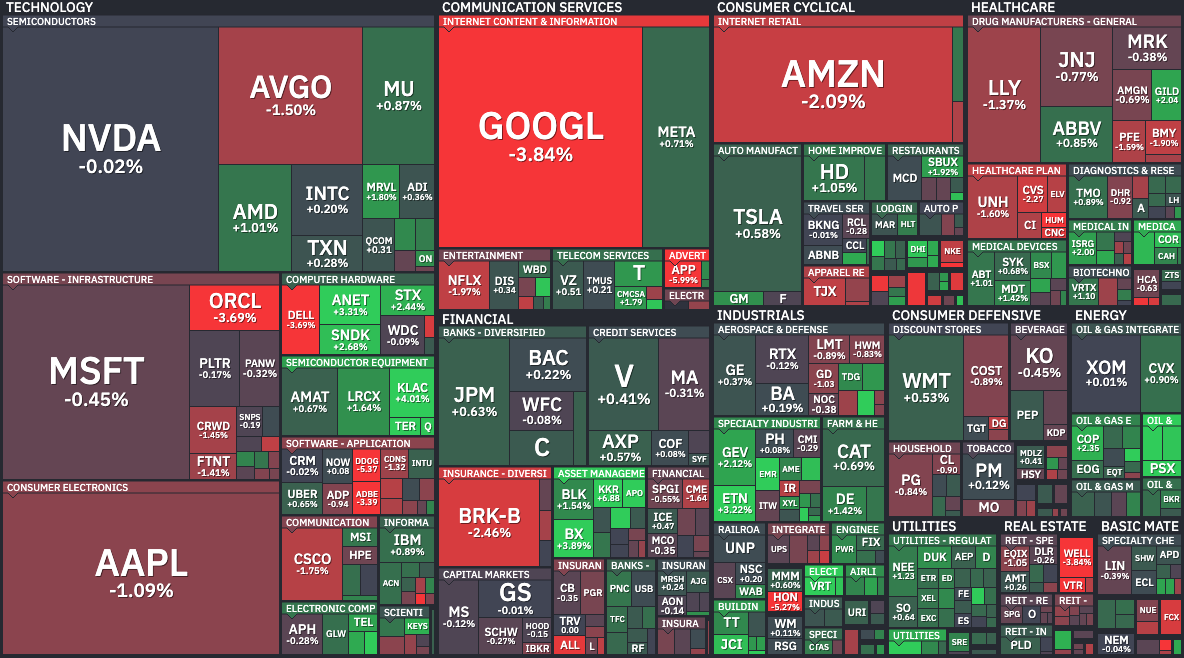
US market map last night (S&P 500 heatmap) · Green=gain/Red=loss (Finviz US color scheme)
Why the US 3 Major Indexes Fell for a Second Day
The Dow closed down 184.13 points (-0.34%) to 53,791.85, the S&P 500 slipped 0.32% to 7,728.20, and the Nasdaq fell 0.60% to 26,445.45. The absolute decline isn't huge, but the back-to-back losses stand out.
The backdrop is the Middle East. Negotiations between the US and Iran to reopen the Strait of Hormuz hit a stalemate again. News broke early in the session that Pakistan was mediating and "some kind of agreement was within reach," but Iran's newly appointed secretary of the National Security Council shut it down, saying "the strait won't open unless the US changes its attitude." On top of that, Houthi militants attacked merchant vessels near the Red Sea, leaving casualties, and the US military launched missiles at Iranian vessels that breached a blockade. President Trump added pressure by countering with demands for Iranian reparations.
The fallout sent international oil prices jumping again. WTI closed at $83.20 per barrel (+1.30%), and Brent at $88.91 (+1.36%). A rise in oil immediately feeds into inflation concerns, sharpening vigilance ahead of tonight's CPI release. The market is pricing in a year-over-year headline CPI of 3.4% and core CPI of 2.5%. Cleveland Fed President took a hawkish tone, saying "more rate hikes will be needed," and CME FedWatch now pegs September rate hike odds at 49.9%.
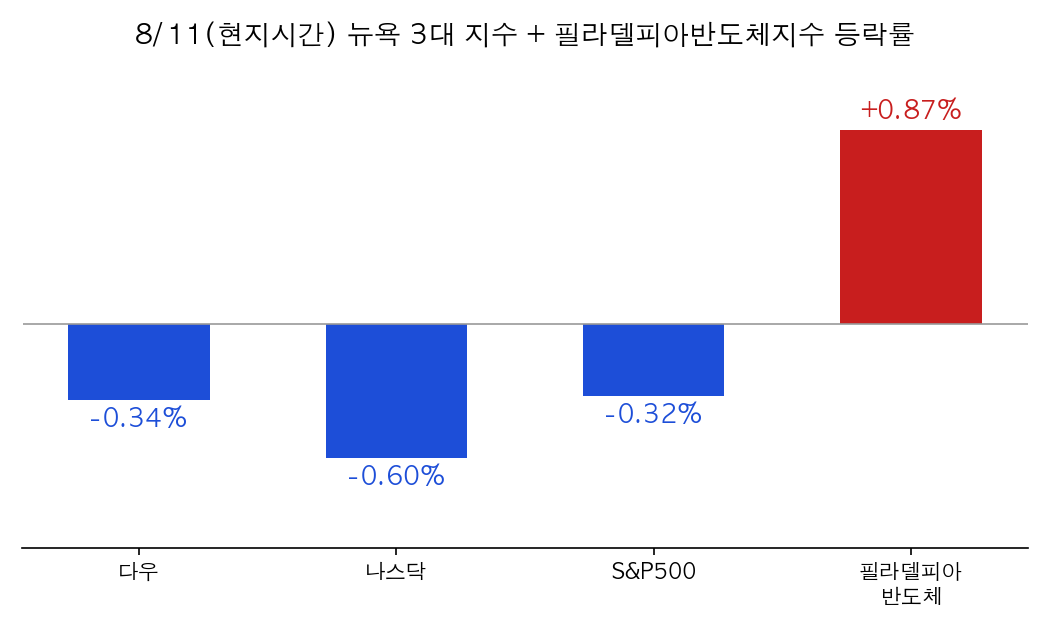
8/11 (US time) NYSE 3 Major Indexes and Philadelphia Semiconductor Index performance
Big Tech Is Falling, So Why Did Semiconductors Bounce?
The index was down, but looking closer reveals a real temperature gap. Amid CPI caution, most Big Tech names retreated: Alphabet A (-3.84%), Amazon (-2.09%), Apple (-1.09%), Microsoft (-0.44%). Recently hot SpaceX took a 3.93% hit on profit-taking, and On Holdings, saddled with weak guidance, tanked over 20% in a single day.
Yet semiconductors shrugged off early weakness and bounced on bargain-hunting. SK Hynix ADR rebounded 4.70% in just five trading days, and SanDisk (+2.68%), AMD (+1.01%), and Micron (+0.87%) came along for the ride. Nvidia barely budged at -0.02%, but what caught the eye was Nvidia joining six major asset managers—Apollo Global Management and Blackstone among them—to set up a $500 billion AI infrastructure fund. That news sent Apollo (+6.26%) and Blackstone (+3.89%) stocks soaring even more than semiconductor stocks.
The Philadelphia Semiconductor Index climbed 0.87% to 12,098.47. Domestic semiconductor exports hit record highs on August 1–10, up 155.4% year-over-year, a story already priced into the domestic market yesterday. US semiconductor stocks finding buyers at the lows suggests some easing of "memory peak" worries.
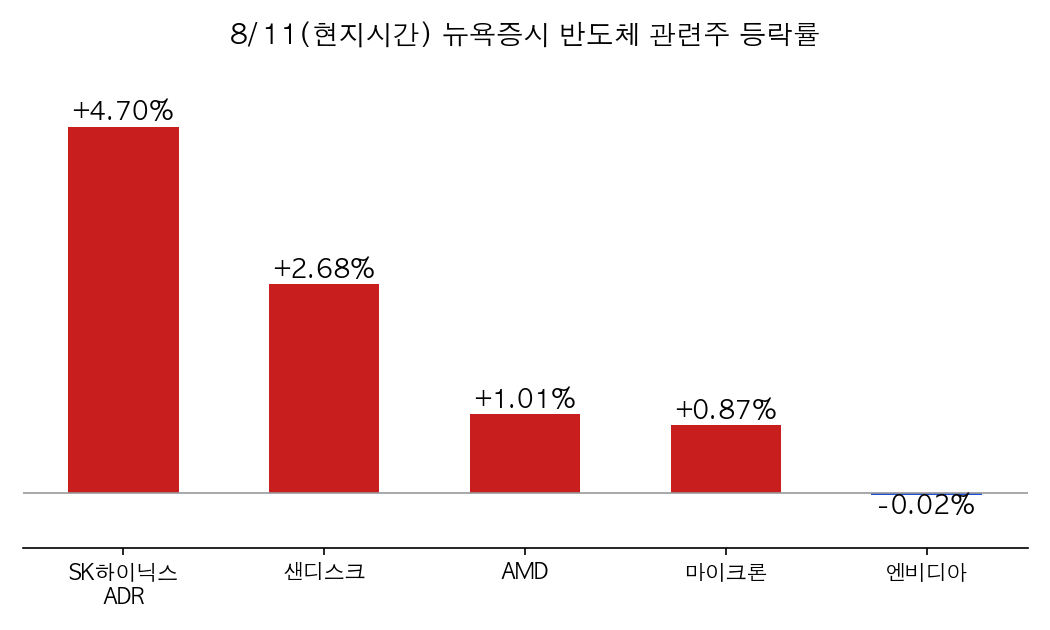
8/11 (US time) NYSE semiconductor-linked stock performance
Rates, FX, Oil—What They Mean for Domestic Markets
US Treasury prices rose (rates fell) as bidding demand was healthy ahead of the inflation data. Yields came in below expectations at the 3-year auction, signaling solid demand. The dollar barely moved, caught between hopes for a US-Iran deal and lingering uncertainty (dollar index 99.83, +0.02).
Back in Korea's forex markets, the won showed strength. The dollar-won rate closed this morning at 1,413.0 won, down 5.3 won from the prior session. Gold prices climbed to a two-month high at $4,441.1 (+0.48%), a reminder that geopolitical risk hasn't fully vanished.
The oil rise cuts both ways. For refiners and chemicals, tighter feedstock spreads could be a tailwind, but for airlines and logistics—sectors heavy on fuel costs—it's a headwind. A stronger won (lower exchange rate) helps import prices but can slightly weigh on won-denominated earnings for export-heavy sectors like semiconductors and autos.
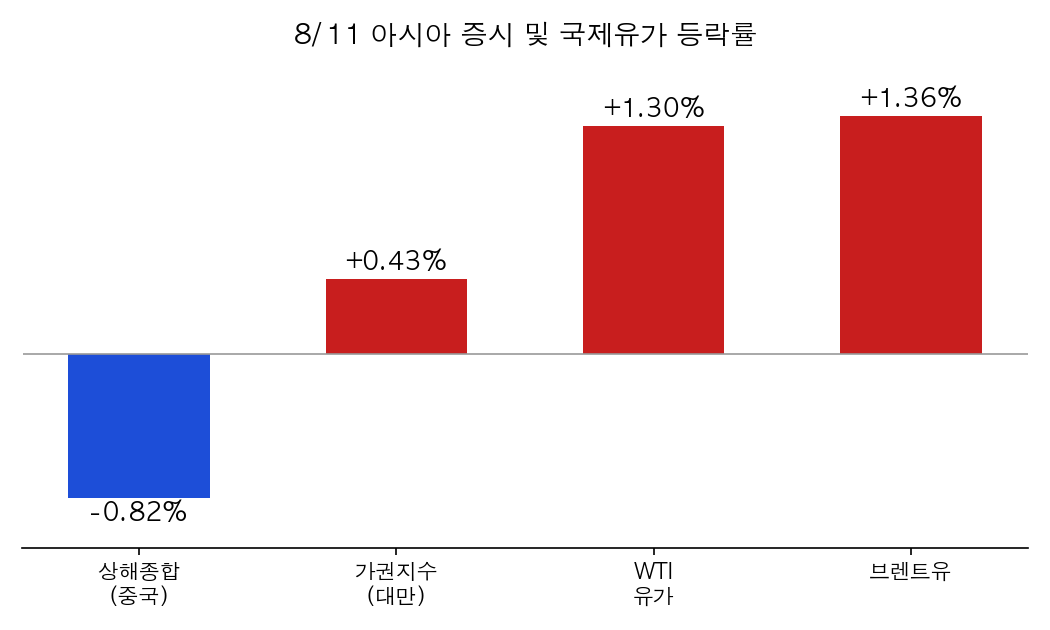
8/11 Asia markets and international crude performance
Yesterday's Asia Markets—Taiwan Smiles, China Frowns
| Market | Close | Change | Notes |
|---|---|---|---|
| Nikkei 225 (Japan) | — | Closed | Mountain Day Holiday |
| Shanghai Composite (China) | 3,934.09 | -0.82% | Hormuz reopening hopes fade |
| Taiex (Taiwan) | 45,120.72 | +0.43% | TSMC July revenue hits record |
Japan closed for Mountain Day. China slipped as hopes for Hormuz reopening dimmed, triggering risk-off sentiment. Taiwan's Taiex, meanwhile, ticked up on news that TSMC's July revenue hit an all-time high, up 44.7% year-over-year. TSMC also guided third-quarter revenue confidently, signaling AI infrastructure spending remains robust—a signal worth watching for Korea's semiconductor stocks.
For Reference—How Was Domestic Markets Yesterday (8/11)?
As a baseline for today's opening, the KOSPI on August 11 closed at 6,345.53 (+0.73%). The index dipped to 6,213.78 intraday but clawed back after news of strong semiconductor exports sent Samsung Electronics (+4.13%) soaring. Foreign and institutional investors bought together, and KOSDAQ also gained, closing at 857.84 (+0.39%) for a second straight day of gains.
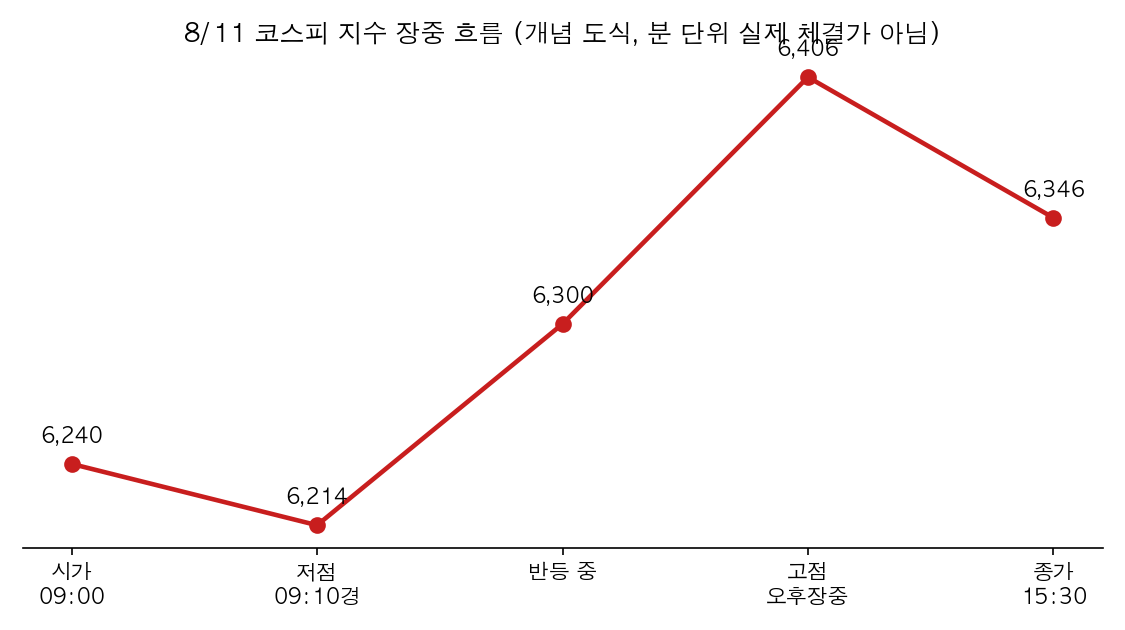
8/11 KOSPI intraday flow (conceptual diagram, not actual minute-by-minute closing)
Today's Domestic Market Watch Points
Here are the key things to watch as KOSPI opens today. I've framed these as watch points, not investment calls.
| Issue | Last Night's Move | What to Watch |
|---|---|---|
| Semiconductors | Philadelphia Semi +0.87%, SK Hynix ADR +4.70% | Will Samsung and SK Hynix extend yesterday's strength? |
| CPI Release | US July CPI due tonight (Korea time) | Will caution before the release carry over to domestic markets? |
| Global Oil | WTI +1.30%, Brent +1.36% | Diverging reaction between refiners/chemicals and airlines/logistics |
| Won-Dollar Rate | 1,413.0 won (-5.3 won, won strength) | Impact of lower rates on export stocks' earnings targets |
| Honam Chip Cluster | Yesterday's construction stock surge (Kumho E&C at daily limit, etc.) | Will related stock momentum hold after the thematic spike? |
In particular, tonight's US July CPI is the biggest wildcard this week. If it beats market expectations (headline +3.4%, core +2.5%), September rate hike fears could swell and weigh on risk assets. If it meets or misses, we might see a relief rally led by Big Tech stocks that got hammered last night. With both US and Taiwan semiconductor indicators looking favorable, there's a real chance domestic chip stocks will stay in focus regardless of how CPI plays out.
In Summary
Last night, New York fell for a second day as Middle East geopolitical risk, an oil spike, and CPI caution all piled on. But tucked inside, semiconductors bounced alone and flashed a bullish signal for domestic markets. Today shapes up as a session where caution ahead of CPI and hopes for chip strength both play a role. Rather than fixating on one index, watching the sector spread should give you a clearer read on today's session.
Investment decisions and their results rest with you.
#NYSE #USMarketClose #KOSPIIndex #KOSPIOutlook #NasdaqIndex #DowIndex #SP500 #PhiladelphiaSemiconductor #SemiconductorStocks #SKHynix #SamsungElectronics #InternationalOilPrices #WTI #DollarWonRate #USCPI #StraitOfHormuz #TSMC #Nvidia #AMD #Micron #KOSDAQIndex #TodaysMarket #PreMarketBriefing #USStocks #SemiconductorExports #RateHikes #FederalReserve #WonDollarRate #AsiaMarkets #DomesticMarketOutlook
댓글
댓글 쓰기