[Korea Market Close] KOSPI Closes at 6,912 — Foreign Investors Return After Five-Day Absence as Retail Investors Sell
The KOSPI closed at 6,912.37 on August 27, 2026, up 104.16 points or 1.53% from the previous session. On the surface, it was a strong day. But the gains masked significant intraday turbulence.
The index surged to 6,996 at the open, a gain of 2.76%. That early optimism faded. By midday, the benchmark had retreated to 6,841, giving back nearly all its gains. Volatility persisted throughout the afternoon before the index recovered toward the day's highs only in the final minutes.
Two events pulled the market in opposite directions. Overnight, Nvidia reported results that beat forecasts. Later in the session, the Bank of Korea raised interest rates. The convergence of positive news and a tightening signal created the day's whipsaw.
Why Nvidia Beat Expectations
Nvidia reported fiscal Q2 revenue of $96.22 billion, up 106% year-over-year and well above the consensus estimate of $92.17 billion. It was the company's 13th consecutive quarter of record revenue. Data center sales, the largest segment, reached $89 billion. Management also issued forward guidance projecting 70% revenue growth, signaling sustained demand from AI infrastructure.
The news provided a tailwind to Korean equities at the open. Semiconductor, power equipment, and battery stocks all advanced as investors anticipated spillover strength in those sectors.
Morning Retreat — What Happened?
The momentum failed to hold. The Bank of Korea's Monetary Policy Committee raised the benchmark rate to 3.00%, an increase of 0.25 percentage points. This marked the second consecutive hike and the first back-to-back increase since the central bank's seven-rate tightening cycle, which ran from April 2022 to January 2023. The BOK also lifted its growth forecast for 2026 to 3.3% (from prior guidance) while holding the inflation outlook steady at 2.7%. Next year's growth is projected at 2.9%.
Higher rates raise borrowing costs for households and businesses. That realization prompted a pullback, and the selling pressure persisted through much of the afternoon.
Foreign Investors Return; Retail Investors Sell
The net flows revealed a sharp divergence. Foreign investors net-bought 145.6 billion won on the KOSPI, their first purchase in five trading days. Institutional investors added 181.6 billion won, marking three consecutive days of buying. Retail investors, by contrast, sold 1.912 trillion won—the second consecutive day of net selling. Observers interpreted the retail outflow as a cautious response to the rate increase.
| Investor Type | KOSPI Net Buying | KOSDAQ Net Buying |
|---|---|---|
| Foreign Investors | +145.6B won | +89.1B won |
| Institutional Investors | +181.6B won | +62.7B won |
| Retail Investors | -1,912.0B won | -149.9B won |
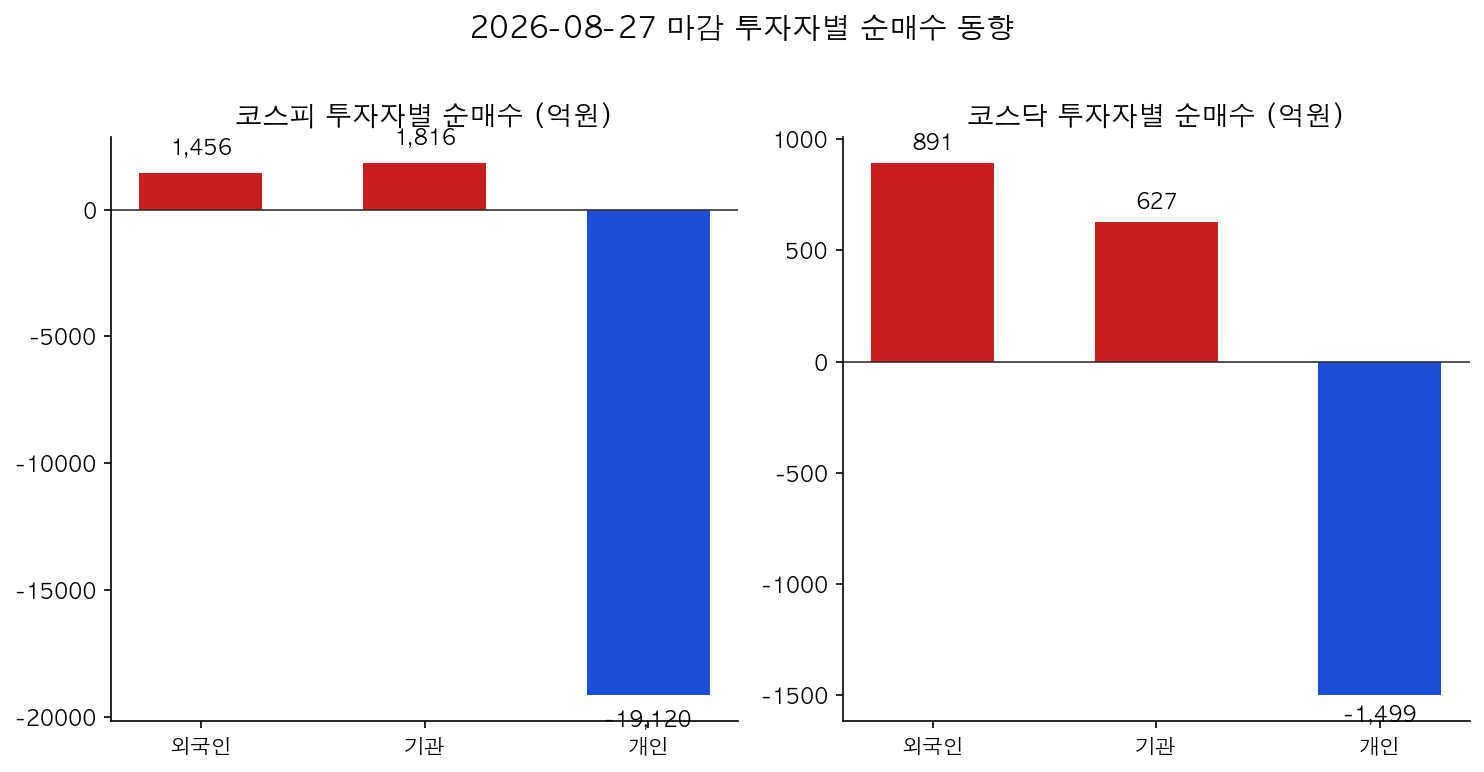
Today's net buying and selling by investor category on KOSPI and KOSDAQ. Retail investors sold in both markets.
The Korean won strengthened to 1,380.9 per U.S. dollar, down 5.4 won. Yields on government bonds fell: the 3-year note dropped 6.1 basis points to 3.755%, and the 10-year fell 5.0 basis points to 4.238%. The decline in market rates despite the rate increase suggests investors believe the cycle will pause, with no additional hikes imminent.
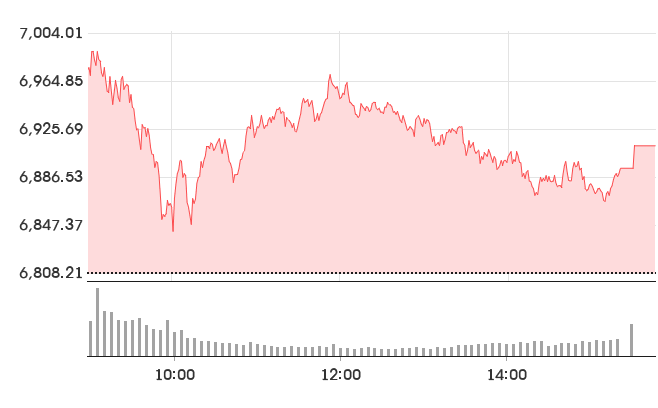
KOSPI daily chart showing the sharp open, morning reversal, and recovery into the close.
The Winners: Power Equipment and Semiconductors Surge
Sector performance was heavily tilted toward technology and industrial stocks. Electrical and electronics rose 2.62%, metals gained 2.30%, and manufacturing climbed 2.04%.
Power equipment stocks were particular standouts. President Trump signed an executive order targeting Chinese power equipment and declared a national emergency, with implementation rules set for a 120-day window. The move signals Washington will expand U.S. and allied-nation procurement. HD Hyundai Electric surged 12.01%, LS ELECTRIC rose 8.93%, and Hyosung Heavy Industries climbed 10.08%.
Battery and energy storage stocks also benefited from overlapping catalysts. The government is reviewing a plan to double the bidding size for the third ESS central contract market to 1+ gigawatt. Separately, Samsung SDI announced it will sell its stake in Samsung Display for 4.45 trillion won to fund North American ESS investments. Samsung SDI advanced 10.27%, while LG Energy Solution rose 5.56%. Semiconductors caught the Nvidia tailwind: SK Hynix added 2.49%, Samsung Electronics gained 1.72%, and Hanwha Aerospace climbed 5.80%.
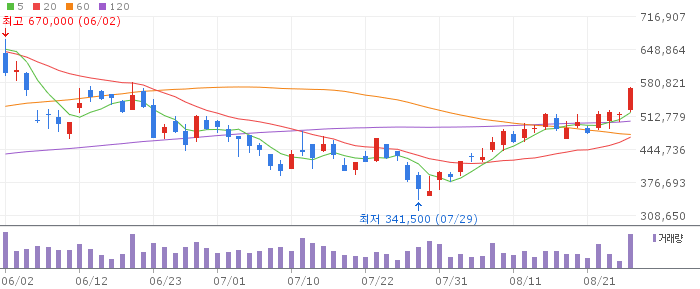
Samsung SDI daily chart. The stock surpassed 10% gains on news of the display unit sale.
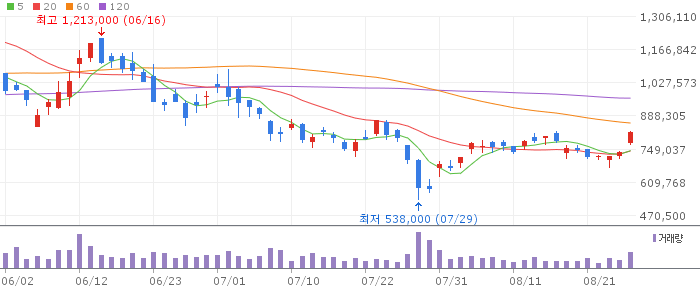
HD Hyundai Electric daily chart. U.S. power equipment restrictions drove today's gains.
The Losers: Hyundai Motor Group Continues to Slide
Retail (-2.36%), utilities (-2.05%), and consumer staples (-1.56%) led declines. Hyundai Motor Group stocks were notable underperformers. Kia fell 4.03%, Samsung C&T dropped 3.10%, Hyundai Mobis declined 2.69%, and Hyundai Motor fell 2.45%. The selloff reflects lingering disappointment from recent investor commentary from Hyundai Motor's leadership. Oil and gas shares were also weak, pressured by peace-related remarks from Trump regarding Iran and Ukraine.
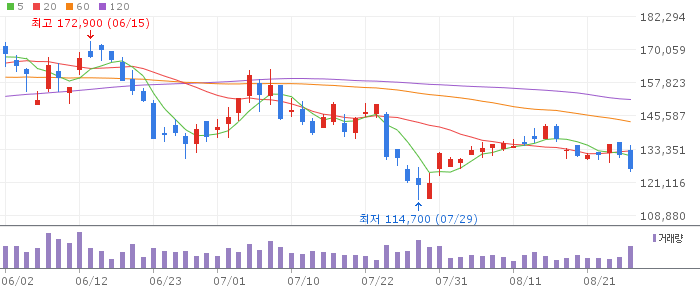
Kia daily chart. Weakness from Hyundai Motor's recent investor day persists.
KOSDAQ Also Rallied
The KOSDAQ closed at 837.65, up 10.78 points or 1.30%. Intraday swings were comparable to the main index—the benchmark fell to 824.22 before recovering to 839.57. Foreign and institutional investors both returned to net buying, while retail investors sold 149.9 billion won for the second consecutive session.
Semiconductor materials stocks led gains. Simtek rose 12.60%, Seo Jin Systems advanced 11.16%, and Ecopro BYM and Ecopro each climbed more than 5%. Rainbow Robotics added 4.55%. On the decline, HLB fell 2.88% and Pharmaresearch dropped 2.15%, reflecting weakness in select biotech shares.
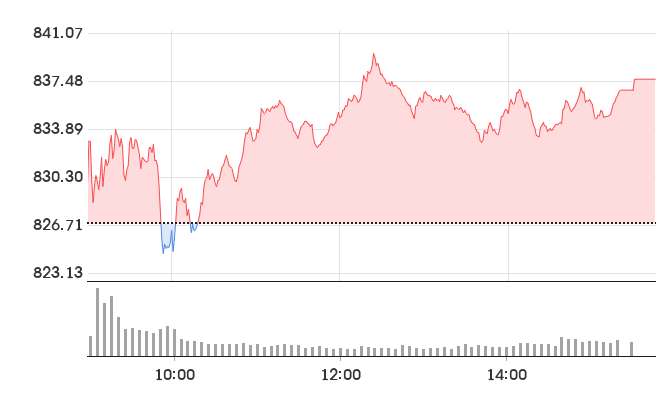
KOSDAQ daily chart.
Notable Movers
Several stocks surged to upper limits on company-specific developments. Paru rose 29.98% on its first day of trading following a nominal value consolidation. Huons Global climbed 29.83% following news that the Huons-Huons Lab merger was withdrawn. Enchem gained 19.56% after shareholders approved deletion of a put option clause in convertible bonds.
S-One attracted attention with a 7.01% rise. According to market reports, a Singapore-based fund proposed acquiring Samsung Group's stake in S-One for 906.6 billion won, or 116,000 won per share, implying a 45% premium to market value. It is important to note that the transaction has not been finalized.
What to Watch
Today combined positive sentiment—Nvidia's strong results—with a hawkish signal from the central bank. The index closed higher, but not before retail investors stepped back for a second straight day, while foreign and institutional buyers stepped in. How this temperature gap narrows will shape the next several sessions.
Monitor whether the BOK signals further rate increases and whether the semiconductor-and-power-equipment rally carries into the next trading session. Watch if foreign and institutional inflows persist over the coming days and whether retail selling abates this week. Given the wide swings in recent trading, the point at which volatility itself recedes will also matter. (Related: August 26 close — Institutions bought alone; retail sold 2.2 trillion won)
For longer-term context on the relationship between rates and stock prices, see also: The Kostolany Egg: KOSPI Rose 7 Out of 10 Times When Rates Fell
Investment decisions and their outcomes remain your responsibility.
댓글
댓글 쓰기