[Feature Stock] Dell's Stock Plunges -4.71%, But It Was the Target Price Cut, Not an Upgrade, That Pulled the Trigger
On August 11 (US time), Dell's stock (DELL) is trading around $436, down -4.71% from the previous day. It's a sharper drop considering that just a week ago, right after earnings, the stock soared to near-record highs riding the AI server rally.
Why did a rallying stock suddenly break?
The trigger for this decline wasn't the earnings themselves, but analyst target price adjustments. Morgan Stanley cut Dell's price target from $477 to $430 on August 7, while maintaining an 'Equal-Weight' rating. The problem is that this new target was almost at the same level as the stock price at the time. It's not that earnings were bad—rather, it sent a signal to the market that 'there's not much room to run higher,' and investors riding the rally took that signal as a cue to lock in profits.
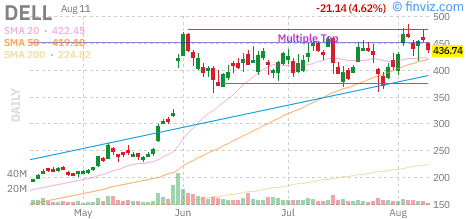
On top of that, rising memory costs—including high-bandwidth memory (HBM)—piled on. AI servers are Dell's growth engine, but they carry a higher component cost ratio than traditional PC and server businesses, squeezing margins. When memory prices spike, revenue grows but profit margins get pinched, and that fed into concerns that 'revenue looks great but margins aren't keeping up'—dovetailing with the target cut.
Why did insiders keep selling?
SEC filings show that Silverlake, the largest shareholder as a private equity fund, and entities tied to Egon Durban—co-CEO and Dell board member—have been steadily trimming stakes over recent months. Just on July 8, a Form 4 filing revealed that a Silverlake-affiliated fund sold about 63,000 shares (roughly $26.95 million) in the $420–$438 range. Over the most recent quarter, there was about $1.45 billion in insider selling, with virtually no corresponding buying.
When a private equity firm is the majority holder and a stock rallies sharply, taking some profits off the table isn't unusual. But when selling continues without any buying to match it, the market starts reading it as a signal that insiders aren't confident at current prices. That's why the decline accelerated when the target cut and insider selling hit at the same time.

Yet the earnings themselves were airtight
The paradox is that Dell's most recent quarter actually blew past market expectations. Revenue jumped 88% year-over-year to $43.8 billion, with AI server revenue exploding 757% to $16.1 billion. Adjusted EPS of $4.86 also trounced the consensus estimate of $2.94. Right after the announcement, the stock soared more than 30% in a single day, marking its biggest single-day gain since the 2018 IPO.
The company also raised its full-year revenue guidance to as much as $169 billion, well above Wall Street's consensus of $142 billion. Its 2027 AI server revenue guidance was also bumped to $60 billion. New AI server bookings of $24.4 billion and backlog of $51.3 billion are both all-time highs. By the numbers alone, calling it 'growth that's already proven' isn't an overstatement.
So does that mean it's already priced in?
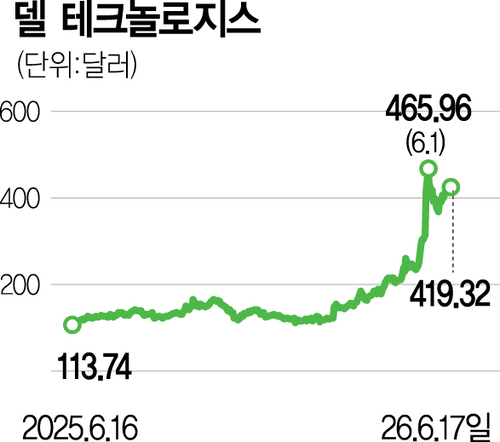
In the month after earnings, the stock jumped more than 4x from $113 to $465. A stock moving at that pace tires easily even on good news and overshoots sensitivity to mixed signals like a target cut. Morgan Stanley's new $430 target was actually less about lowering earnings expectations than it was a valuation comment saying 'there's not much room to run given how far it's already moved.' That said, valuation headwinds were probably less the real cause than a magnifier of the profit-taking instinct after such a sharp rally.
Consumer lines like Alienware remain in the clear
This plunge is about valuation of the AI server and data center business (ISG) and insider supply/demand dynamics—not about the competitive health of its Client Solutions Group (CSG) like Alienware laptops and gaming. What's core to recent results is that both ISG and CSG—the two revenue pillars—are growing together. This pullback is less a flaw in a specific division than an overall market speed bump.
The honest risks:
· Valuation headwind — P/E has climbed to 36x, so any further upside needs another confirmation from next quarter's earnings.
· Memory costs — If component prices like HBM keep rising, margin pressure could persist even as AI server revenue climbs.
· Whether insider selling continues — Worth watching to see if Silverlake keeps unloading or if the selling lets up.
· At roughly 8% below the 52-week high ($476.90), whether this pullback damages the trend or is just a short-term breather gets settled at next earnings.
So here's the bottom line
The company's fundamentals are already proven by the numbers, and it's fair to see this decline as a byproduct of post-rally consolidation, target-price reality checks, and insider sales—not earnings deterioration. There's one thing to watch: whether Silverlake's insider selling keeps going or eases up. If it eases, this pullback likely stays just the normal breather after a sharp rally. If the selling continues, you'll get a hardening signal that 'even insiders don't believe in this price.' For a stock that quadrupled in a month on AI servers alone, the real test may not be next quarter's results but how quietly it gets through this correction right now.
This is a US-listed stock, and this piece is factual analysis, not a buy or sell recommendation. Investment decisions and results are entirely your own.
#Dell #DellStock #DELL #DellTechnologies #USStocks #USMarket #AIServer #MorganStanley #SilverLake #EgonDurban #InsiderSelling #TargetPrice #PlungingStock #AIStocks #DataCenter #ClientSolutionsGroup #InfrastructureSolutionsGroup #Alienware #NYSEMarket #Nasdaq #KoreanRetailInvestors
댓글
댓글 쓰기