Good morning, August 19, 2026. Last night—August 18 local time—New York's big three indices all fell in step: Dow -0.22%, S&P 500 -0.69%, Nasdaq -1.33%. But the real bloodbath was in semiconductors. The Philadelphia Semiconductor Index (SOX) cratered -4.98% in a single session, with SK Hynix ADR diving -9.19% and Micron sinking all the way to -6.99%.
The culprit? Treasury yields. The US 30-year Treasury rate climbed to 5.34% intraday, breaking a 19-year high—and doing it again in just one day, no less. Yesterday, the Kospi soared to 7,216 intraday on strong semiconductor export figures, but then got hammered down to 6,869 by institutional selling before closing. Today, those overnight declines in chip leaders will be baked right in from the open. This piece walks you through last night's damage in New York and the key flashpoints that could rattle the Kospi today.
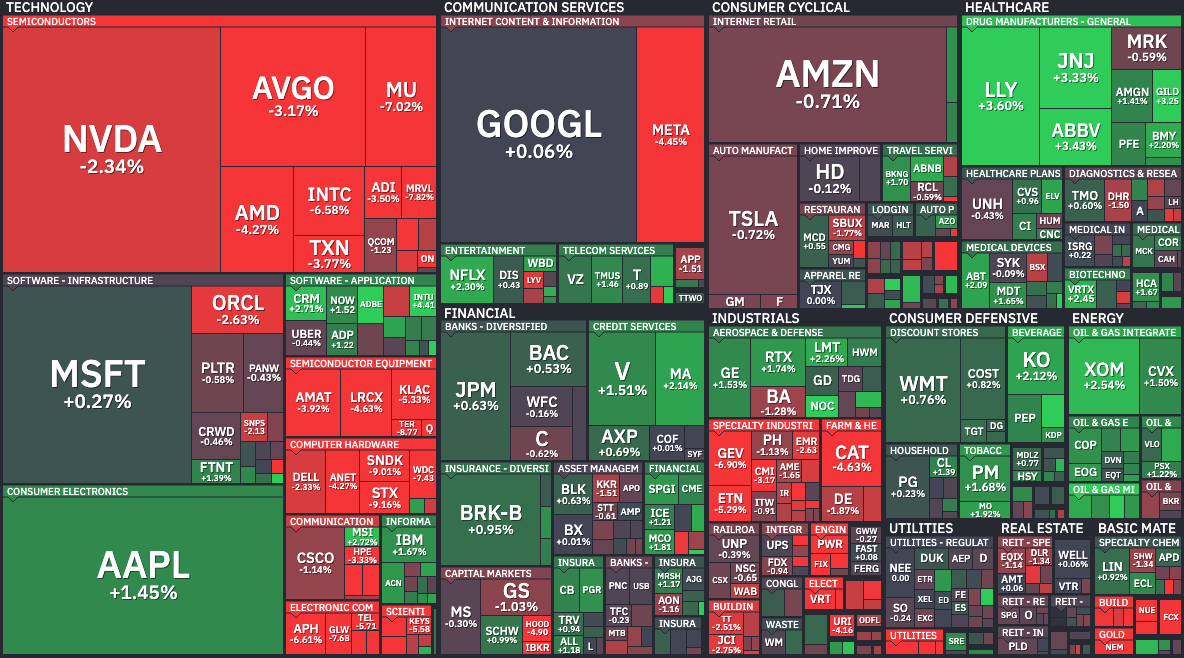
Last night's US market map (S&P 500 heatmap) · Green = gains / Red = losses (finviz US color scheme)
US Big Three: Semiconductors Dragged Them Down
The Dow Jones Industrial Average fell 116.38 points (-0.22%) to close at 53,343.40, the S&P 500 dropped 53.30 points (-0.69%) to 7,691.76, and the Nasdaq Composite fell 355.20 points (-1.33%) to 26,289.71. The Dow's smaller decline reflects the fact that traditional industrial stocks held up better than chips and tech did.
The Nasdaq bore the brunt of the tech and semiconductor selloff. Before the open, Western Digital, Marvell Technology, and Seagate all signaled 5–6% declines, sending Nasdaq 100 futures down -1.34% at the start and maintaining that momentum through the session. Add in pre-earnings caution ahead of Nvidia's results due August 20, and you've got a recipe for pain.
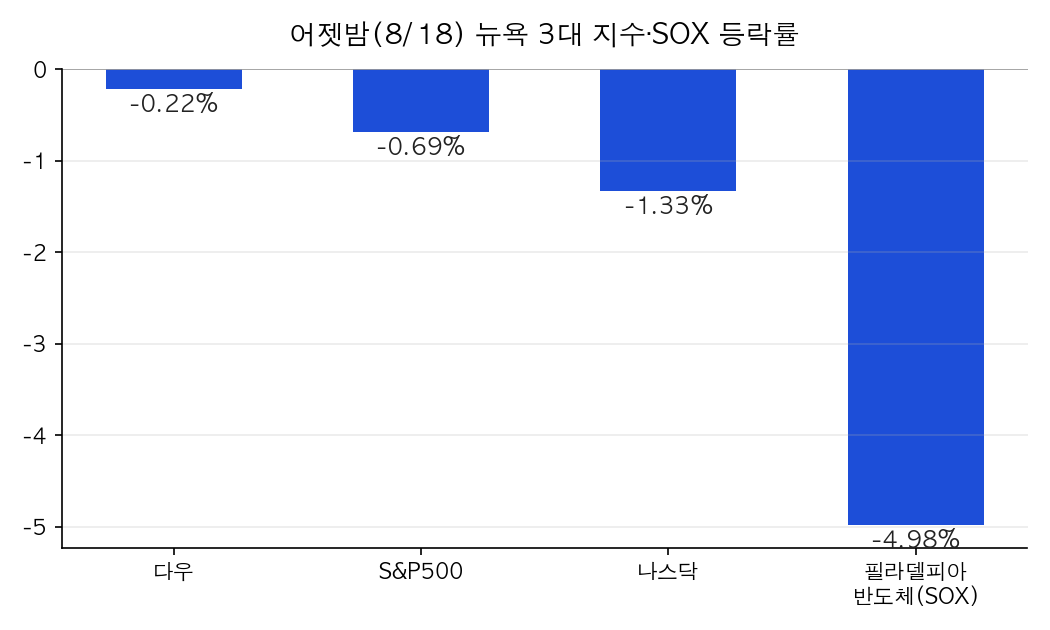
Last night's New York big three indices and SOX performance
Philadelphia Semis -4.98%, SK Hynix ADR -9.19%
The Philadelphia Semiconductor Index took the biggest hit. SOX plunged 628.54 points (-4.98%) to close at 11,992.46, surrendering the 12,000 level in a single session. Domestic investors' favorites got hit particularly hard.
SK Hynix ADR crashed -9.19% to close at $155.61, while Micron fell -6.99% to $941.05. Nvidia dropped -2.34% to $219.74, TSMC ADR slipped -0.83%, and AMD declined -1.63%. Rising Treasury yields hit growth stocks and high-multiple names the hardest by immediately repricing future profits at a higher discount rate. The growth and memory leaders that have driven the AI rally absorbed the full brunt of that repricing.
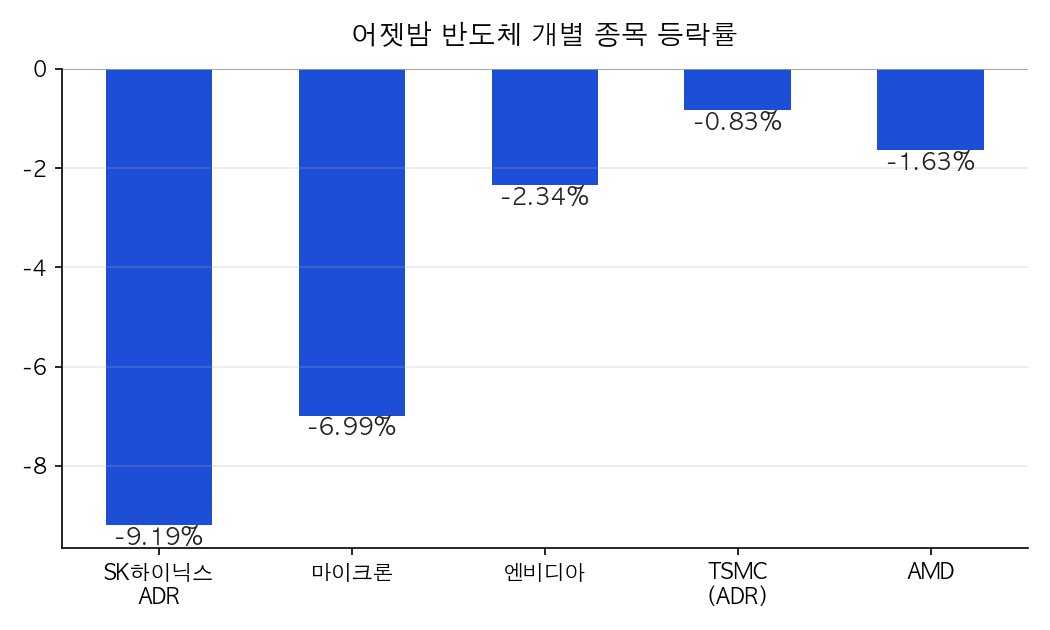
Last night's individual semiconductor stock performance
30-Year at 5.34%, Oil and Currency Join the Fray
The US 30-year Treasury yield climbed to 5.34% intraday, resetting a 19-year high set back in 2007—twice in one day, no less. The 10-year also hit its highest level since January 2025 intraday before settling around 4.71%. The collapse of the US-Iran ceasefire memorandum as negotiations hit their deadline brought Middle East geopolitical risk back into focus. Brent crude surged for three straight sessions on that anxiety, trading above $91 a barrel. The worry: rising oil prices stoke inflation fears, which in turn ratchet up pressure on rates.
The dollar index hovered around 99.6, essentially flat. On the domestic front, the won-dollar rate weakened to 1,413.0 yesterday—5.3 won weaker than the prior session—hitting a 10-month low. That's aligned with foreigners' five straight days of net buying in the Kospi.
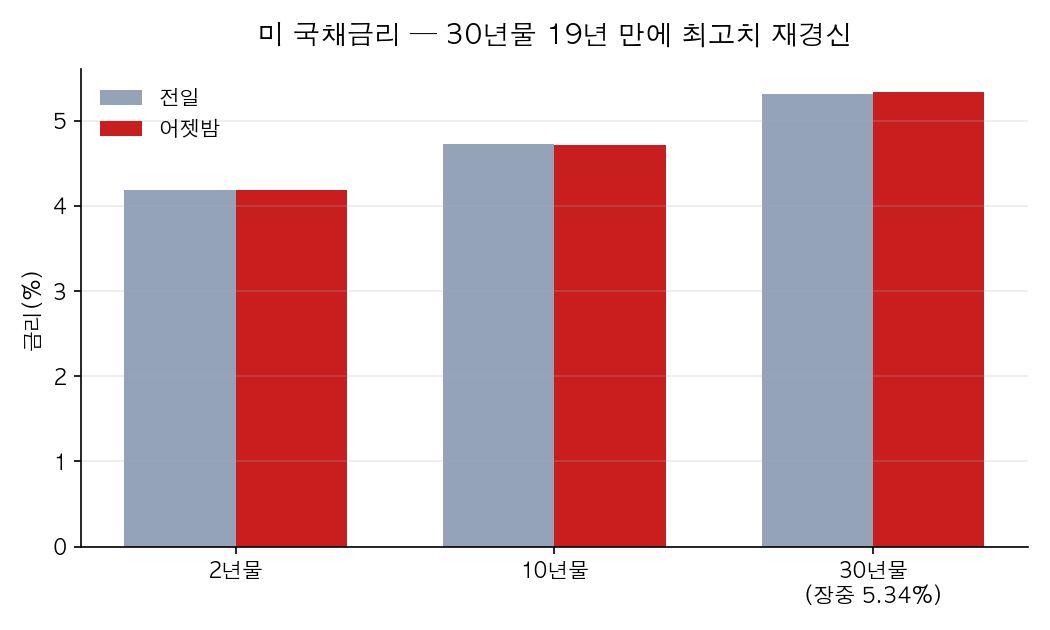
US Treasury yields—the 30-year has reset its 19-year high again
| Indicator | Level | Change |
|---|---|---|
| Dow Jones | 53,343.40 | -0.22% |
| S&P 500 | 7,691.76 | -0.69% |
| Nasdaq Composite | 26,289.71 | -1.33% |
| Philadelphia Semiconductors | 11,992.46 | -4.98% |
| US 30-Year Treasury | Intraday 5.34% | 19-Year High Reset |
| WTI (Prior Day) | $84.50 | +2.55% |
Yesterday's Asia Markets—Chips and Nikkei Fall Together
Yesterday the Kospi closed down -1.55% (108.11 points) at 6,869.83. It started strong, surging to 7,216.62 on expectations of a stellar semiconductor export number (July exports up 176.3% YoY at $41.17 billion), but afternoon institutional selling—795.1 billion won worth—pushed it all the way down to 6,788.78 before it trimmed losses into the close. Foreigners chalked up their fifth straight day of net buying and individuals flipped to net buyers too, but they couldn't overcome the institutional wave.
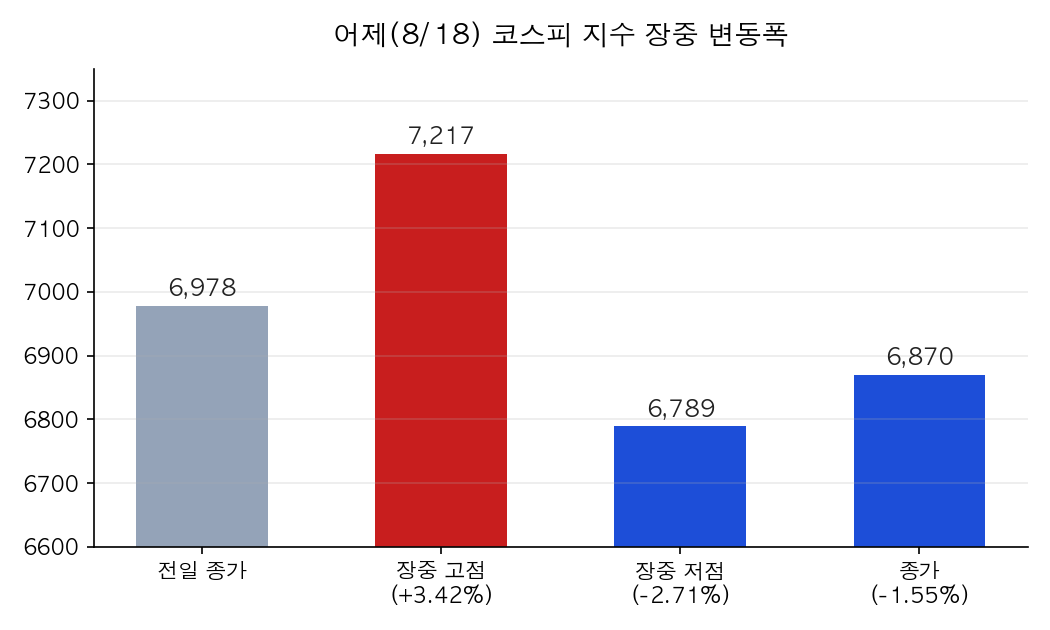
Kospi intraday range yesterday—from +3.42% to -2.71% within a single session
A daily swing of 6 points—from high to low, roughly a 6.1% move—tells you the market's simultaneously digesting strong positives (booming chip exports) and sharp negatives (soaring Treasury yields, geopolitical jitters). We're in a directionless, reactive mode where each piece of news swings the index hard.
The Nikkei 225 tumbled -2.54% to 67,460.73 yen, dragged down by semiconductor stocks (Kioxia -7.58%, Tokyo Electron -6.17%, Advantest -5.08%) and Japan's own long-duration rate spike (10-year yields hit 2.94% intraday, a 30-year high). Taiwan's Taiex fell -1.20% to 45,308.68 on renewed US-Iran geopolitical tensions, though TSMC held better at -0.83%. China's Shanghai Composite stood alone in strength, rising +0.19% to 3,990.30 on food-security buying (El Niño fears, JPMorgan's grain inflation warnings).
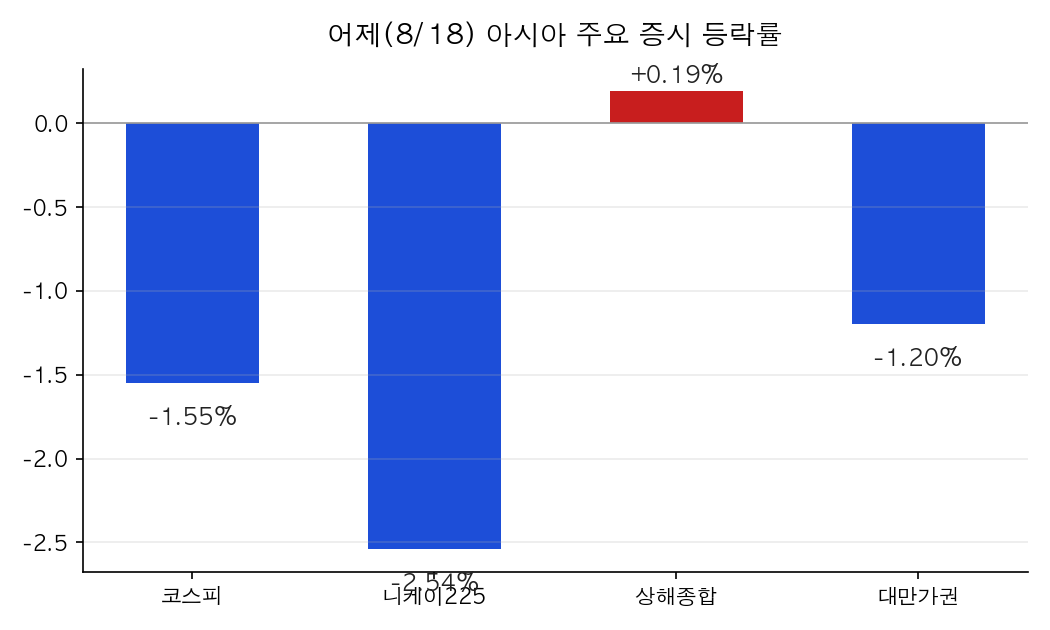
Yesterday's major Asia market performance
Today's Home Market Watch Points
Rather than bold predictions, let me flag the key things to watch. First: do Samsung Electronics and SK Hynix follow through on last night's US memory-chip collapse (Micron -6.99%, SK Hynix ADR -9.19%)? Yesterday they diverged—Samsung fell -2.19% while SK Hynix actually rose +1.03%—so today's litmus test is whether both move in lockstep.
Second, watch Treasury yields. Does the 30-year keep resetting record highs for a second straight day? And does that momentum feed into domestic 3-year and 10-year yields (which rose to 3.847% and 4.382% respectively yesterday)? Third, was yesterday's institutional flip to 795.1 billion won of net selling just a day's worth of profit-taking, or the start of a downtrend? Also keep in mind that semiconductor volatility could spike ahead of Nvidia's earnings report on the 20th.
Bottom Line
Last night in New York was a day when semiconductor declines dwarfed the broader index losses. A single number—5.34% on the 30-year—cascaded into SOX -4.98% and SK Hynix ADR -9.19%, and that cascade carries straight into today's Kospi open. Given yesterday's wild swings from intraday 7,216 to 6,869, expect more volatility today. Focus on individual chip names first, indices second.
To sum it up, the three things to check today are: ① whether Samsung Electronics and SK Hynix follow the overnight US memory plunge, ② whether the Treasury yield rally (domestic 3- and 10-year included) extends another day, and ③ whether yesterday's institutional selling repeats. Rather than fixating on the index itself, parsing these three threads will give you an earlier read on today's direction.
This piece is meant as informational background for your own investment decisions and does not constitute a buy or sell recommendation on any specific stock. Investment decisions and their outcomes rest with you.
#KospiIndex #USMarkets #USMarketClose #PhiladelphiaSemiconductors #SOX #SKHynix #Micron #Nvidia #TreasuryYields #CrudeOil #KospiOutlook #SemiconductorExports #WonDollarRate #NasdaqIndex #DowJones #TSMC #AMD #NikkeiIndex #ShanghaiComposite #TaiwanWeightedIndex #HormuzStrait #Iran #SemiconductorStocks #TodaysMarkets #KospiWatchPoints #GovernmentBondYields #ForeignerNetBuying #InstitutionalNetSelling #MarketOutlook #USMarketClose #NYClosing
댓글
댓글 쓰기